Recent, random film reviews
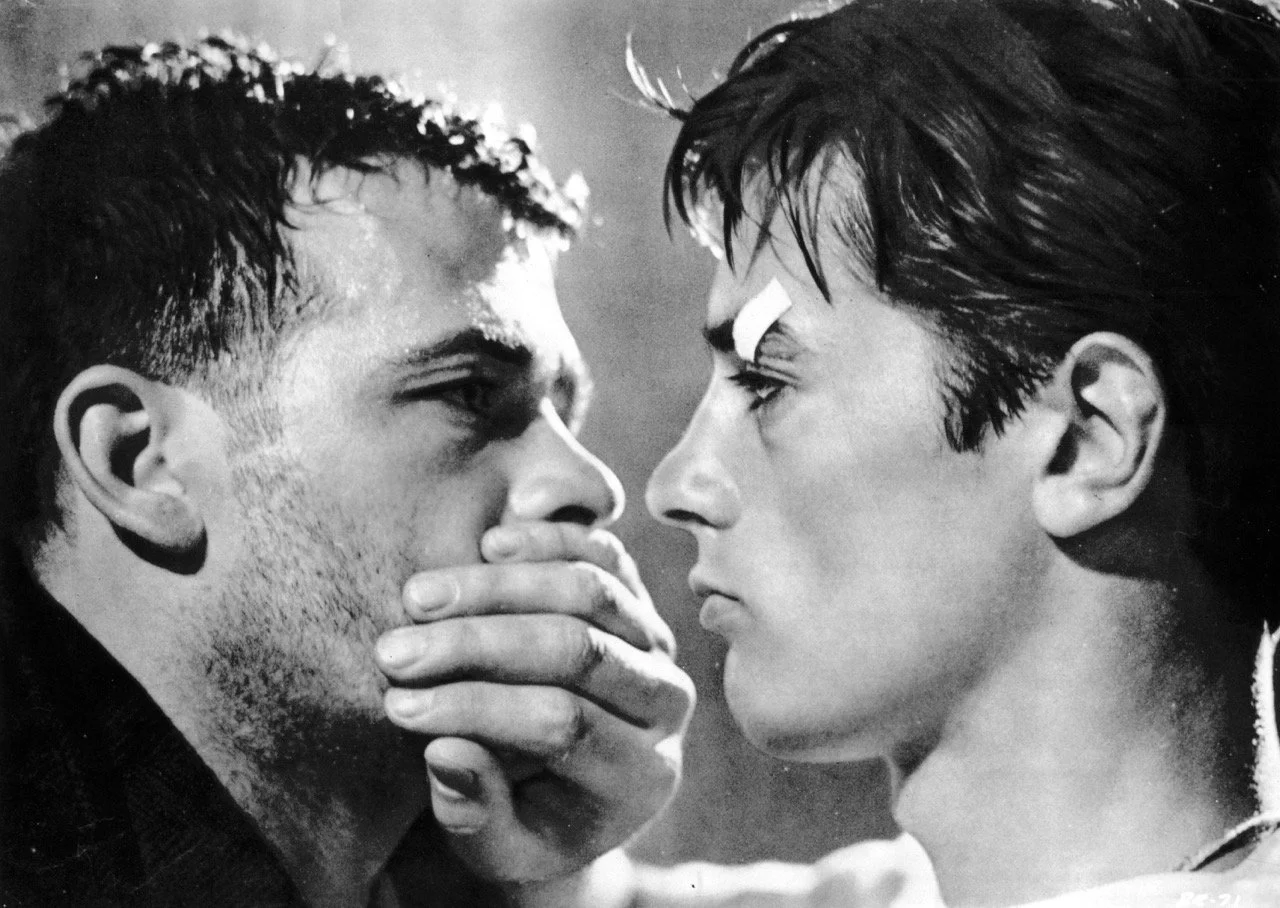
You talking to me? Simone and his brother, Rocco.
A month or so ago we watched four random films on consecutive nights and found various random links between them after the viewings:
Beau Travail (Claire Denis, France, 1998) ★★★★★
War Requiem (Derek Jarman, UK, 1989) ★★★
Bait (Mark Jenkin, UK, 2019) ★★★★★
Couscous (Abdellatif Kechiche, France, 2007) ★★★★★
I loved Beau Travail long before it came in at number seven (I still find its polling quite extraordinary, a film that was originally commissioned by a TV company, to come in so highly) on the 2022 Sight and Sound Greatest Films of All Time list. Its colours, rhythms, movements and music all create a beautiful and poetic retelling of Herman Melville’s short story Billy Budd. And then there’s the ending, the film’s most famous element.
In a film with little dialogue (though it has a reflective voiceover), music features heavily, ranging from 1990s Eurodance to Benjamin Britten’s 1951 opera Billy Budd, which in the film the music brilliantly emphasises the rituals of the men of the French Foreign Legion. Claire Denis shows the poetic, rhythmic and indeed homoerotic qualities of the men’s actions, and Benjamin Britten was homosexual, and the opera contains themes on the subject (as does Herman Melville’s novella, which the opera is based on).
War Requiem is also an opera by Benjamin Britten, composed in 1961-2. The film version has no dialogue at all; the soundtrack consists of Britten’s opera and the images portray scenes from Wildred Owen’s WWI poetry and experiences. It is a difficult watch, especially when the film intercuts horrific footage of various wars from the 20th century.
Bait also employs experimental sound and little dialogue: the film was shot silent on a 16mm Bolex (you’d know if you ever used one – they’re very loud) and all the dialogue and sounded recorded afterwards, creating a unique feel.
If the other three films all have sparse, if any, dialogue, Couscous makes up for it in spades, with the non-stop chatter of an extended North African Muslim family, creating an intimate, realistic atmosphere. Most of the talking is by the stunning Rym (Hafsia Herzi), and hardly any of it by the supposed anchor of the film, the somewhat stilted Slimane (Habib Boufares). In fact, at the end my partner exclaimed she needs to see it again now she realises the seeming main character is not that important at all. The ending, a belly dance by Rym to save the disastrous opening of a restaurant, is one of the most erotic scenes ever committed to celluloid.
Bait and Couscous are both set in fishing ports, one in a Cornish fishing village, the other in Sète, in southeast France. Aside from the decline of the fish industry, both films look at the working class trying to get ahead – and getting flattened by the middle class. Couscous consists of endless bureaucracy and red tape as Slimane and Rym try to get an old boat converted into a restaurant, and middle class white officials decide if they can get the appropriate licences.
Bait concerns a local fisherman, currently unable to afford a boat, dealing with a wanky, middle class family from London who have bought his childhood home for their second home, renting it out and spending holidays there. Tensions frequently arise until things reach their tragic climax. The London’s couple sense of entitlement versus the downtrodden fisherman’s determination is almost painful to watch.
The Batman (Matt Reeves, USA, 2022) ★★
The Dark Knight (Christopher Nolan, USA, 2008) ★★
Rocco and his Brothers (Luchino Visconti, Italy, 1960) ★★★★★
We watched the above three films, also on consecutive nights, last week, the first two only because they were free on ITVX, and The Batman only because we’d been to Glasgow recently and I’d read it was partly filmed there. Well, we had to wait 2 hours and 54 minutes (out of a total running time of 2 hours and 57 minutes) to see a few shots of Glasgow’s famous necropolis. The film is so dull and long and pointless, I fell asleep the first night we tried watching it and saw the rest the following evening. I fell asleep during The Dark Knight too and we gave up watching that altogether (though I’d seen it once before).
I firmly believe that it’s teenage Reddit users who lionise such superficial, flashy directors as Christopher Nolan and Dennis Villeneuve (Reddit threads like ‘Denis Villeneuve is among the greatest directors of all time’ just make my heart sink, with various users commenting that Sicario or Arrival is their favourite movie ever, a masterpiece. I mean, WTF? Haven’t they heard of decent films?). Obviously none of the two directors films appear in the above mentioned Sight and Sound 250 Greatest Films of All Time, though of course unfortunately we are all entitled to our own opinion.
I had been thinking that Rocco and his Brothers, a black and white, three-hour Italian neo-realist melodrama from 1960, would also certainly make me fall asleep but I am pleased to report it was a stunning film which kept me wide awake from the first scene. There is no relation to the Batman films, other than they share a similar length. In fact, it was the opposite of the Batman films. Whereas they are all style over substance, Rocco was style and substance – it’s gorgeously shot by Giuseppe Rotunno with an operatic score by Nino Rota but the disintegration of the family unit, five brothers and, of course, their mother, after moving to Northern Italy in search of work, is a gripping and tragic story. Apparently a big influence on Scorsese and Coppola, both Italian-Americans, it’s easy to see why. Part-boxing film, part-family melodrama and finally Greek Tragedy, its many themes include homesickness, culture clash, betrayal, loss, desire and rage.
Previously on Barnflakes
Fisherman’s Friends vs Bait
My Childhood Just Flew By
Top 10 free films to stream, February 2024
The Top 100 Films