Yalla, Habibi
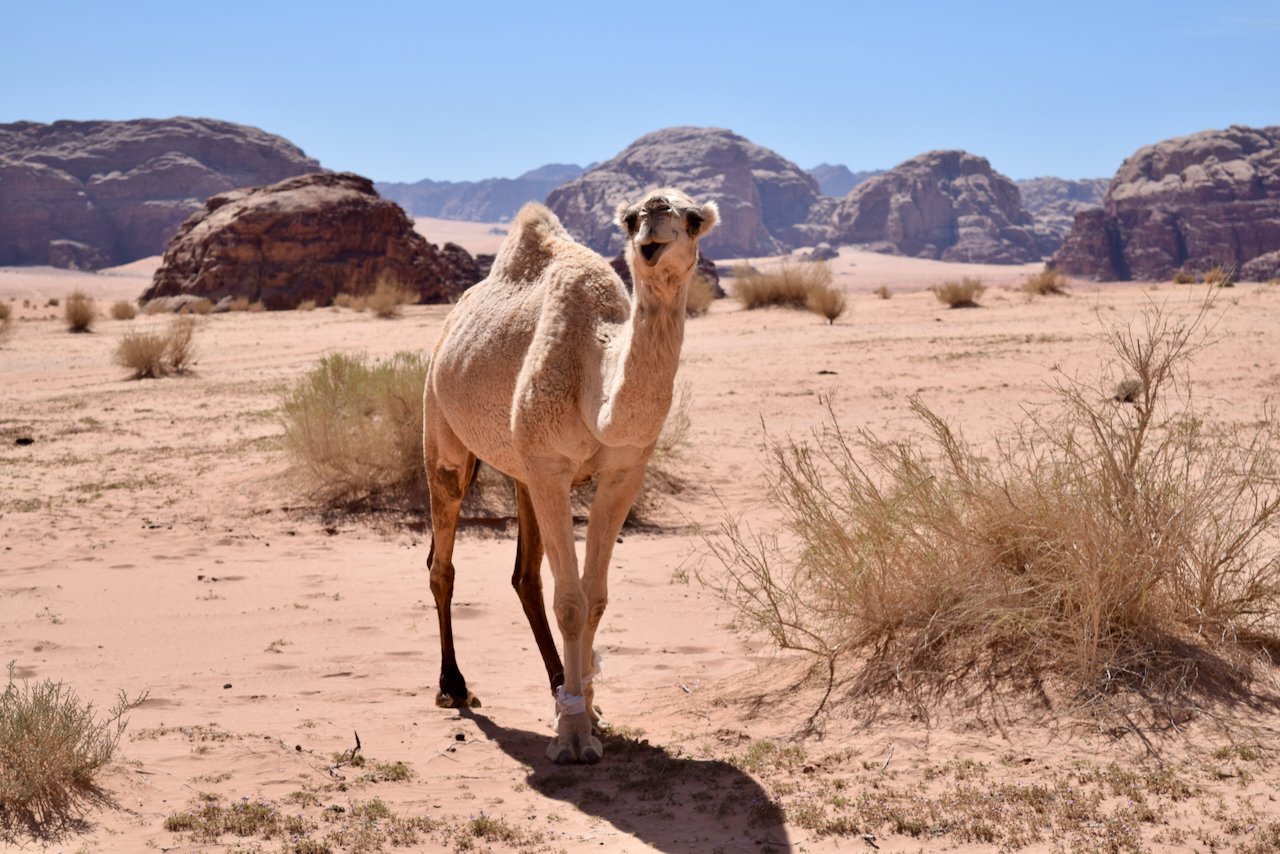
Pleased to see me? Apparently not, it’s just the natural upward curve of a camel’s mouth. Note its bound legs; probably not that much to smile about at all.
Jordan has been on my mind for many years, no doubt partly due to Indiana Jones riding through the canyon to the Treasury at Petra at the end of the Last Crusade (1989). 1989! At the time I assumed Petra was a film set but when I realised it was real, I knew I had to go, though it seems I was in no hurry.
Jordan as a whole feels like a film set with its amazing array of ruins and landscapes. Despite the tourism, one feels more like an amateur archaeologist than a tourist, and there’s a sense of adventure and wonder travelling around. Indeed, even Petra (which can get over a million visitors a year, when there’s not a war on its borders) has barely been touched, with something like 95% of the ancient city still tantalisingly underground, unexplored.
Saturday 7th February 2026
We arrived at Queen Alia International Airport (designed by Foster + Partners in 2013 as brutalist Bedouin tents), 35km outside Amman, and spotted our names printed on a piece of paper ‘Helen & Barnaby’ being held by our driver (the first of many), a jovial, round-faced chap. We hit it off straight away, especially when my accidentally trying to get into the driver’s seat became an ongoing joke all the way into central Amman, a long journey what with the horrendous traffic (apparently here literally everyone owns a car or two). The capital city didn’t look promising, with basic, beige-coloured block buildings piled on top of hills – the traditional seven hills of Amman (actually there’s now over nineteen). But being back in a Muslim country felt great, what with the mosques, the call to prayer, street life (the life is all outside), and sheep and goats herded by shepherds on any patch of grass, even next to motorways (I could barely watch as sheep seemed to constantly veer off onto the road; luckily the traffic never seemed to go above 5mph).
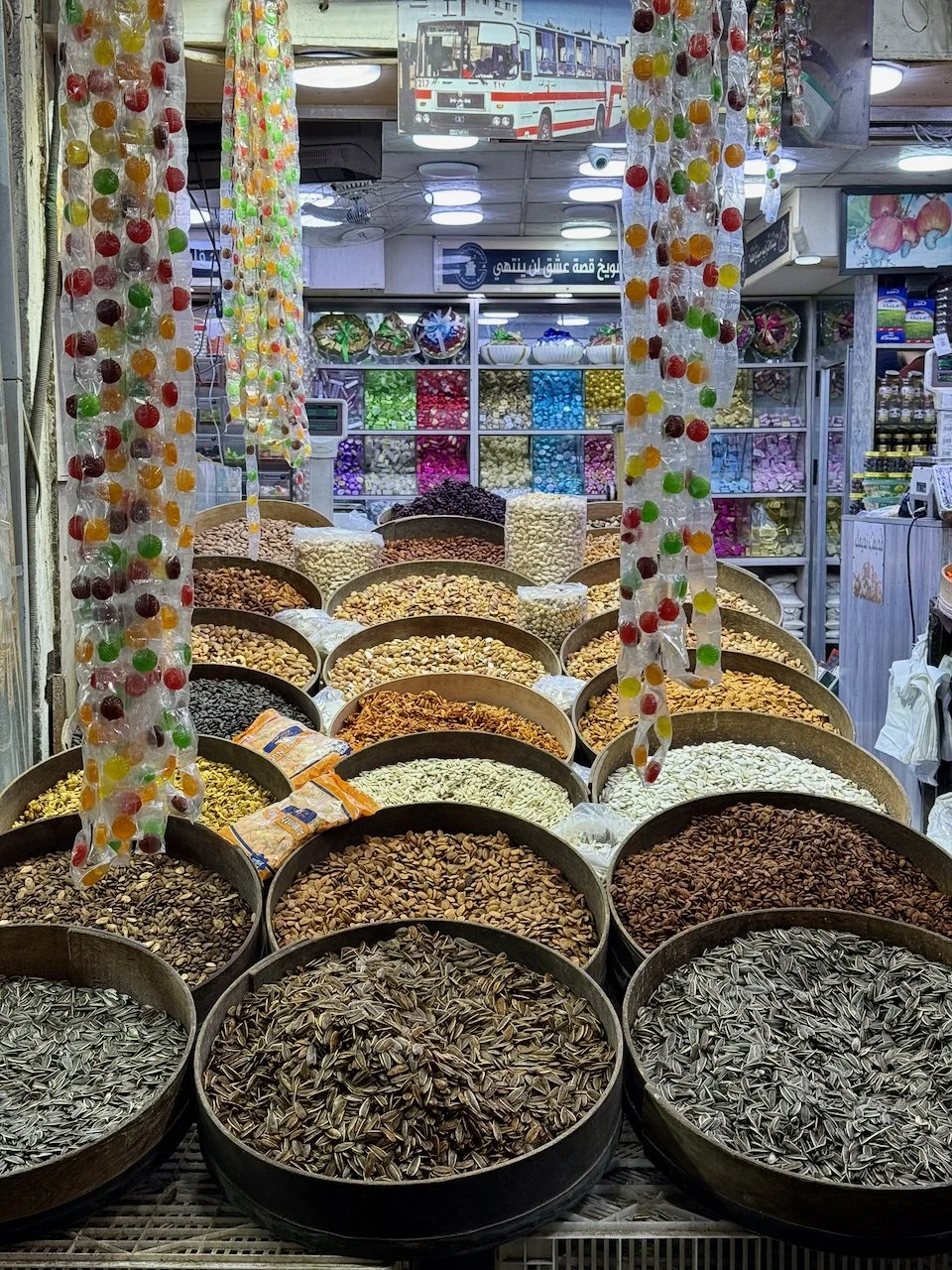
We eventually reached our hotel, next door to a shoe repair stall, dropped off our bags and went to look around downtown. We plunged into the vibrant night food markets, a riot of colour, smells and bright lights, even singing and dancing. Fruit and veg stalls were next door to Roman ruins; it was an interesting area for sure.
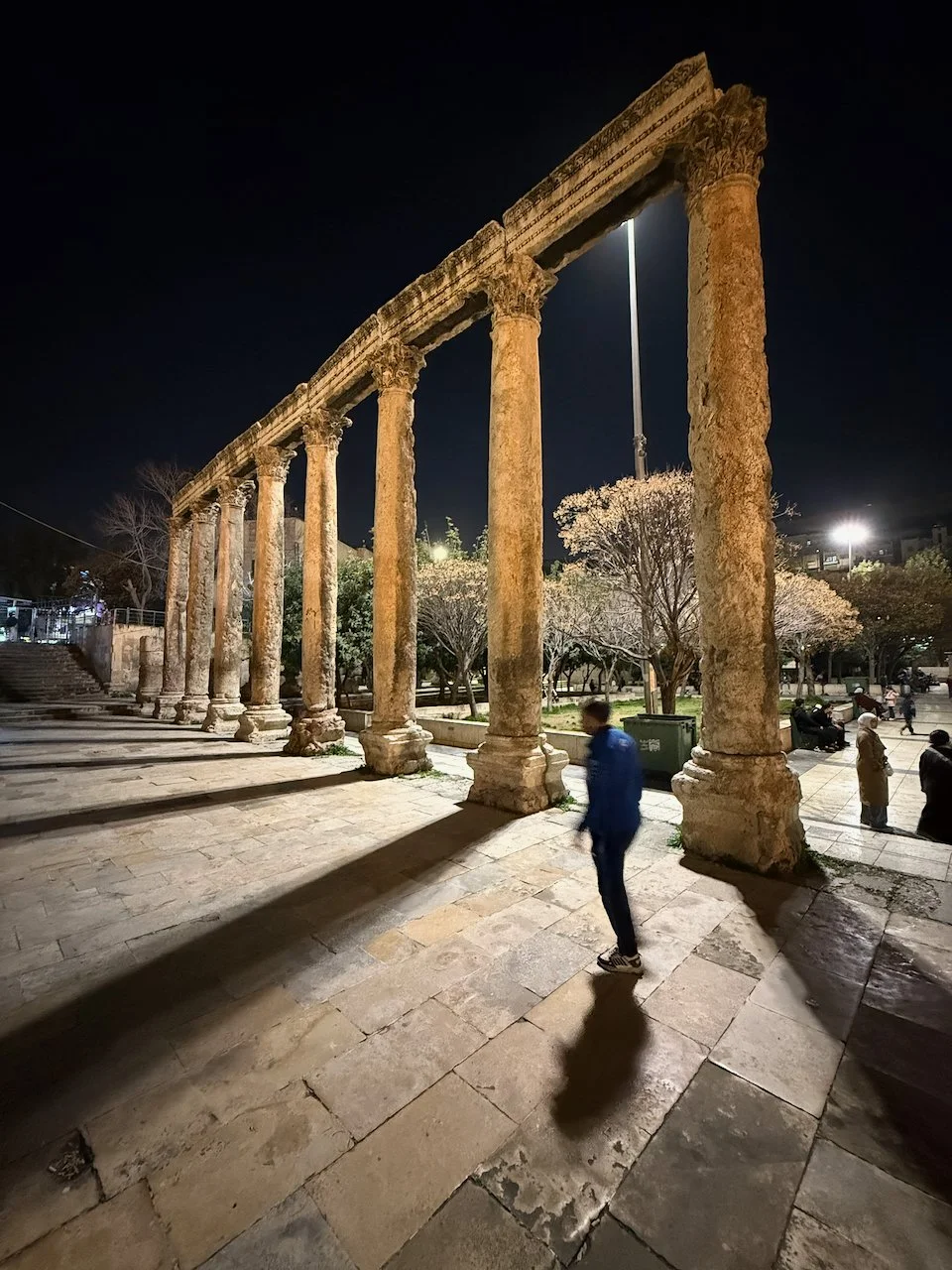
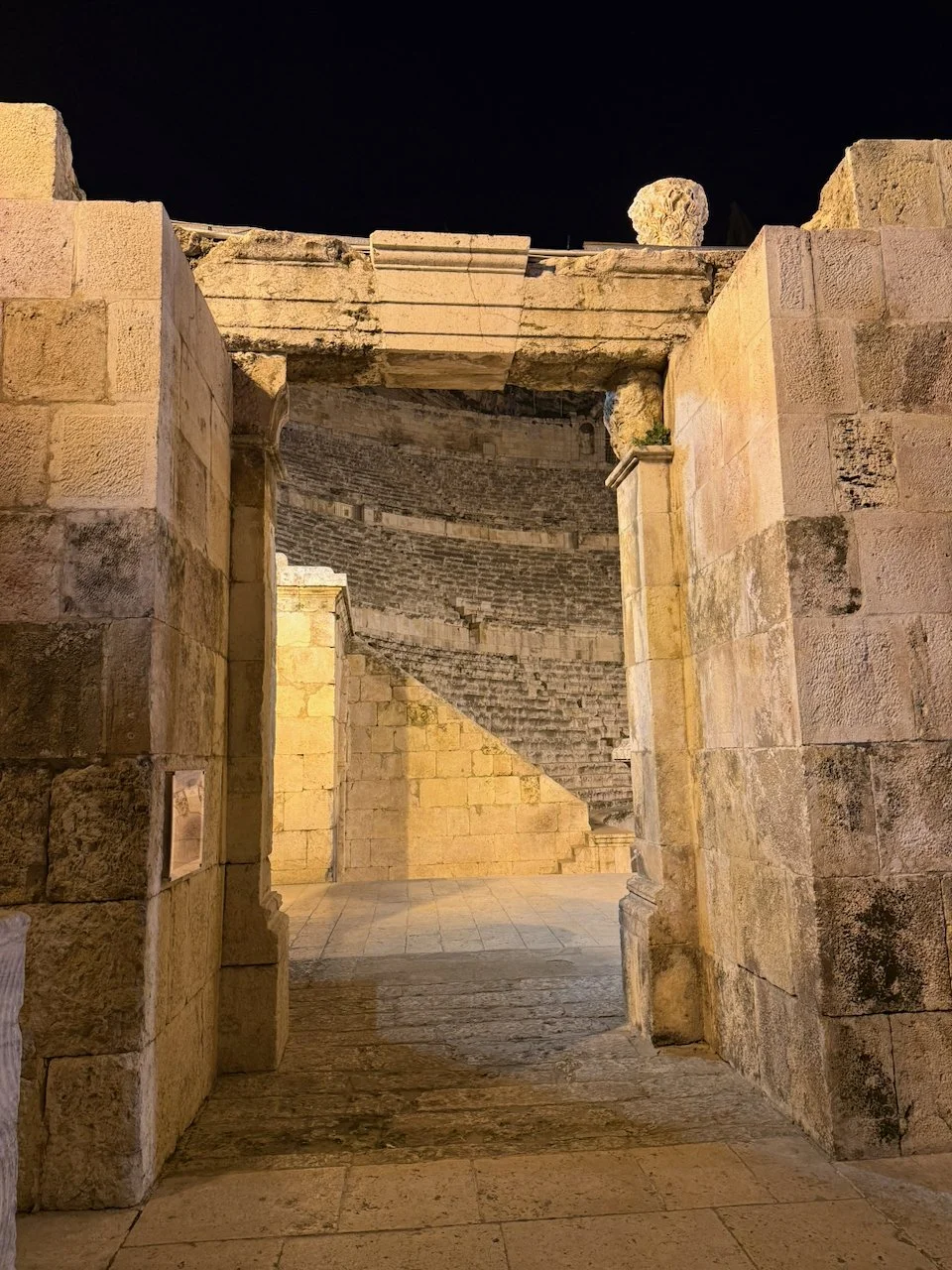
A large, public square, the Hashemite Plaza, was surrounded by a 2nd century Roman theatre alongside pillars where, despite it now being nighttime, children were playing football and cats were sitting or fighting all over the place. The area felt completely safe, a lot safer than the roads, which were still chock-a-block with cars, and to get over the road you just had to walk, and hope for the best.
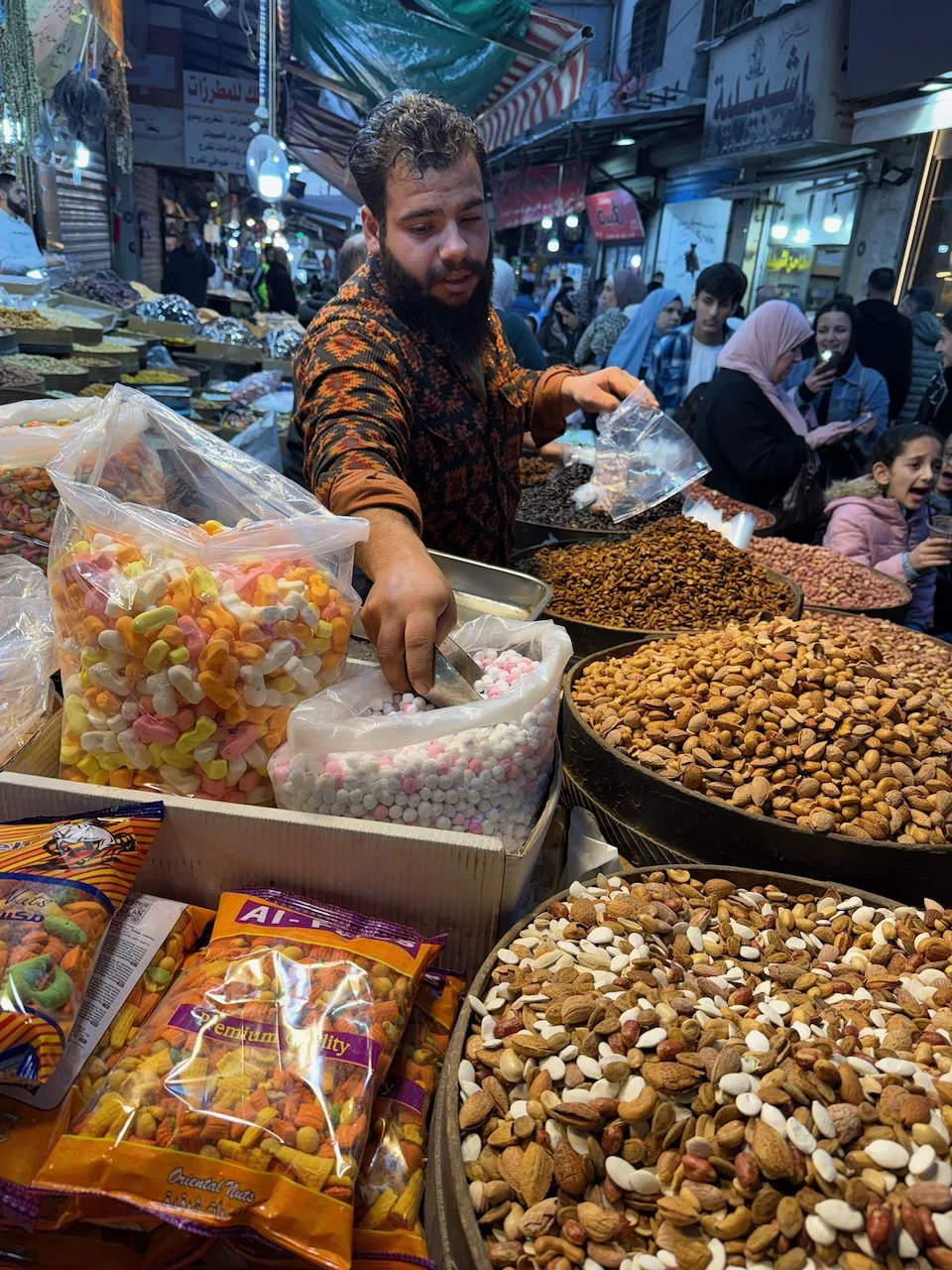
We got lost pretty soon, and standing in the middle of the street, guide book in hand, must have looked it, for a lovely Palestinian family (husband and wife, mother and daughter) took pity on us, insisting on walking us to the restaurant we were trying to find. For once, we had various recommendations: from a colleague, from a friend of the colleague living in Amman, and from another friend of his, as well as the Lonely Planet guidebook (mostly kept in the bag, barely used).
The family took us directly to Hashem, a legendary and extremely cheap restaurant serving simple yet fresh fare like hummus and falafel since 1952. Afterwards we couldn’t miss the queue for kunafa outside Habiba, also recommended to us as the best place to eat the popular dessert, a pastry filled with salty white cheese topped with pistachios and drenched in syrup. Served on a paper plate with a plastic fork, the dish was being eaten by all ages young and old, male and female, on their own, in groups, sitting, standing, walking. Life was all on the street. This was downtown Amman on a Saturday night and it felt pretty good.
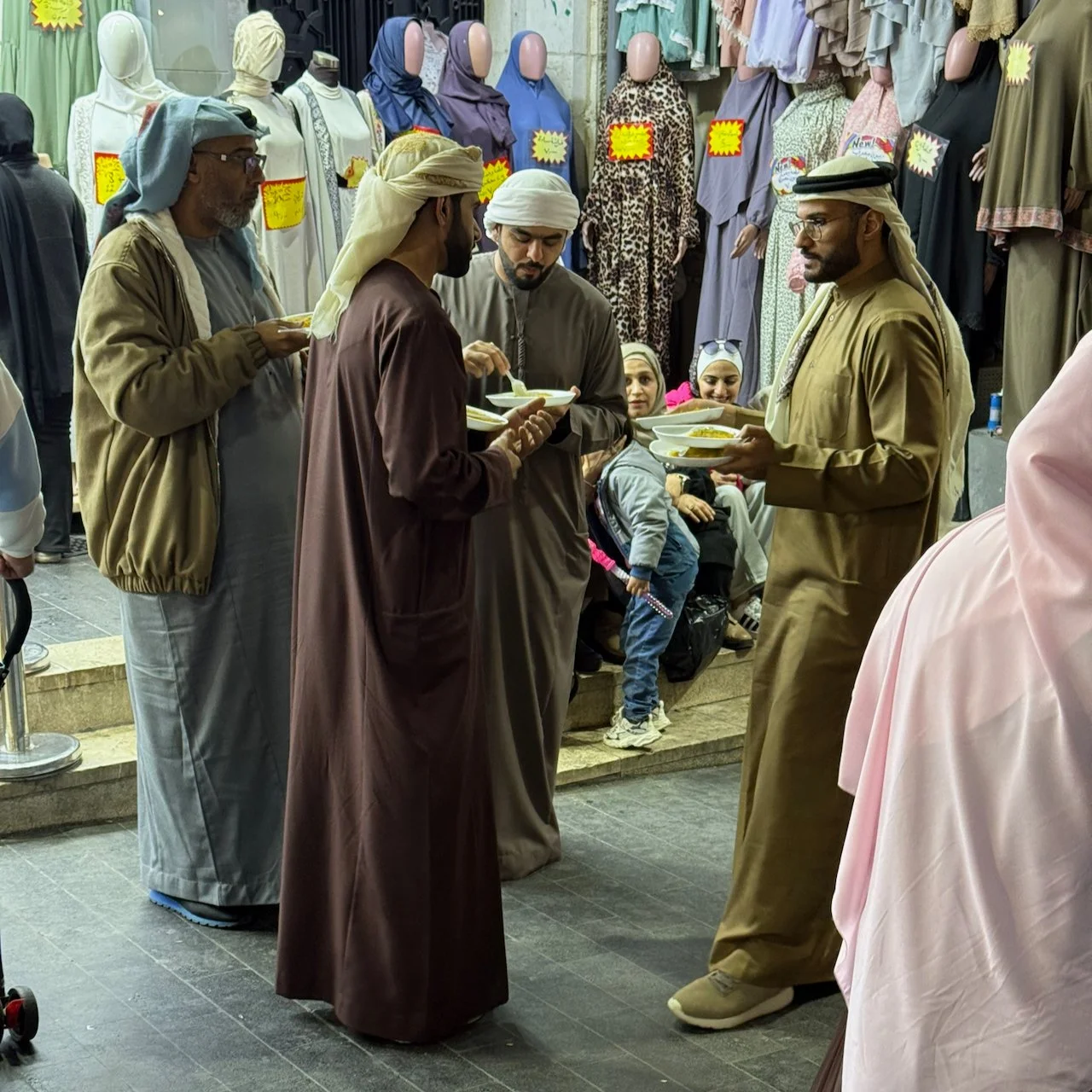
Eating kunafa on the street.
Sunday 8th February 2026
We were picked up the next morning at our hotel by our driver for the day. H asked him what she would ask every driver, waiter, hotel owner or shepherd we came across: why is Jordan so peaceful whilst the surrounding countries are in conflict? There were many answers but several constants: the king was a big one; the long (350km) border with Israel another; the 1994 peace treaty with Israel and the mix of people that make up Jordan (including many Palestinians and other refugees) were all spoken about during the week H asked the question. Only one person (a Bedouin Pirates of the Caribbean lookalike) said, I dunno, what do you think?
Armed with our Jordan Passes (essential for ‘hassle-free’ entry to dozens of the country’s top tourist attractions), our first stop was the Roman ruins of Umm Qais, in hindsight a warm up for the main event, Jeresh. Driving there, the landscape was becoming hilly and more fertile, with trees and fields. One of my favourite sights was groves of olive trees with lovely yellow flowers growing beneath them. The Jordan Valley was below us and, as it was a clear day, there were excellent views of three countries – Jordan, Israel and Syria. We could see the Biblical Sea of Galilee (actually a 13-mile long lake), where Jesus apparently performed various miracles.
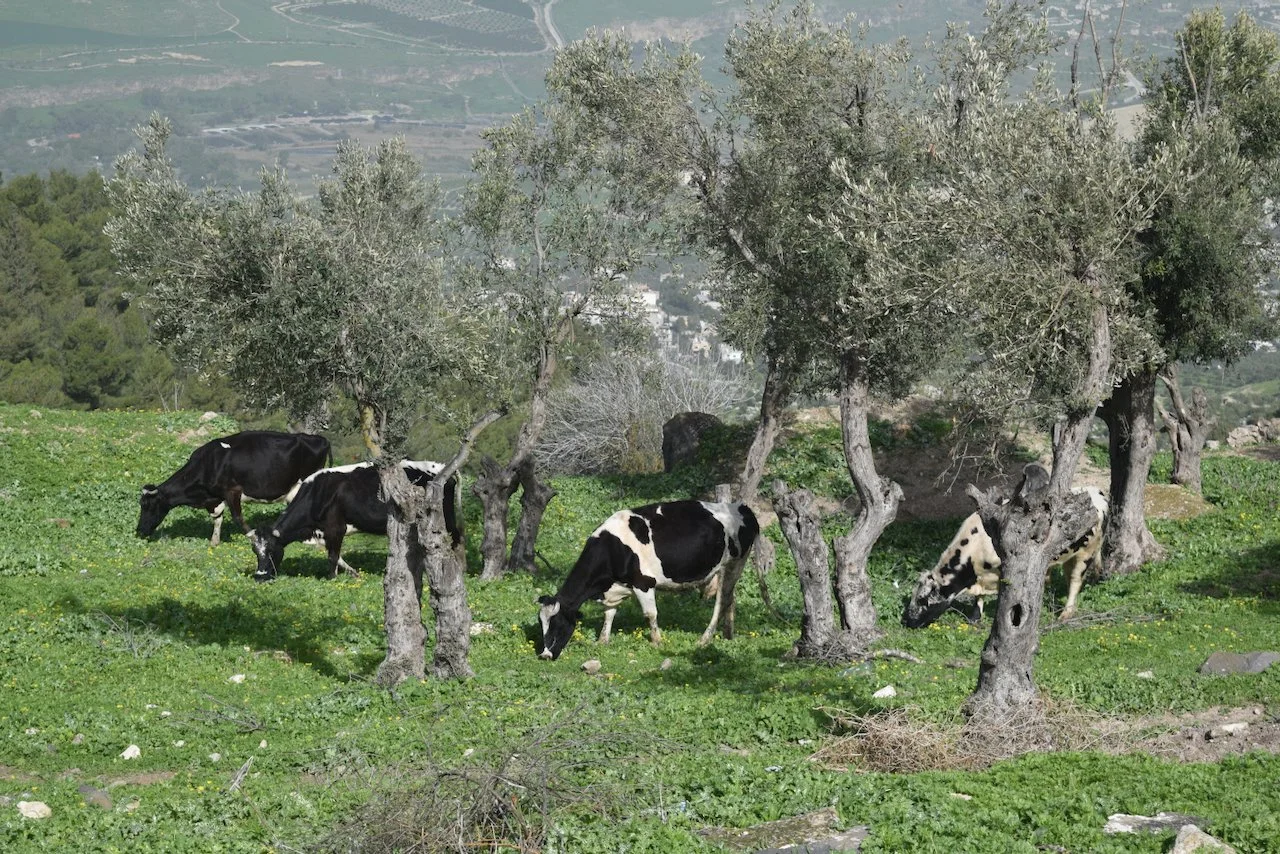
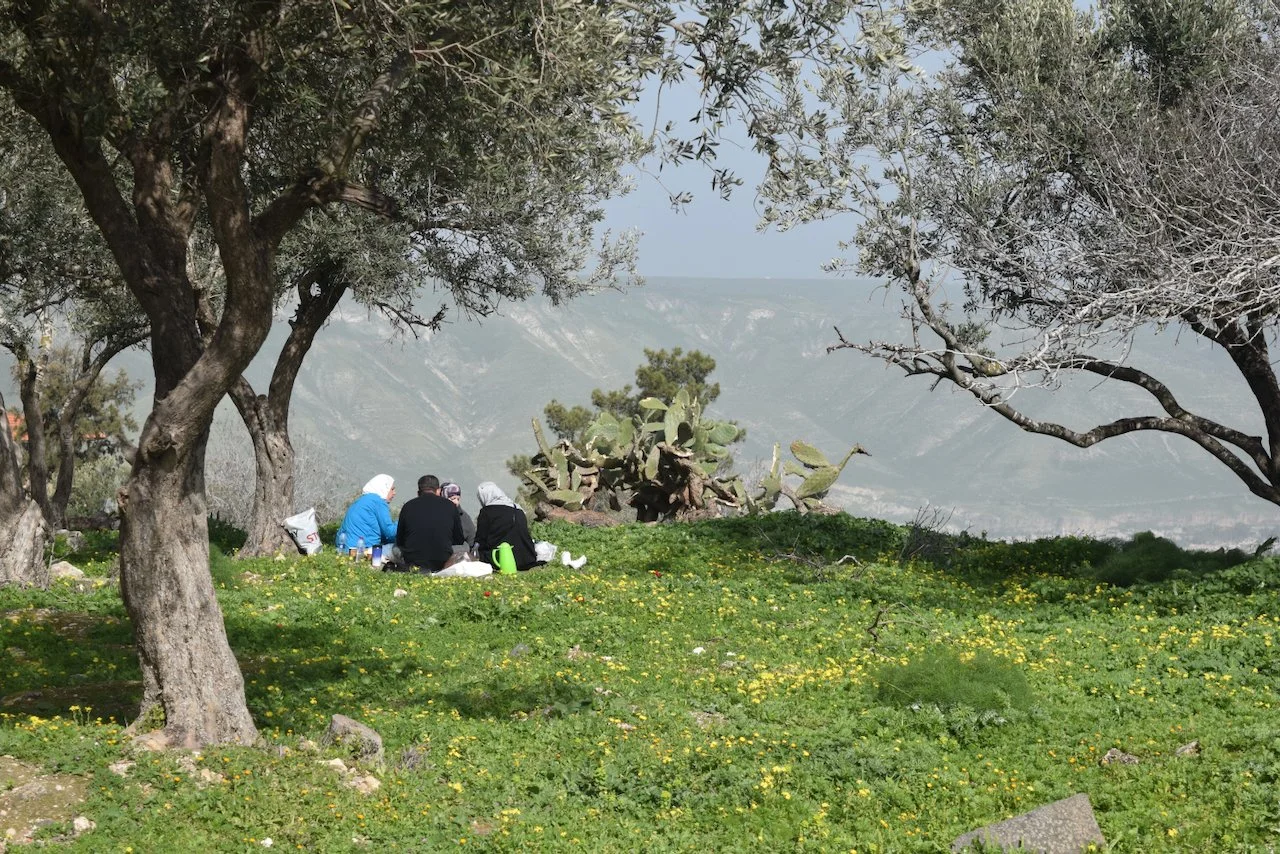
Wandering amongst the ruins virtually by ourselves, it was so peaceful and beautiful. Cows were grazing in nearby olive groves, a family were having a picnic nearby. I loved the combination of the rocky ruins and overgrowth; it looked as if under every stone they’d be a scorpion, in every clump of grass, a snake, on every hot rock a lizard. Unfortunately I saw nothing, maybe it was too early in the year.
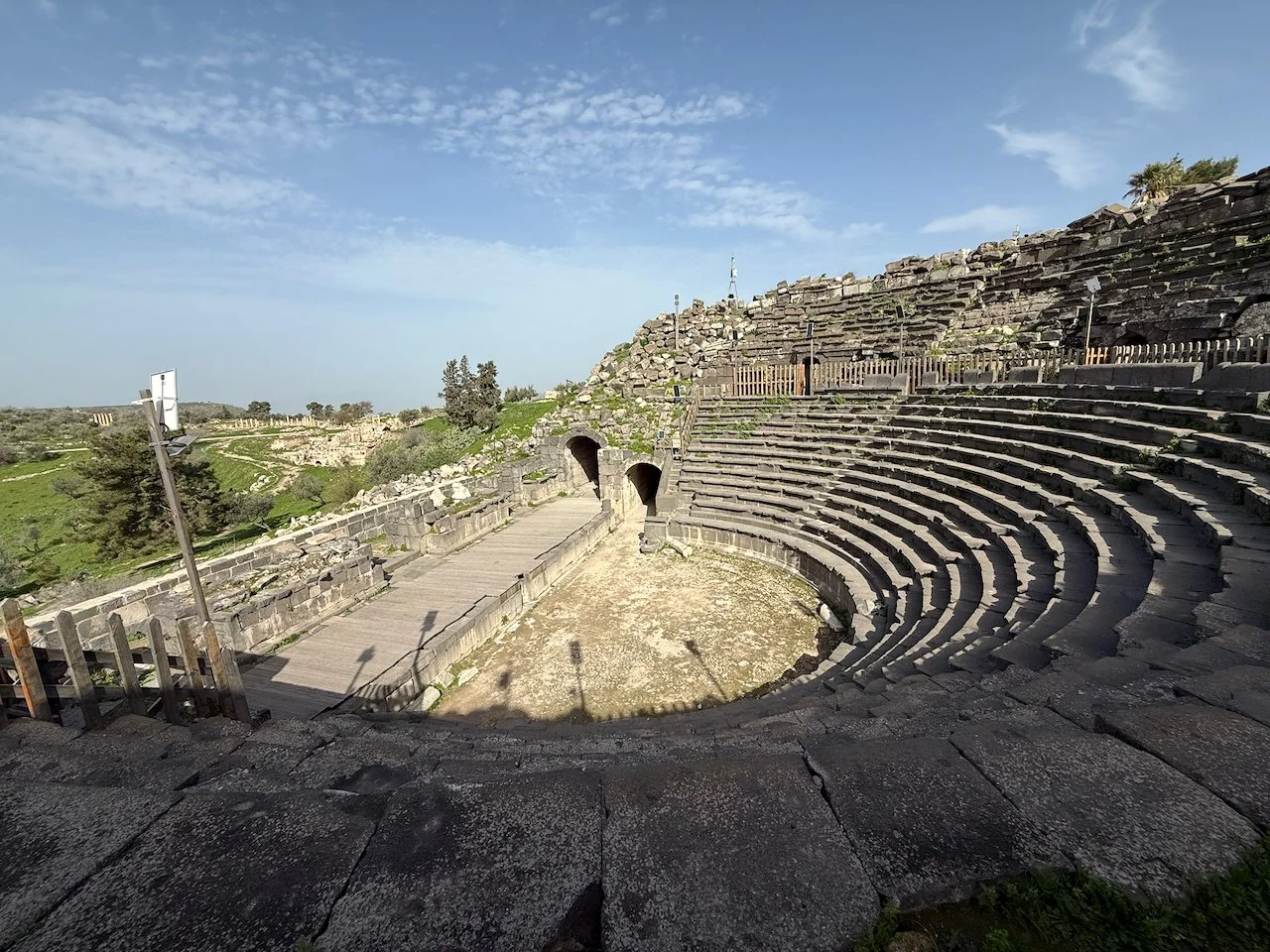
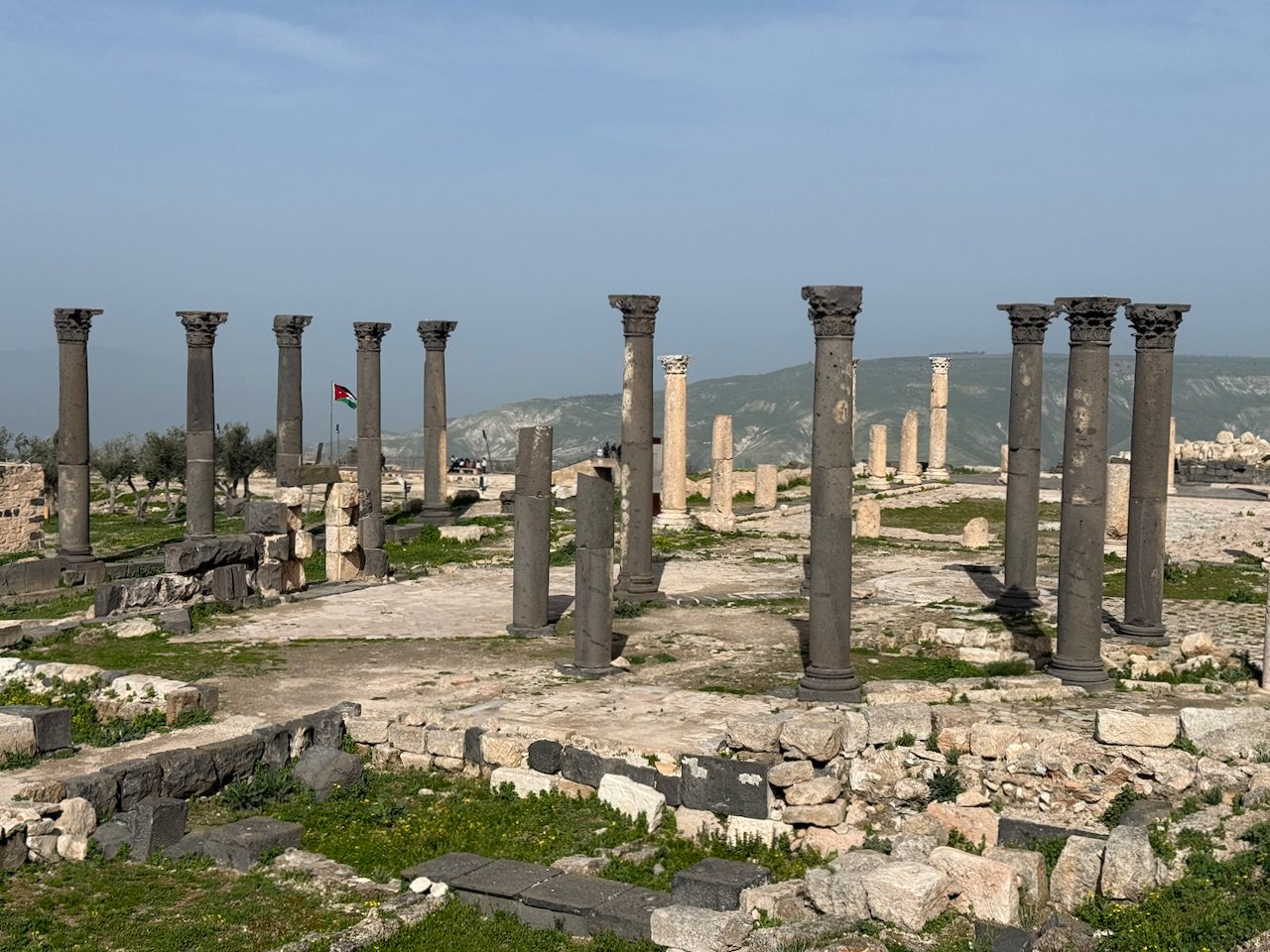
We spent so much time wandering around Umm Qais, and realising Jeresh was far larger, we didn’t linger long at Ajloun Castle, our next stop, a 12th century fortification on a windy hilltop.
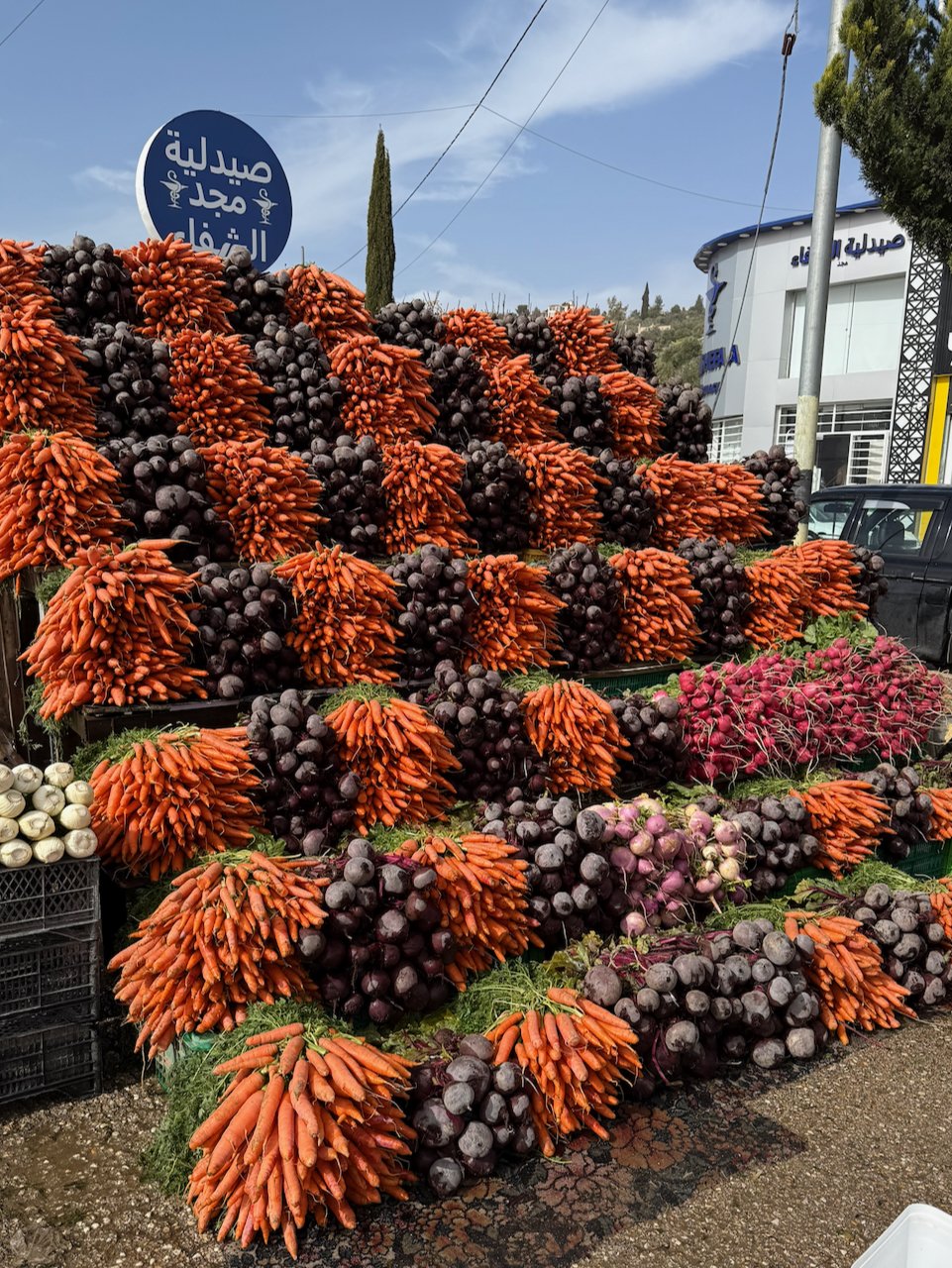
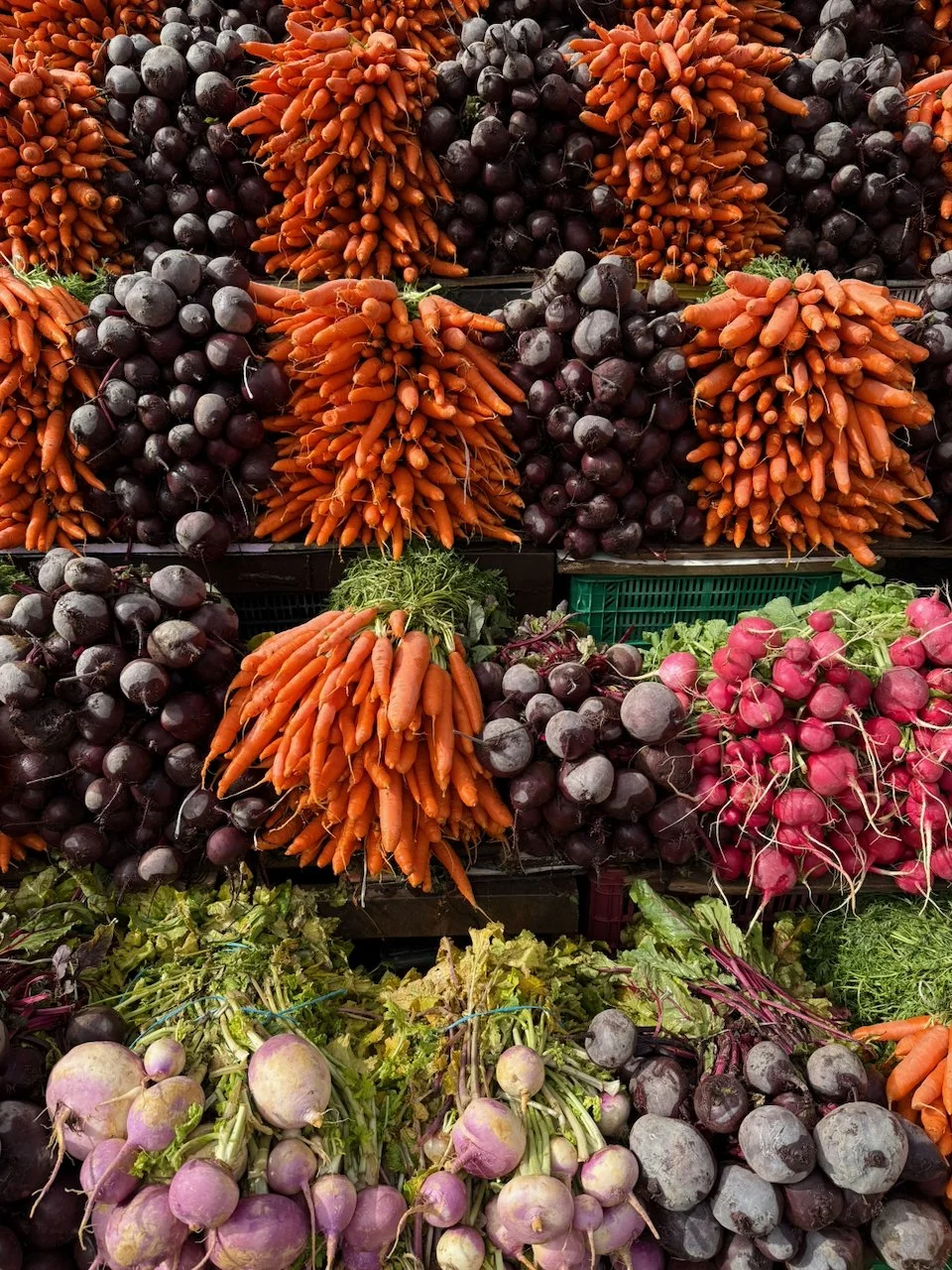
On our way to Jeresh we heard a truck with a loudspeaker shouting out non-stop Arabic, it echoed for miles around, it sounded quite annoying so we assumed it was a politician broadcasting his manifesto but when we asked the driver he said it was someone selling cheap potatoes and carrots.
For lunch our driver stopped at a fantastic roadside bakery where we got a lovely wrap filled with felafel, chips and salad for a dinar (handily equivalent to a UK pound). It was becoming that my favourite things in Jordan were roadside attractions: herds of sheep or goats with their shepherds were the best, but also immaculate, lush food stalls, selling fruit and vegetables (carrots and cauliflowers seemed to be most bountiful) from the fertile Jordan Valley. At this point it should be mentioned that half our photos were drive-by shootings: pictures taken from a moving car.
We arrived in Jeresh not really knowing what to expect but were confronted with the Arch of Hadrian, built for, yes, him of the Wall fame, but somewhat more impressive than the typically English anti-climax. Technically Jeresh is the modern town surrounding the ancient city of Geresa, but everyone calls it Jeresh. Built on Greek ruins by the Romans (followed by other civilisations), the Greco-Roman remains of the walled settlement are in amazing condition, with preserved streets, theatres, hippodrome, baths, temples, hundreds of columns and much more sprawling over a huge area, something like twenty acres.
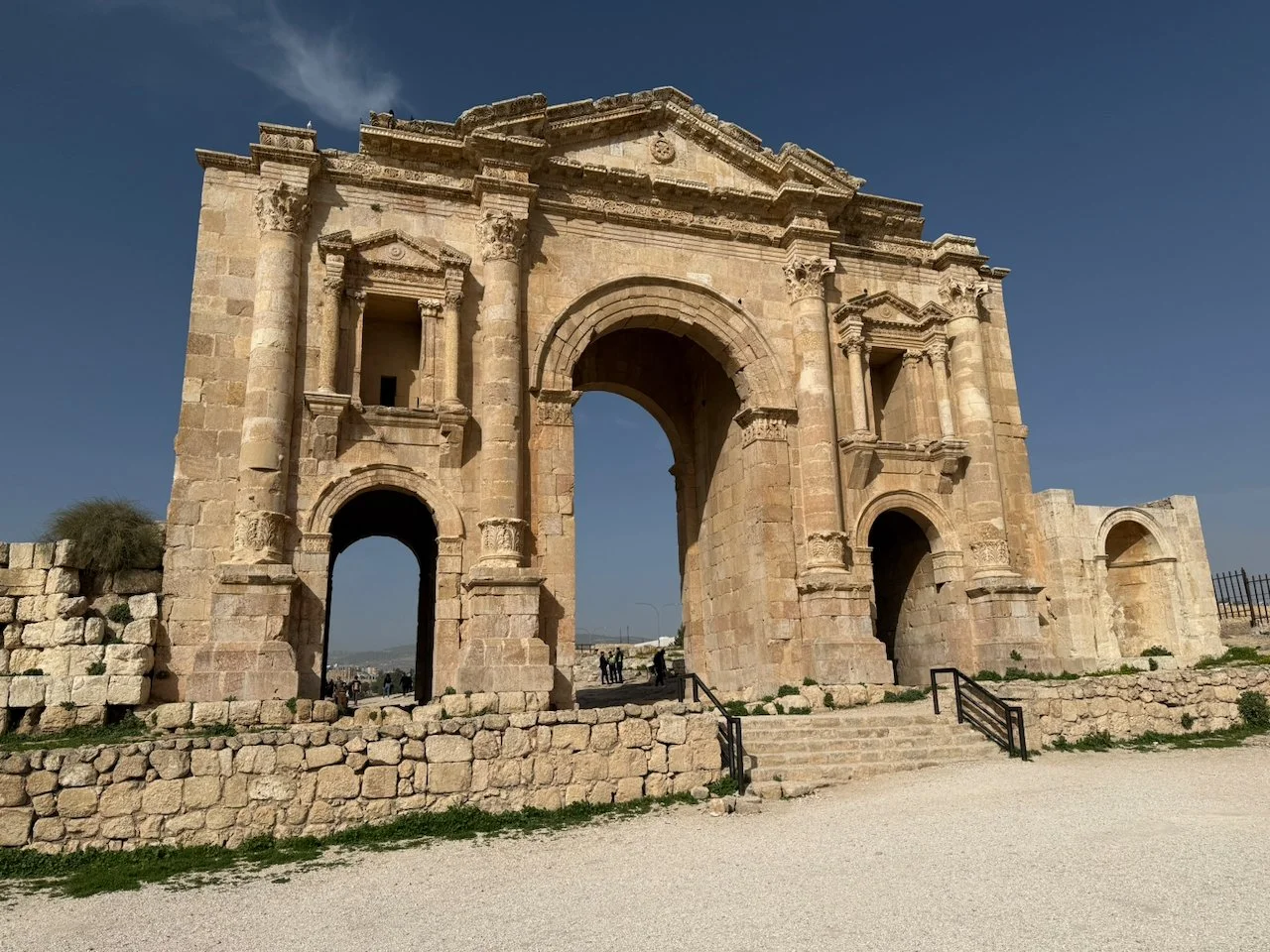
Arch of Hadrian, built to honour a visit by the Emperor in the year 129. I’m lucky to get a cup of tea for my official visits.
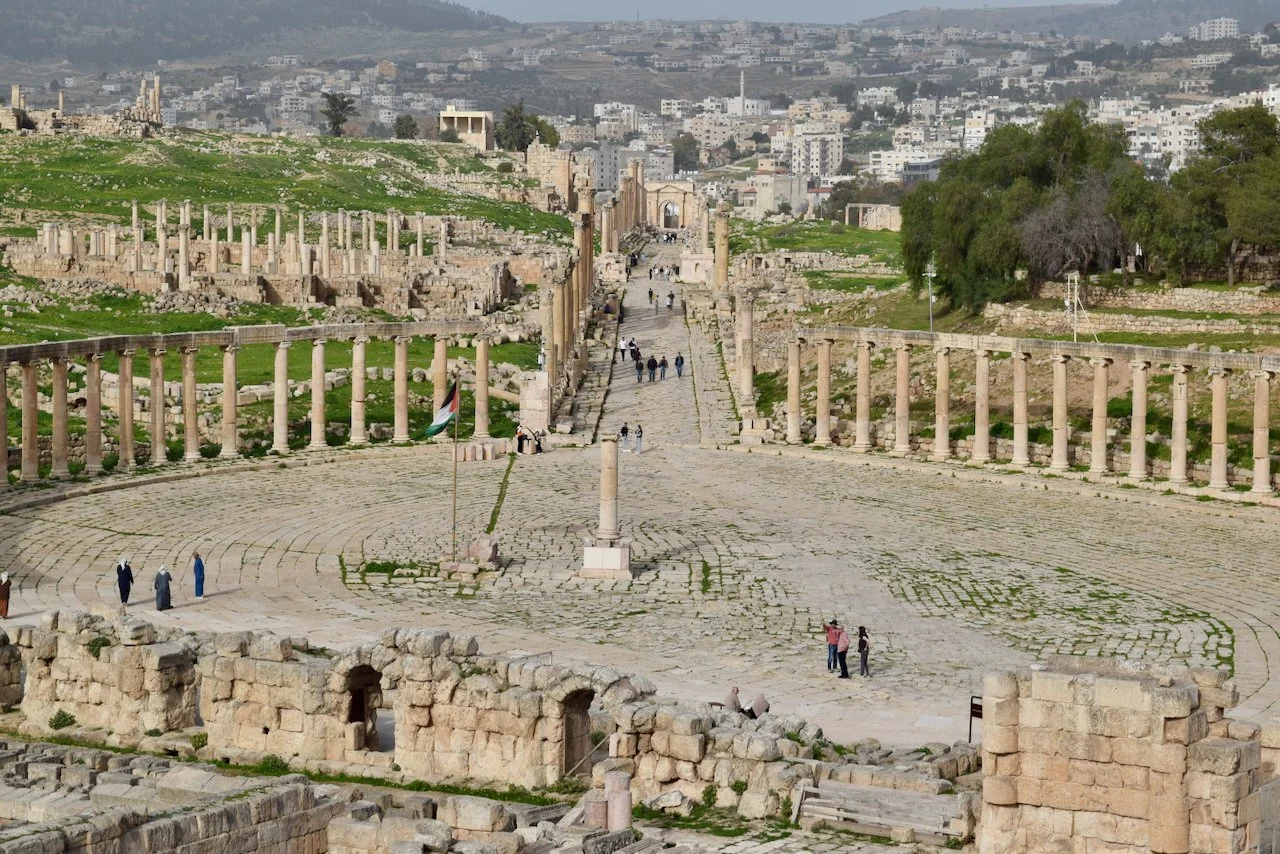
Oval Plaza, Jeresh.
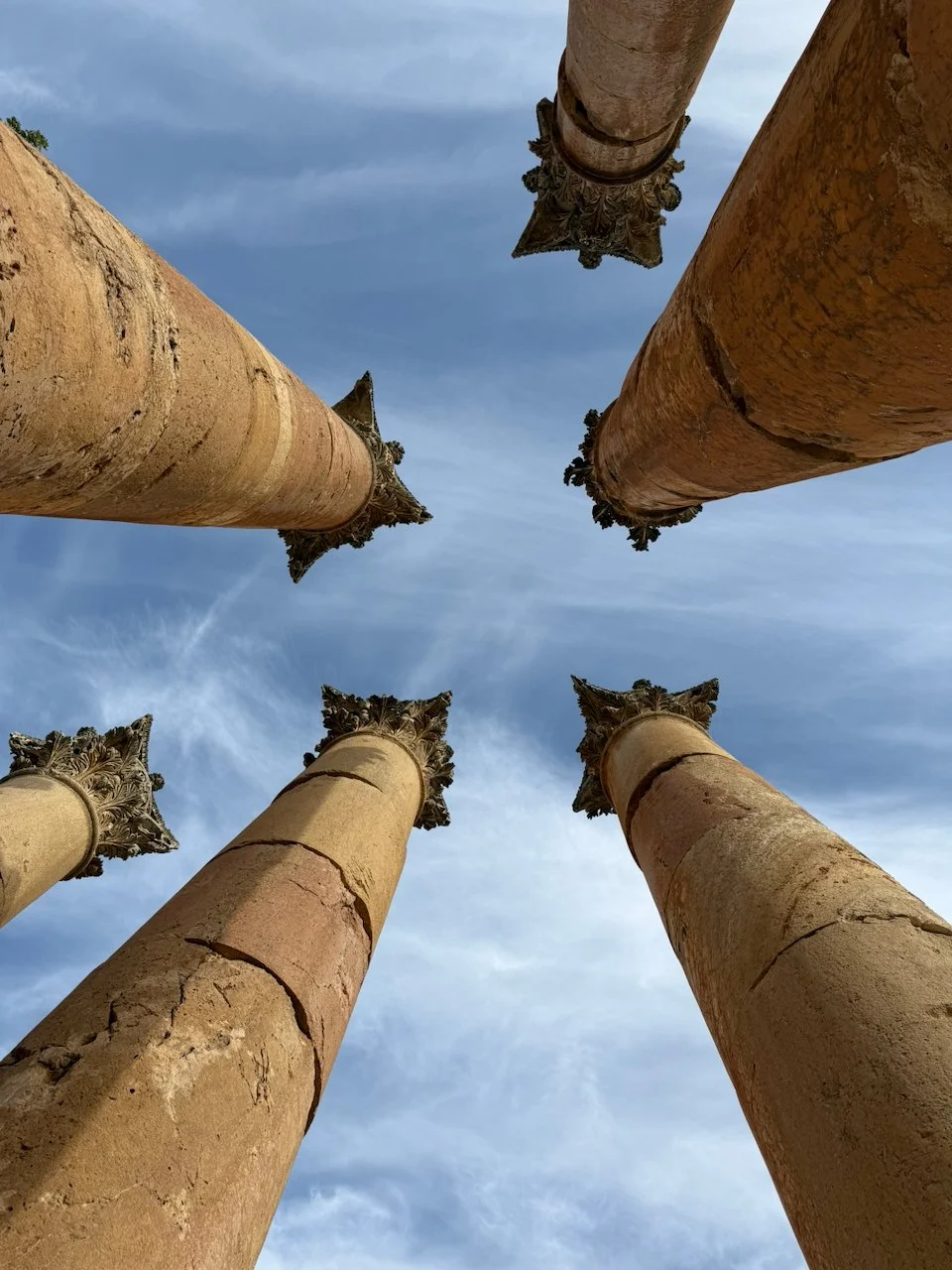
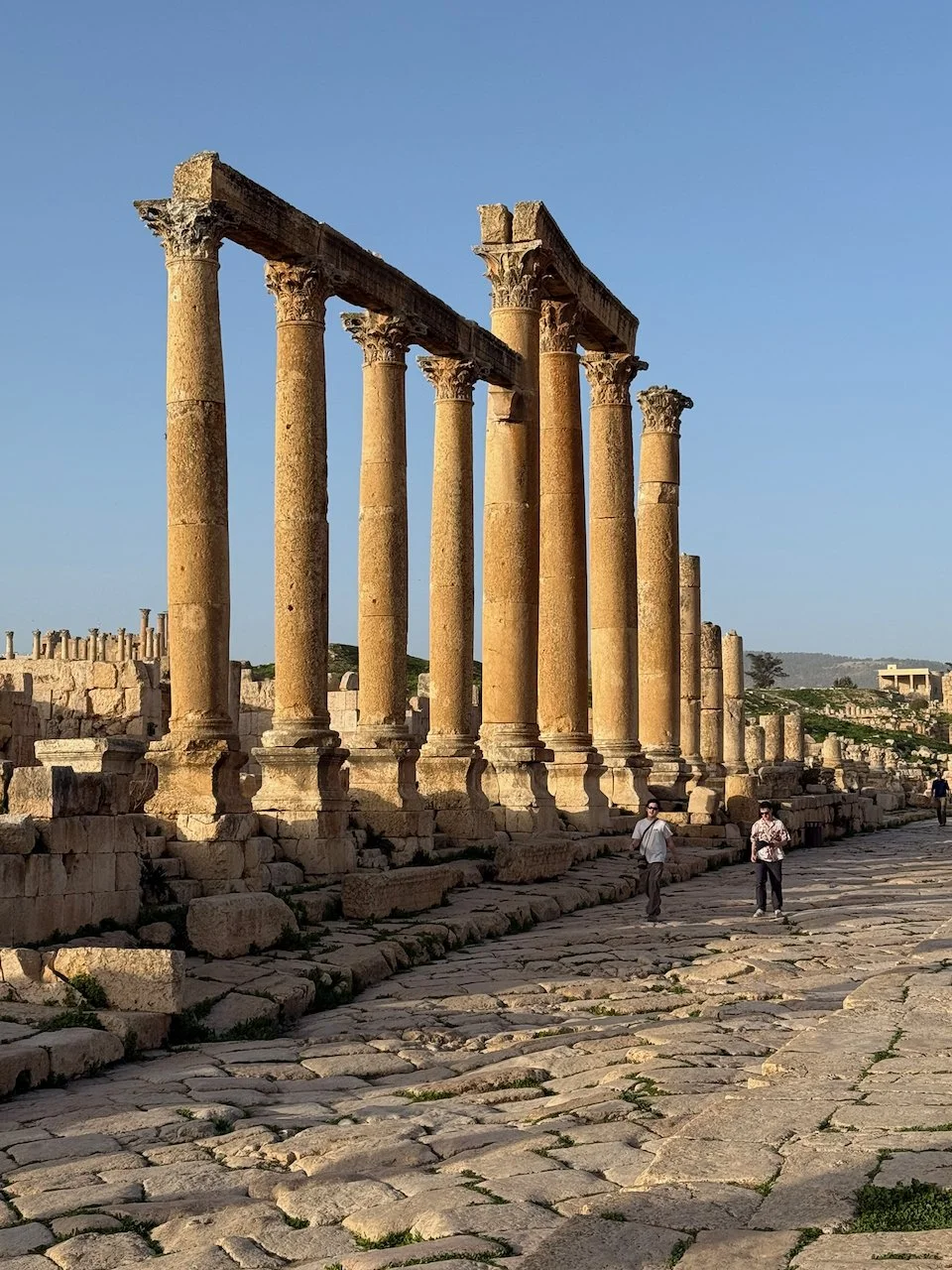
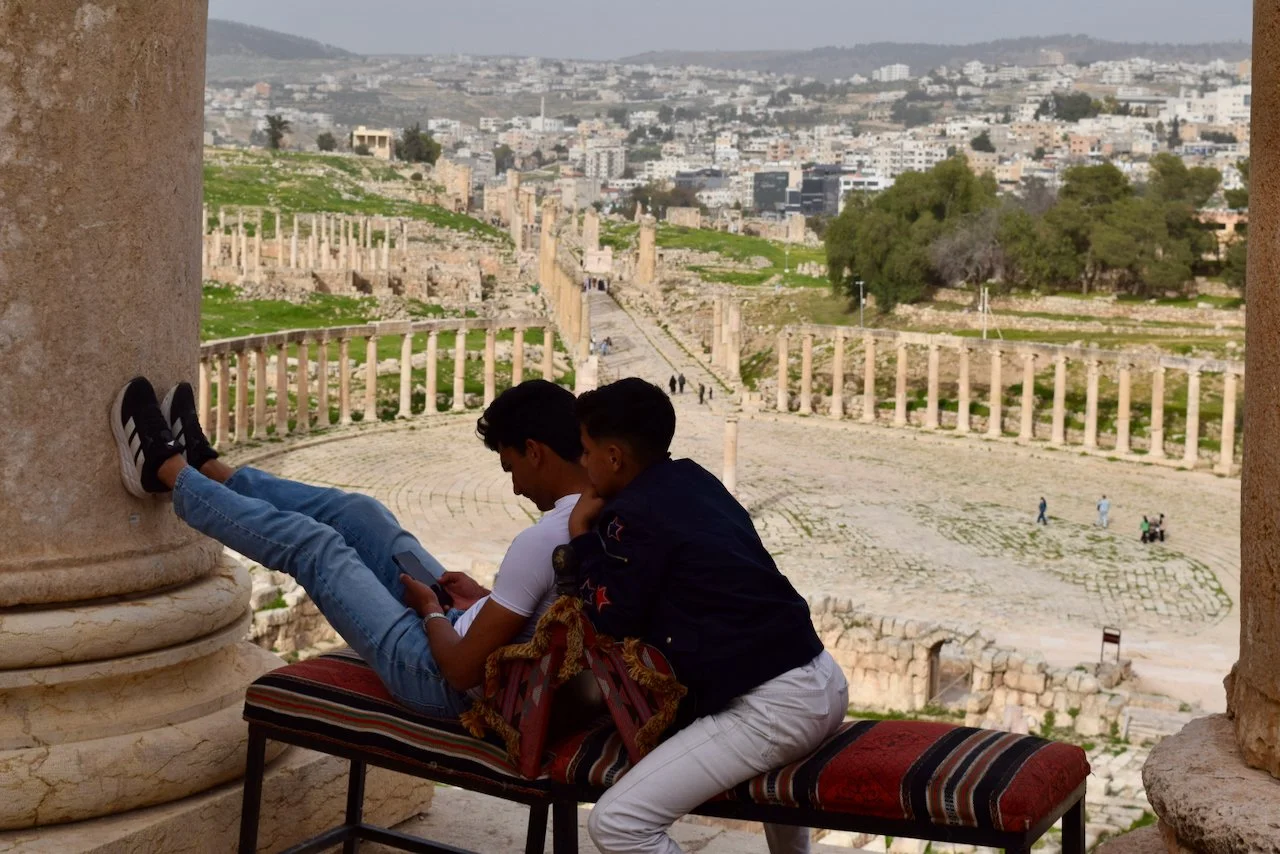
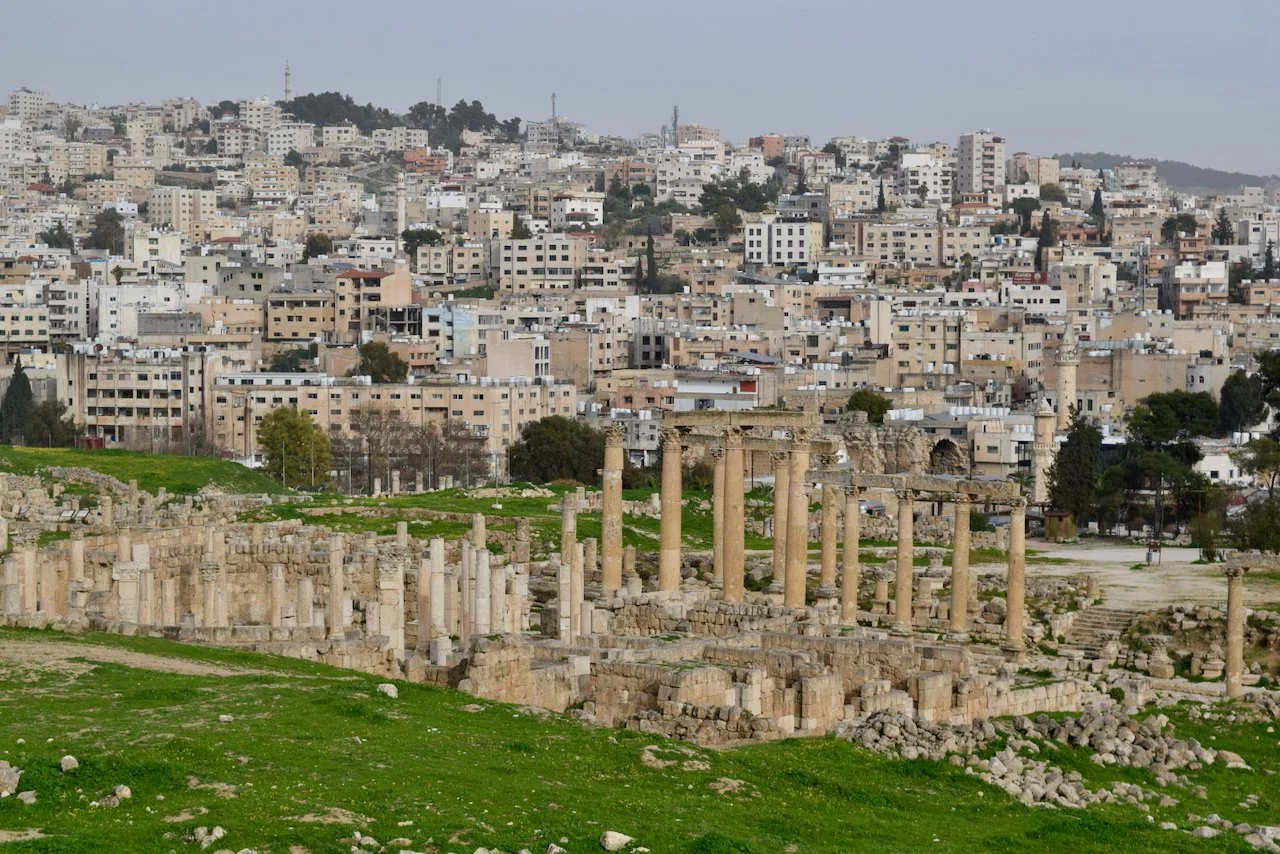
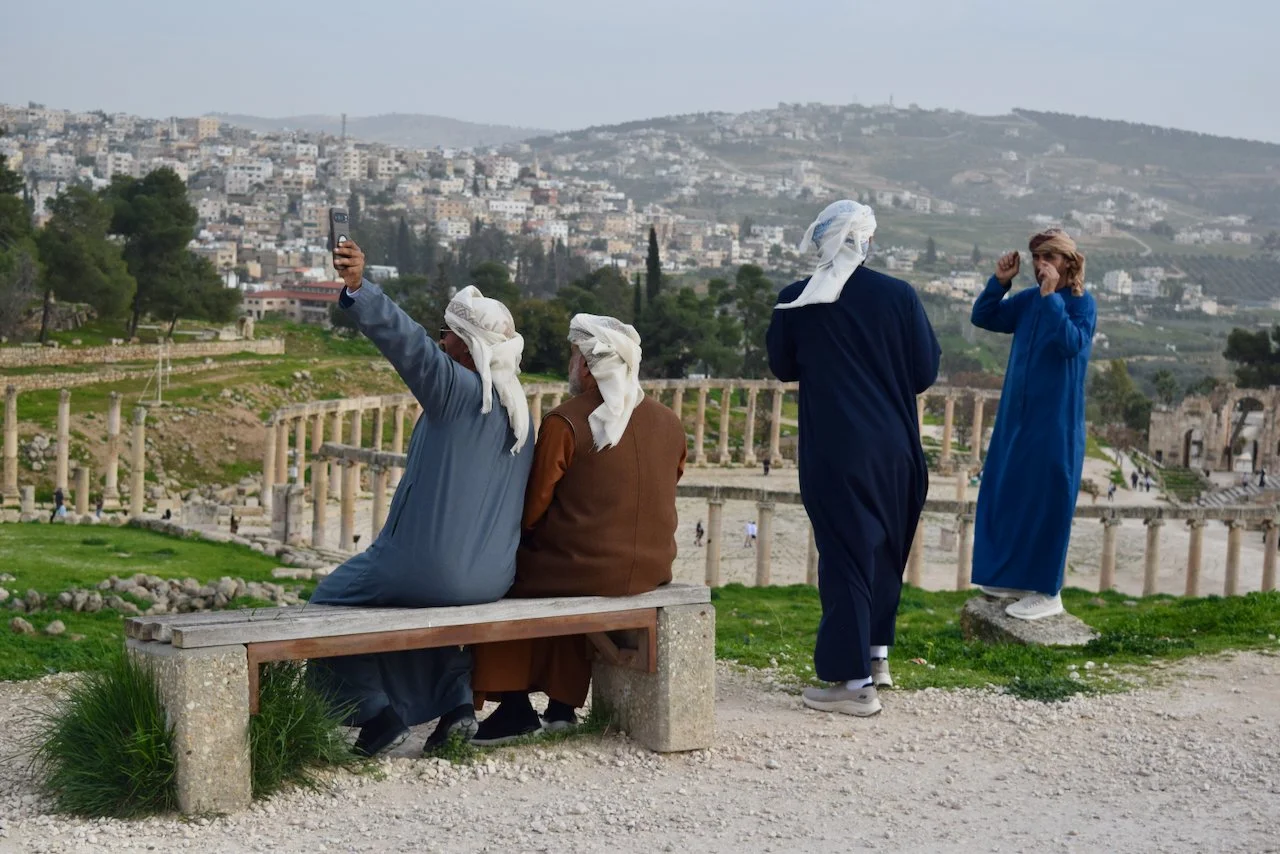
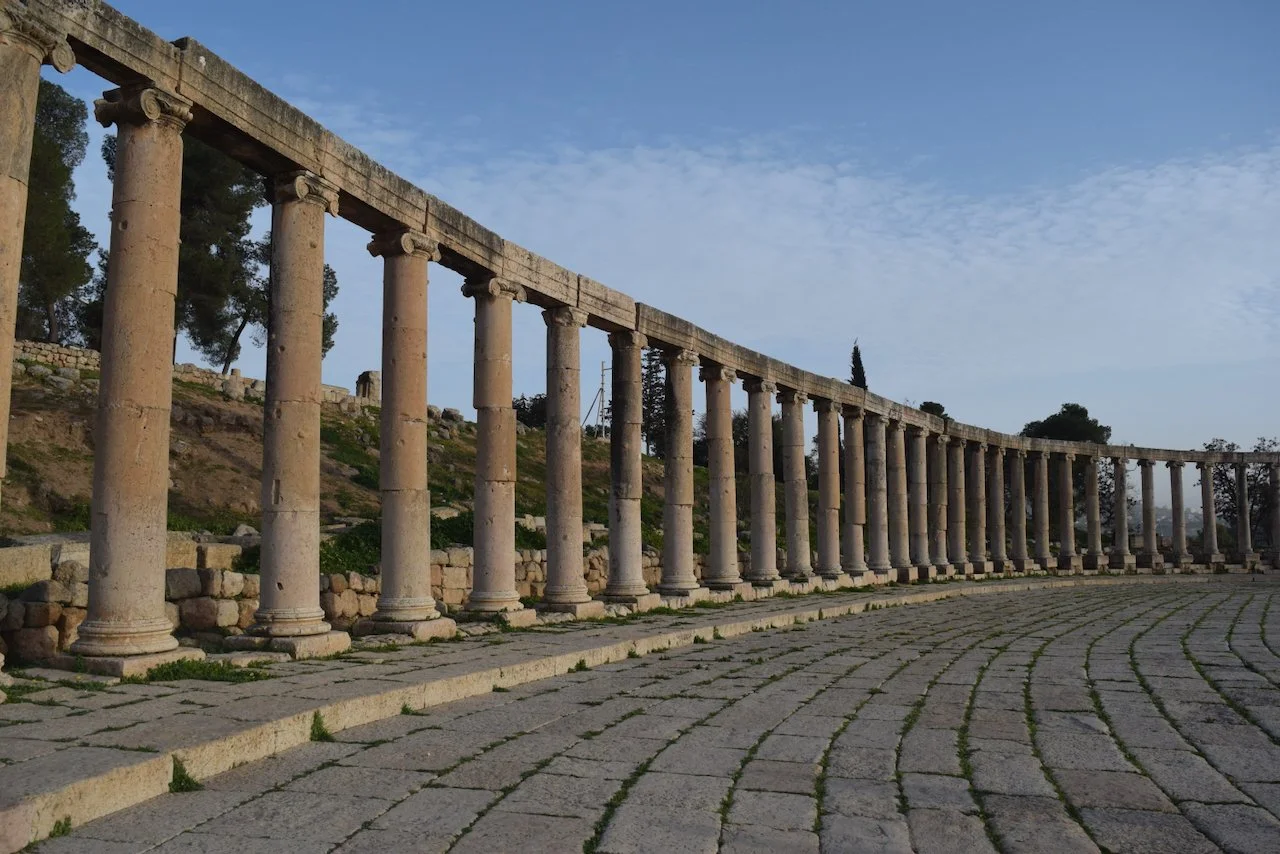
I stepped away from H for five minutes to take a photo of a wonky column; when I returned she had seen and photographed a hoopee (and it had now obviously flown away), a beautiful-looking bird with an exotic, mohawk crest, light brown/orange body feathers and striking black and white wings. We’d just been reading about them, not even in relation to Jordan, maybe in the Azores (another place I’ve always wanted to go…), and then she sees one. When I’m not there. Just incredible. Still, here I was, in one of the most amazing Roman ruins in the world. I couldn’t complain. Much. Besides, the hoopee has also been spotted in Cornwall.
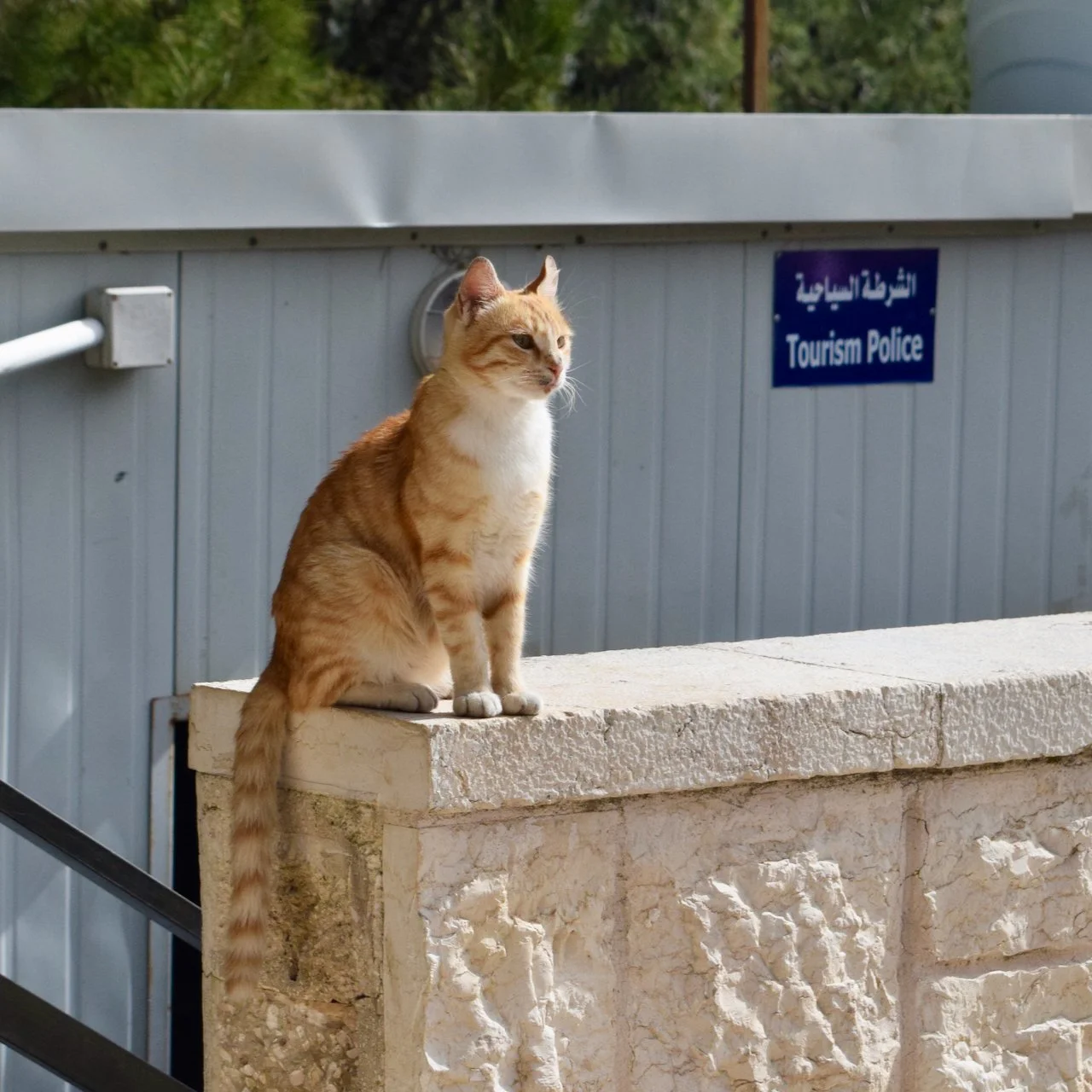
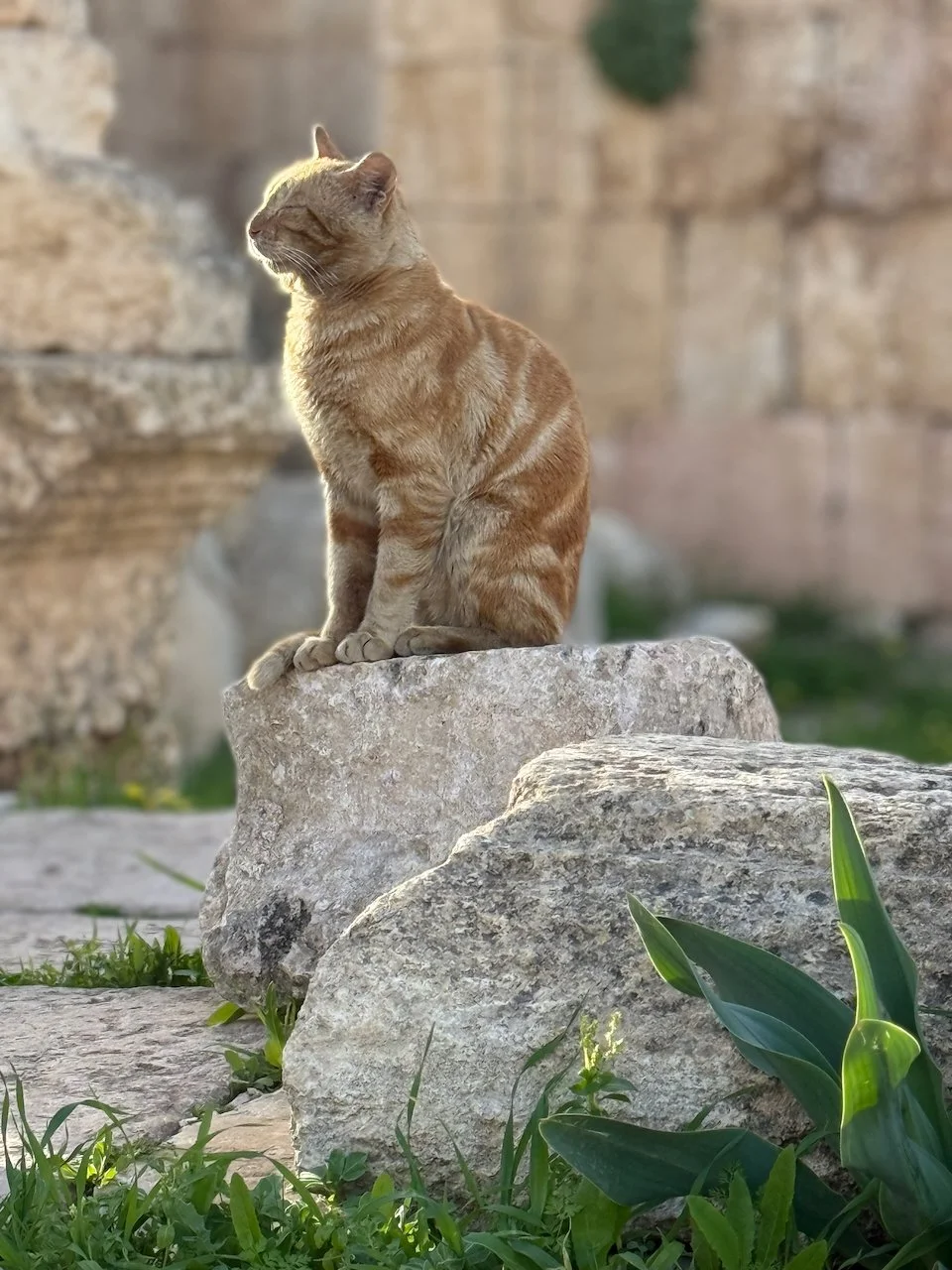
Most cats abroad I wouldn’t dare touch, they look feral, manky, diseased and malnourished (but most likely aren’t… in Sofia, Bulgaria I’d tried feeding one cat until a man nearby pointed out to me, around the corner, a huge bowl of cat food. I’d also caused a cat riot one night in the same city after buying a large bag of cat food and distributed it around the back streets), but in Jordan not only do they look lovely, healthy and friendly but also, like in ancient Egypt, they appear to be the guardians or protectors of the ancient monuments. Or maybe they’ve just realised where they can get the most strokes, from cat-loving tourists like me.
On the way back we got the driver to drop us off at Sufra restaurant on Rainbow Street (I found myself repeatedly singing Rainbow Street to the tune of Prince’s Alphabet Street), an expensive yet ‘authentic’ eatery on the ‘famous’ road. We couldn’t quite see anything special about the restaurant or the street; though Sufra was situated in a nice, old fashioned villa, it was five times the price as last night’s meal, and tasted the same.
Monday 9th February 2026
A new driver, Abood, was half an hour late, smoking and drinking coffee, then we stopped off for more coffee after half an hour, then a petrol stop (I can’t complain about the amount of stops; every time I saw a roadside sheep or a camel I’d excitingly shout out ‘Stop! Camel!’ so I could take a photo). Once out of Amman, the landscape was completely different to yesterday, it turned a barren and flat desert. With ugly plastic bags absolutely everywhere, millions of them, mainly black, some blue. Blowing in the wind, trapped in trees, bushes, fences, just everywhere, yet so ubiquitous as to be invisible, part of the landscape. But I would be embarrassed if I was Jordan.
We were heading east, to the desert ‘castles’, most of them not actual castles, such as our first stop, the isolated Qasr al-Kharana, date and purpose unknown, possibly a traveller’s inn, a meeting place, an agricultural outpost… Anyway, now, for sure, its purpose is no doubt: the building is a popular tourist stop. Situated in the barren, flat landscape, it’s an imposing almost-square structure with curved buttresses at the corners and halfway along outer every wall, a large, central courtyard and a two upper floors containing some sixty rooms. Once the only tour bus had left, we had the place to ourselves, well, apart from the pigeons (cats weren’t the only animal who can act as guardian).
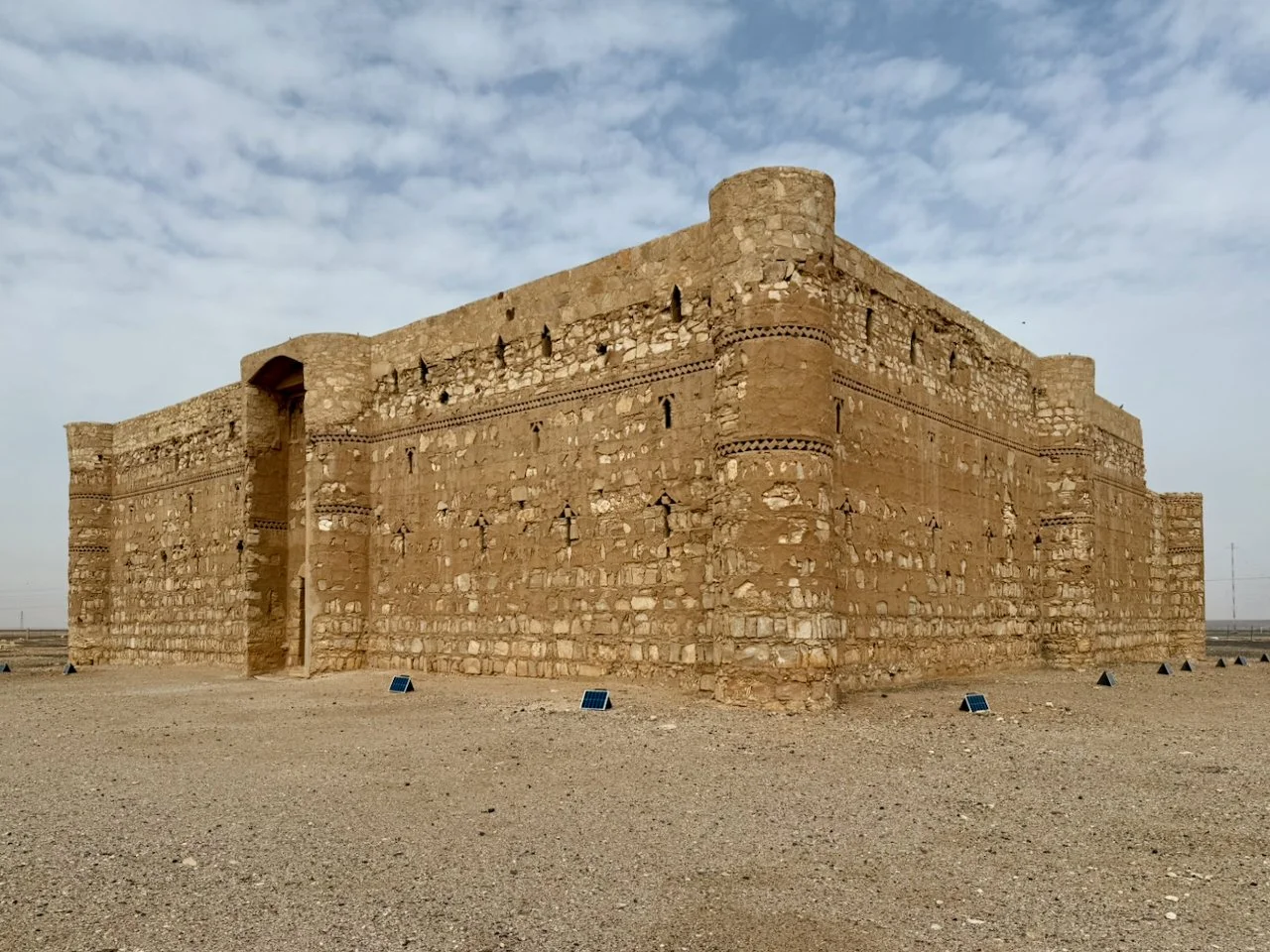
Qasr al-Kharana.
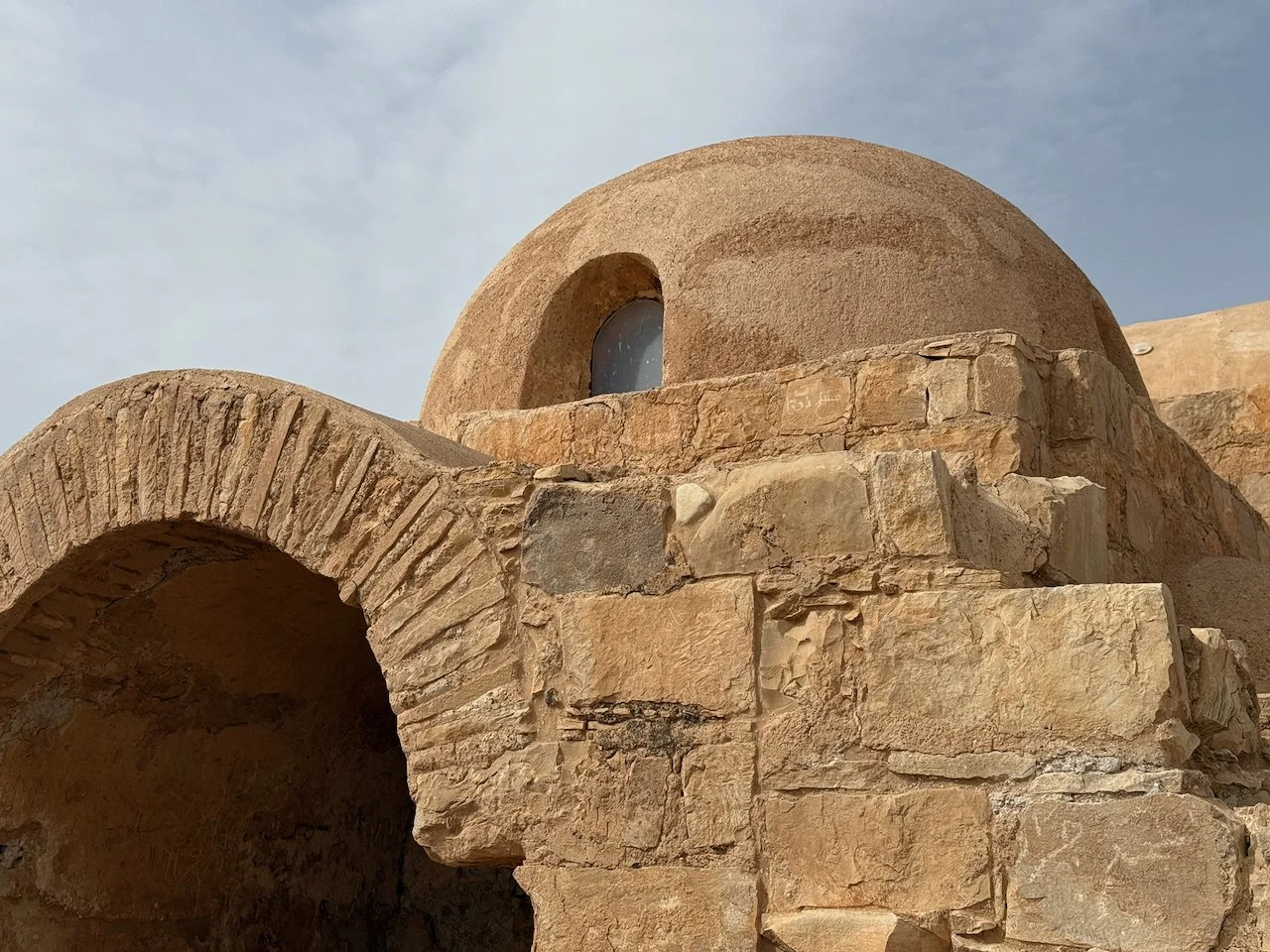
Quseir Amra’s dome and arch.
Our next castle stop was also not a castle but a hammam or bathhouse: Quseir Amra is a beautiful little 8th century building adorned with domes and arches. It wouldn’t look out of place on the Star Wars desert planet Tatooine. We went into the small office next to the car park to have our Jordan Pass stamped, then walked along the path to the building. I went off-piste to look at some plants growing in a dried-up pond, and frightened lots of funny-looking, long-legged darkling beetles, causing them to scurry into the bushes.
I looked around the outside of the building, the only part of a larger palace complex remaining. H asked me if I’d been inside. I hadn’t, and possibly wasn’t even going to bother until she told me I ought to. Naturally, we hadn’t looked in the guide book to prepare us for the breathtaking frescoes that adorned every surface of the interior. There were depictions of hunting scenes, animals, birds, plants, working craftsmen, musicians, dancers and even, well, it looked like an almost naked, certainly topless woman emerging out of a bath, and other barely clad ladies too.
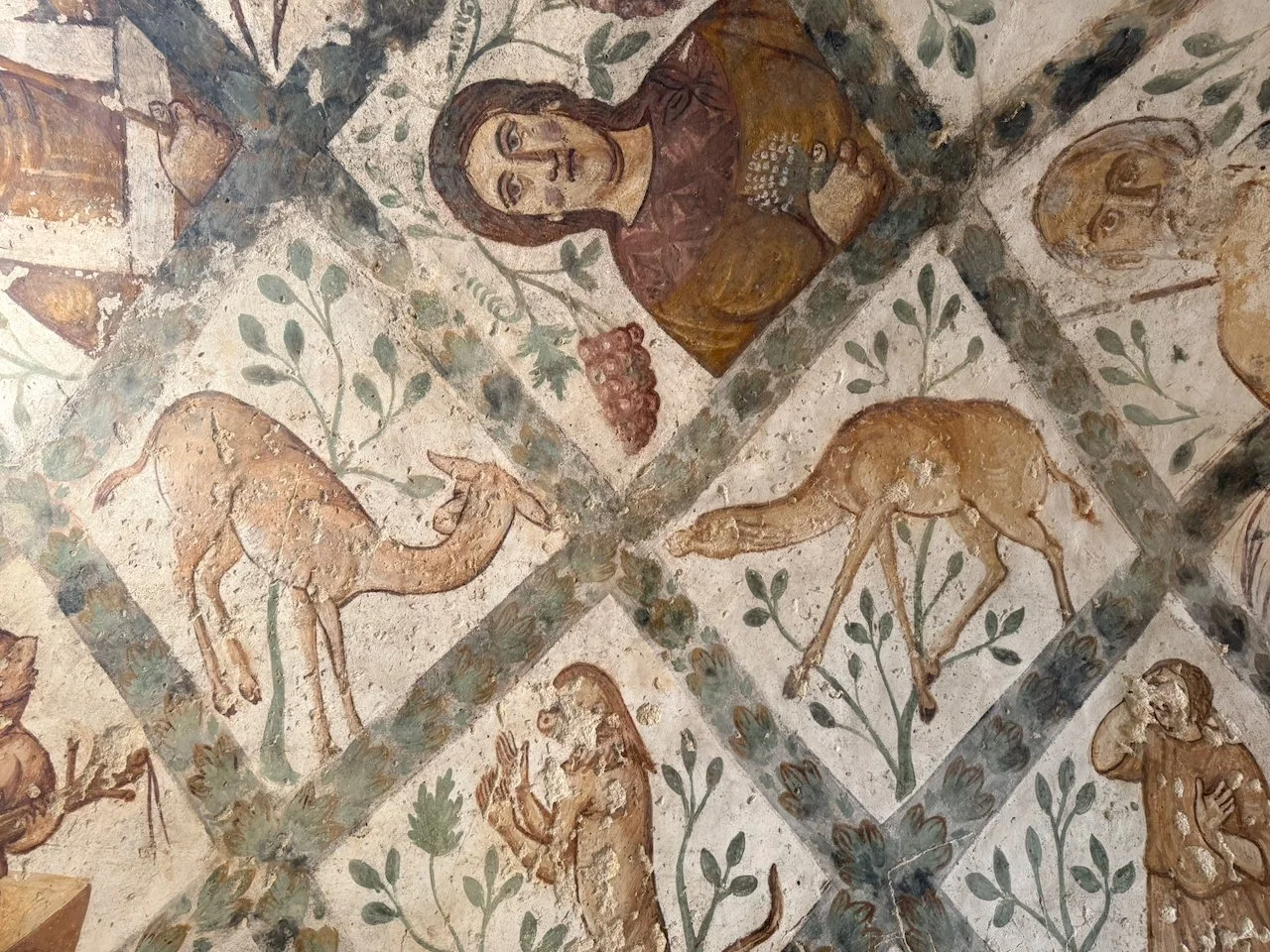
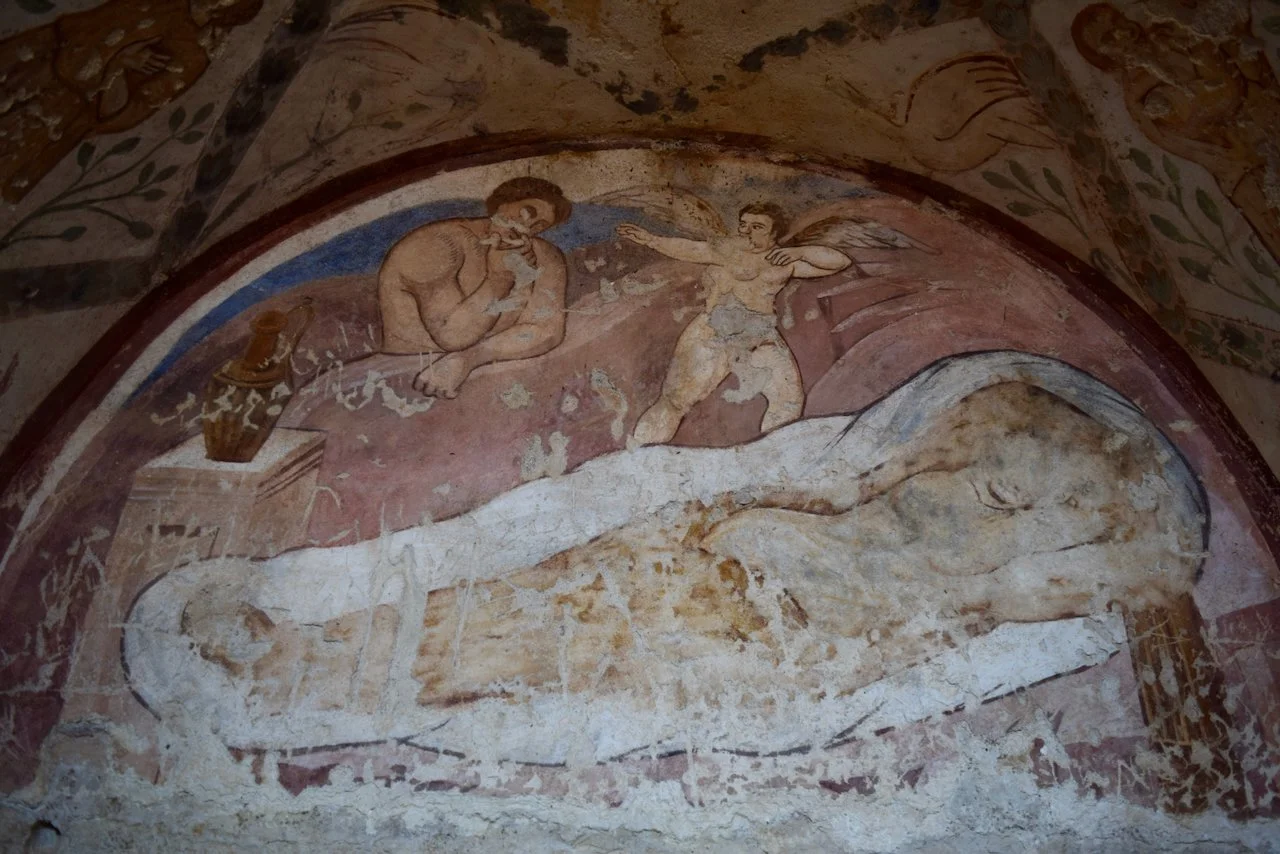
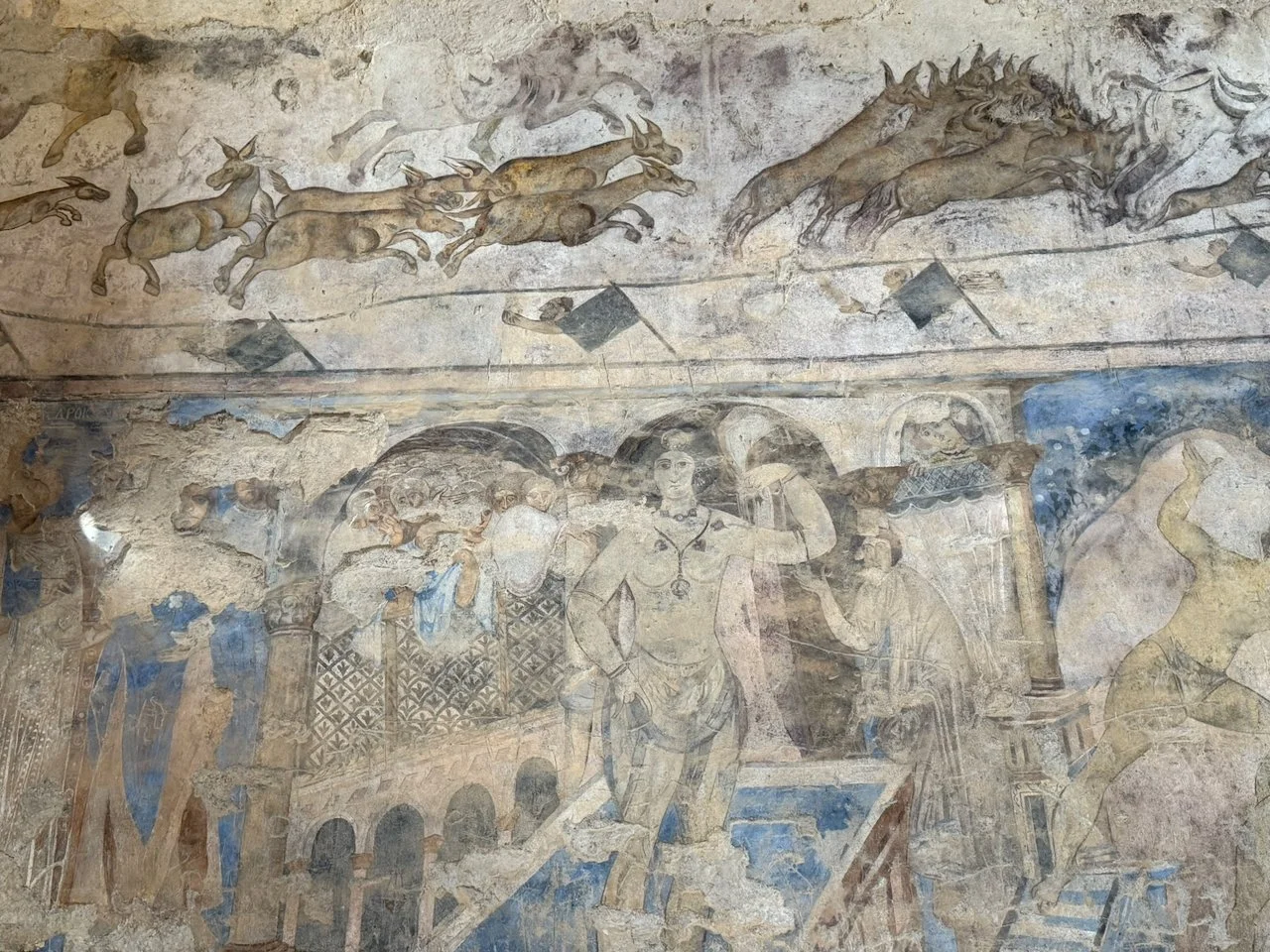
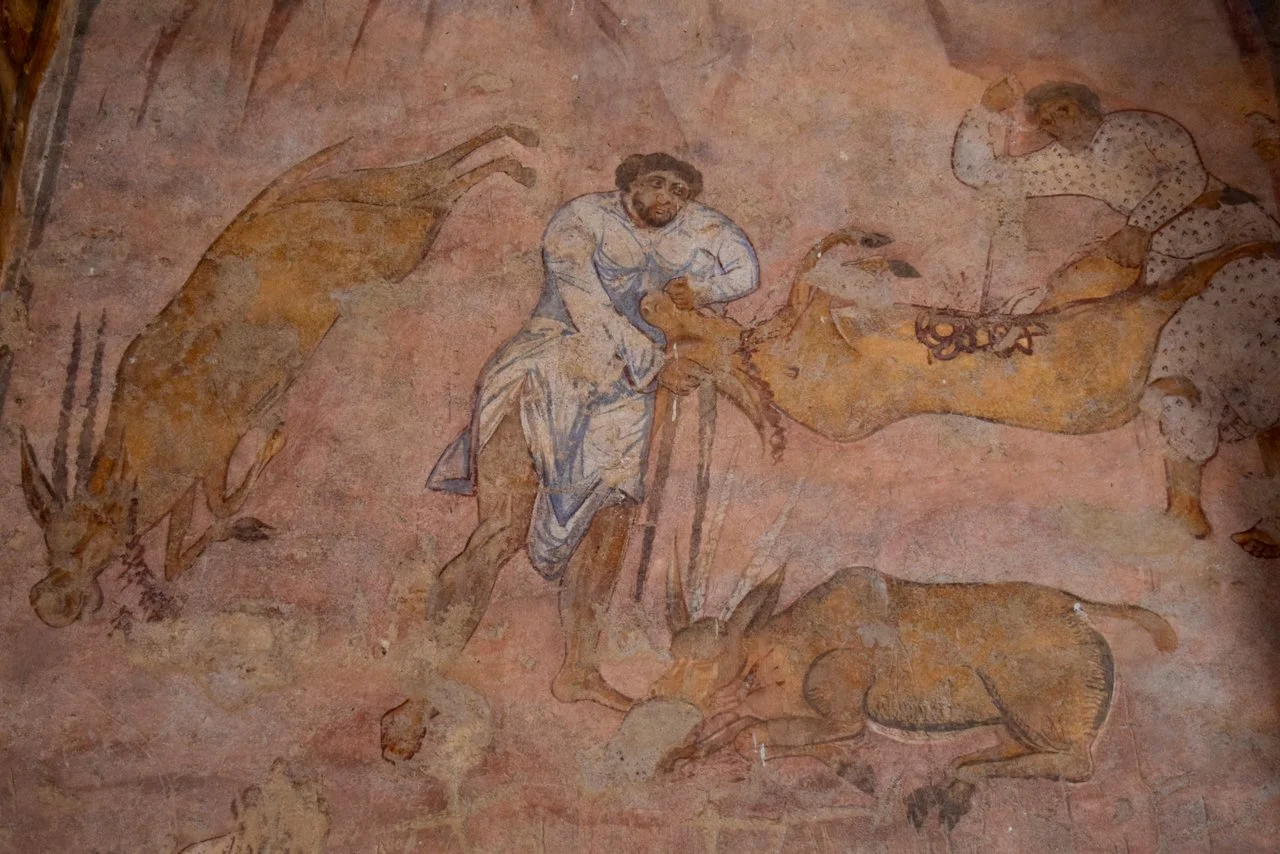
It was hard to believe the paintings were Islamic – traditionally, painting human or animals in Islamic art is forbidden (known as aniconism) as, you know, only God has the right to create such forms. Hence art is Islamic countries has such a rich history of geometric patterns. However, there are of course numerous exceptions, including these frescoes, created for Prince Al Walid II towards the end of the Umayyad period, the first hereditary Islamic dynasty dating from 661–750 CE. By all accounts the prince enjoyed doing exactly what was painted on the walls: womanising, drinking wine, desert hunting and poetry. And who could blame him?
Our next stop actually was a castle: Qasr al-Azraq, the blue in its name taken from the blue water of the nearby oasis, now rebranded as a wetland reserve. ‘Used by Lawrence’ says the plaque outside the entrance, and like Madonna or Jesus, he only needs the one word. He is, of course, T. E. Lawrence, more famously known as Lawrence of Arabia, and we would see many places where the officer, archaeologist, diplomat and writer lived, stayed or fought.
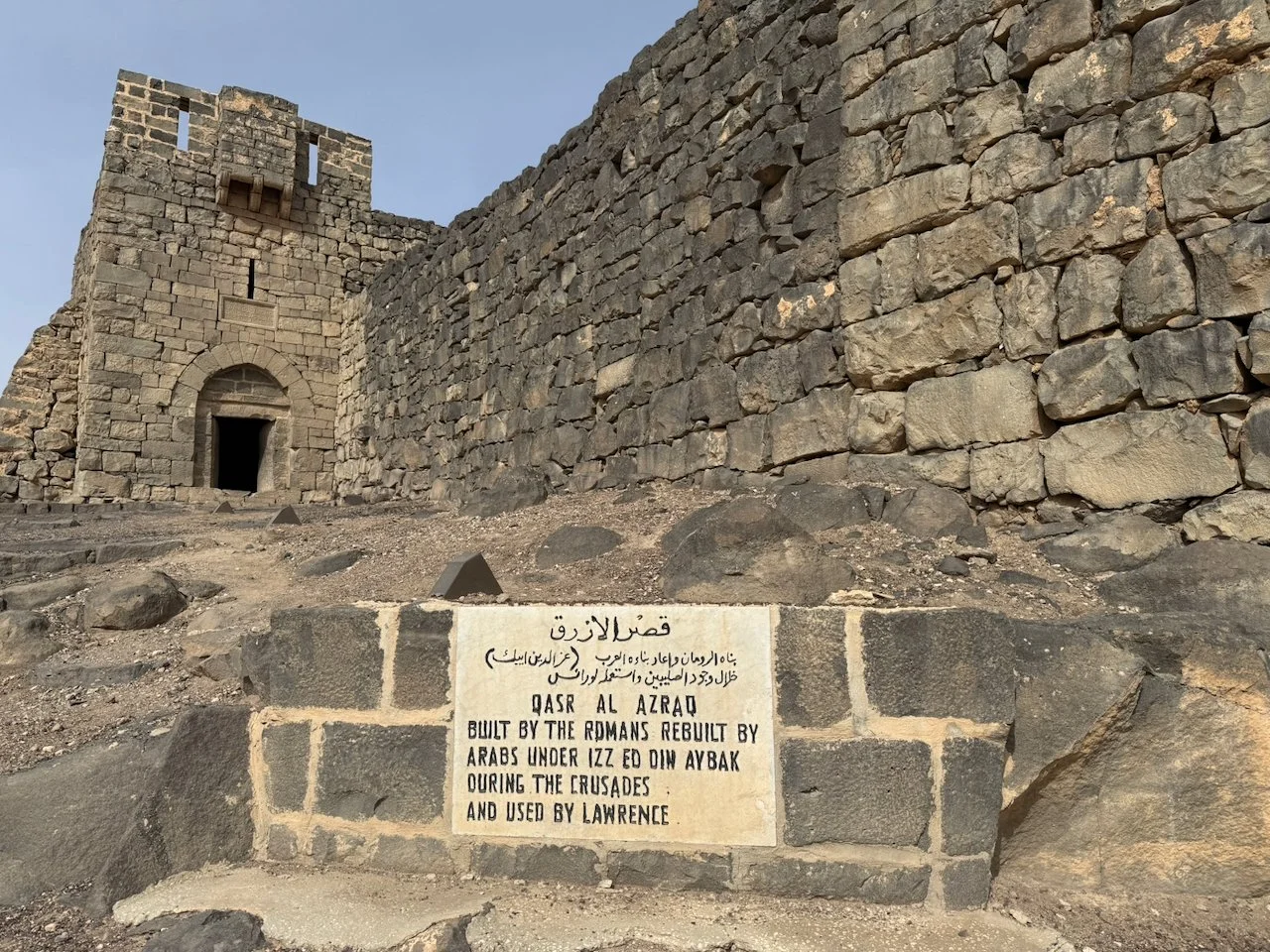
Lawrence woz ere… Qasr al-Azraq.
Built in the distinctive black basalt rock of the area, the castle is fascinating for the various civilisations who have inhabited it: first the Nabataeans, then Romans, Byzantines, Umayyads, Ayyubids, Ottomans, with Lawrence himself holed up there in the winter of 1917, and finally the Druzes. Each empire customised the fortress to fit their needs, a form of recycling I thoroughly approve of. We would encounter this technique in many places in Jordan.
By now Abood (who up until now waited patiently – napping or scrolling – in his car whilst we spent as much time as we wanted in each location) was getting fed up and tried to put us off the next location on the itinerary. I had wanted to go to the ruined town of Umm al-Jimal but Abood dismissed it with a wave of his arm as “the same as Azraq” (this is despite it being on the itinerary and us having paid for it). It’s true it was built with the same black rock but al-Jimal was a whole village with some 150 buildings and al-Azraq a single fortress. He begrudgingly agreed to take us, though neither H or I knew how far it was and it ended up taking at least an hour. Still, it was worth it.
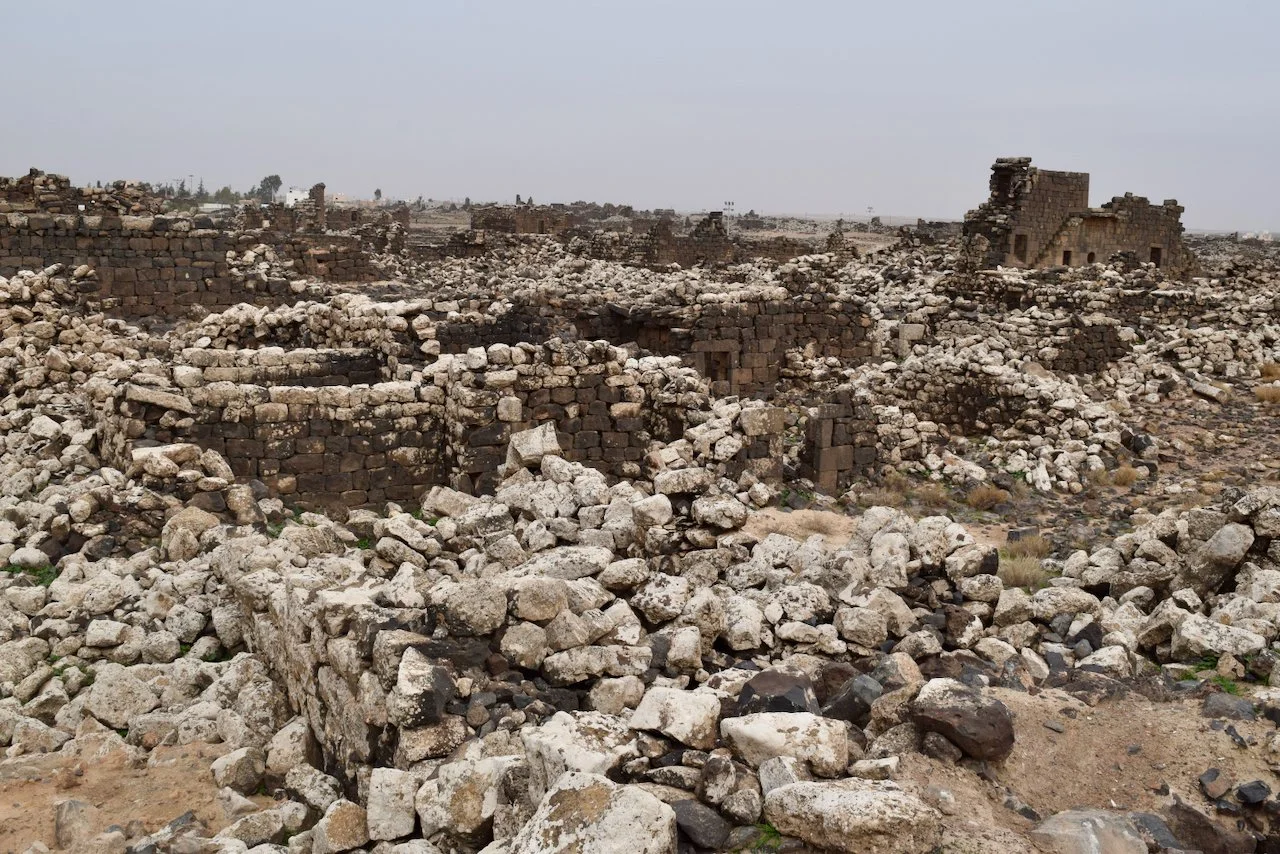
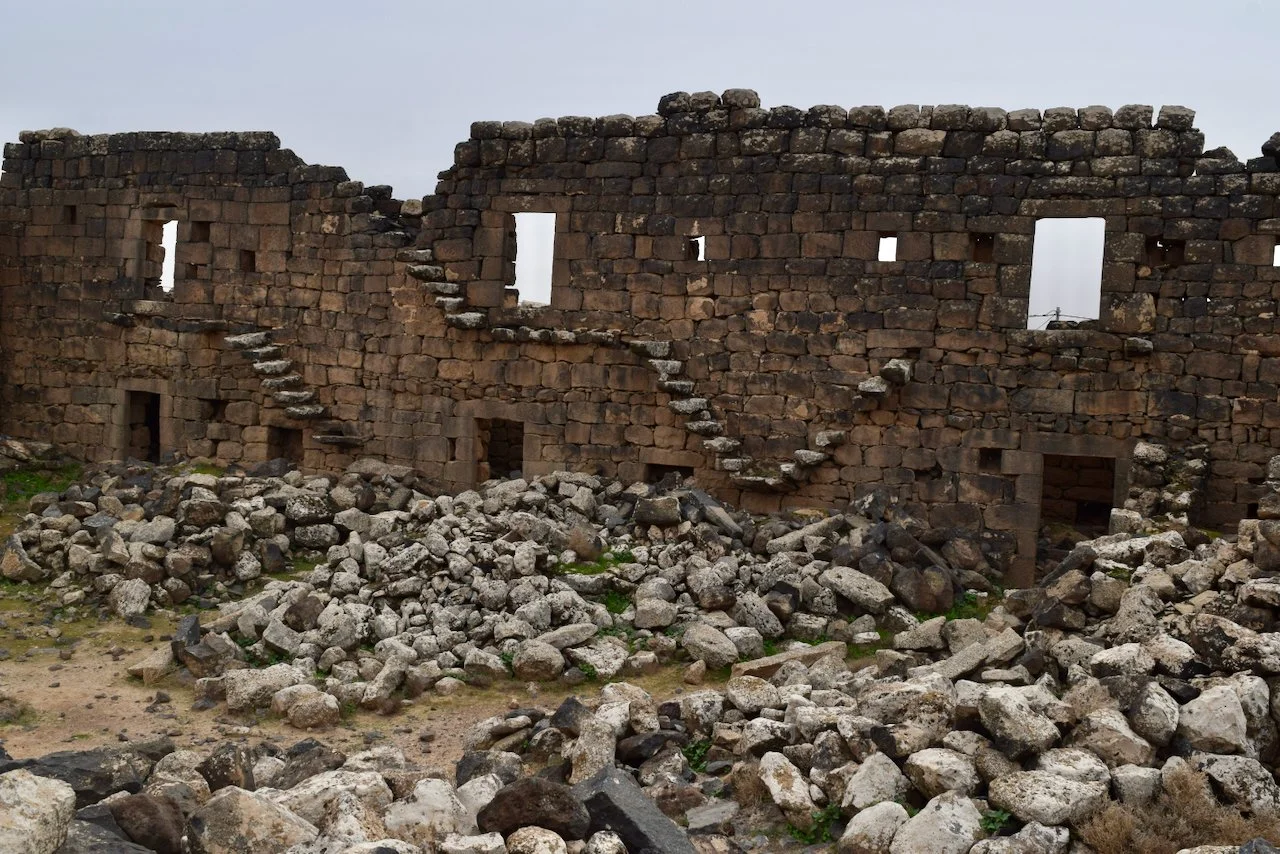
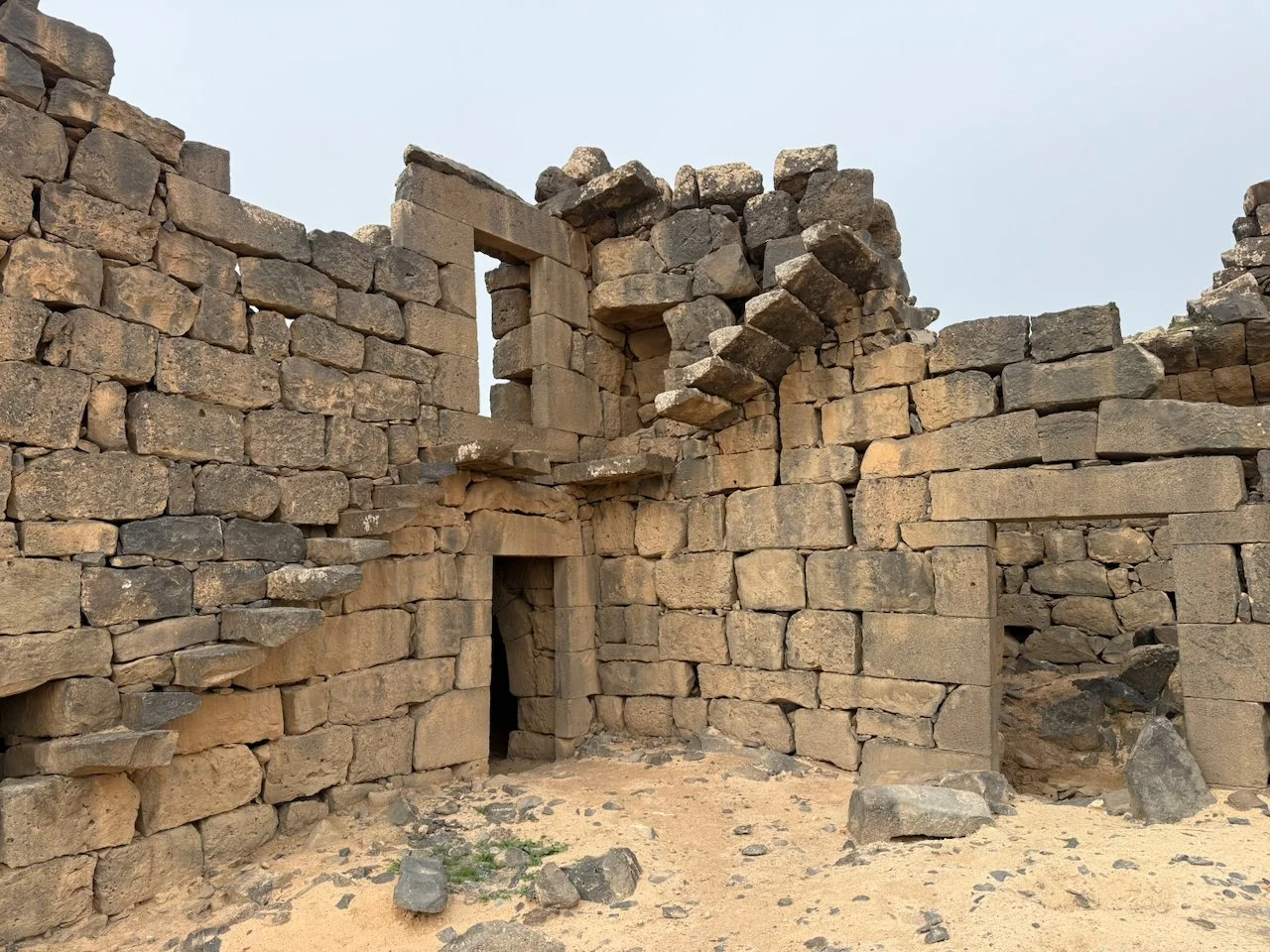
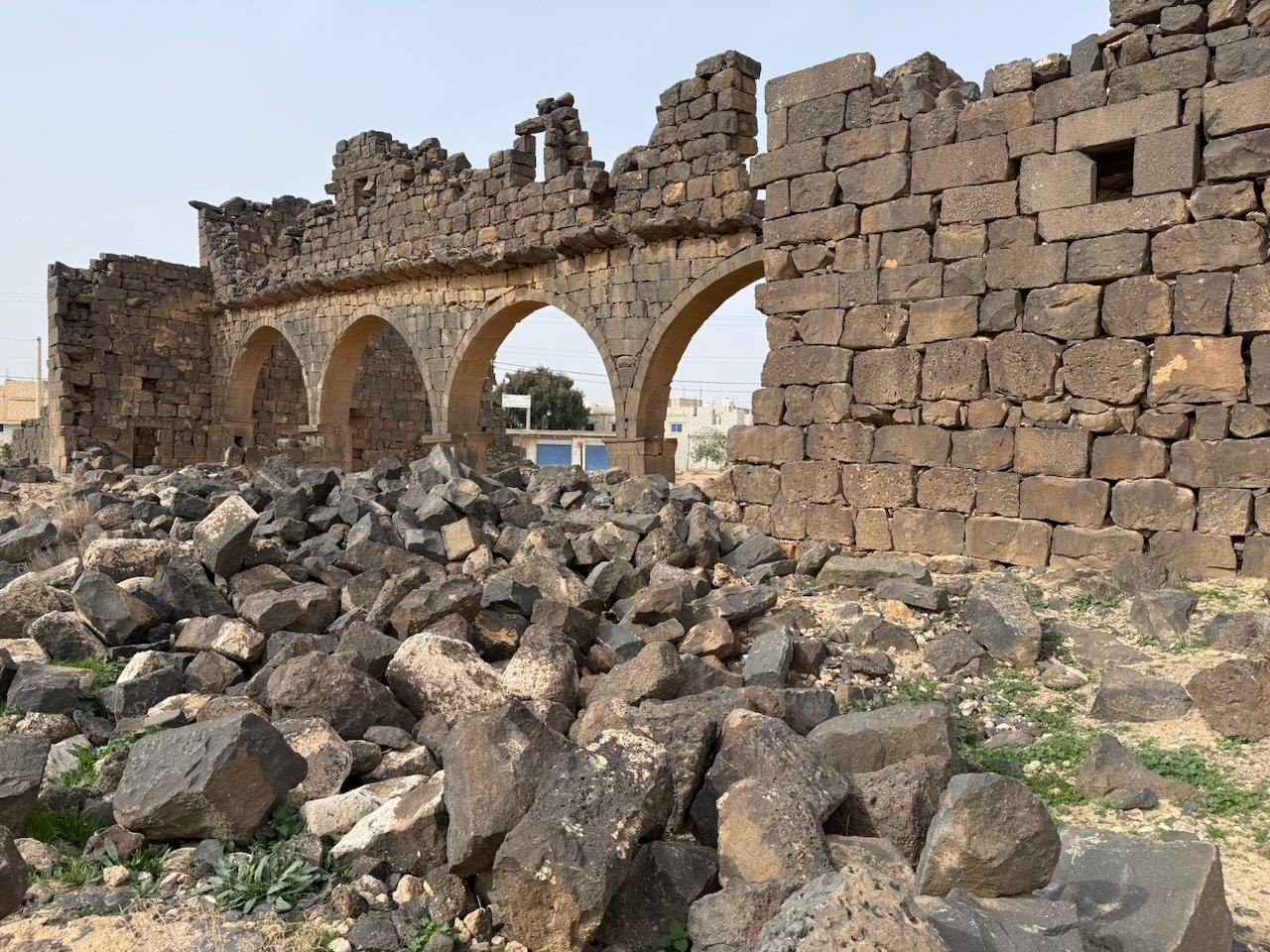
Umm al-Jimal is just four kilometres from the Syrian border (luckily, as at three kilometres our travel insurance would have been invalidated). It is essentially a huge area of rubble (with some walls, arches and staircases still remaining), as the whole town had been severely damaged in two earthquakes, one in A.D. 749. It immediately reminded me of photos of the ruined Charleston from the American Civil War. The black basalt rock had the look of being burnt.
We walked around the complex, eventually talking to a Jordanian who spoke good English, not exactly a guide (as we thought at first), but an archaeologist. Muaffaq spoke to us about the site as we walked around it (we couldn’t believe bits of pottery we could pick up from the ground were 1000, 2000 years old), and also his life, for about an hour or so. He has worked at Umm al-Jimal since he was a child, so it’s been a lifelong project. He said he knows every rock, every piece of pottery. He studied in Jordan and Germany, and still lives in the modern town that surrounds the ruin with his wife and children.
Again, every ruin we went to I was expecting snakes and lizards to appear. I kept on giving them the chance: ‘You’ve got sun, stones to bask on, places to hide, grass, come on, it’s time to appear’, I’d say, but they never did.
We had spent hours walking around the complex, and felt bad for Adbood waiting so long, so I went over to his car, woke him up, and asked him to join us for coffee. He leaped out of the car, thanked me profusely, putting his hand on his heart, then shook my hand, but declined the coffee. ‘Enjoy yourself, no problem.’
On our way back we asked Adbood if he recommended anywhere to eat. Even though he dropped us off right outside the restaurant, it nevertheless sounded complicated to enter – go upstairs here but the restaurant is over there somewhere. Anyway, we went in the wrong restaurant, the owner surprised to see us, the menu all in Arabic and customers all locals, but still, it was fine, we ate the usual bread-hummus-falafel-chips-salad then went for a walk to find the famous Amman Citadel, closed but I just wanted to get a glimpse at it – one of those things we promised ourselves we’d see at some point, then never got around to.
(Perversely and inexplicably we sometimes found ourselves comparing Jordan to Cornwall – the black basalt rocks of Umm al-Jimal reminded us of Roche Rock, and the arches and columns of the Roman ruins reminded us of some Cornish tin mines, like Geevor. The weather was the main thing it didn’t remind us of – it had been raining in Cornwall every day for 40 days; we were in a Biblical land, but Cornwall’s weather was proper Biblical. The weather in Jordan was blissful – I’d been warned of cold, snow and rain as it was so early in the year, but it was continually sunny yet mild, just perfect).
Tuesday 10th February 2026
We agreed to meet Abood, our driver from yesterday, half an hour later this morning but he was still late. Today we were going down the ancient King’s Highway all the way to Petra. This route is far more scenic than the more direct Desert Highway plus has various interesting stopping off points – castles, towns, vistas etc. Our first stop off was Mount Nebo – the location where Moses supposedly died. Actually we’d double-booked, as were coming back here in a few days, so we didn’t go in the church but followed a Christian pilgrimage path down the hill for a bit, looking at the views, flowers, caterpillars and plastic bags poetically blowing in the wind.
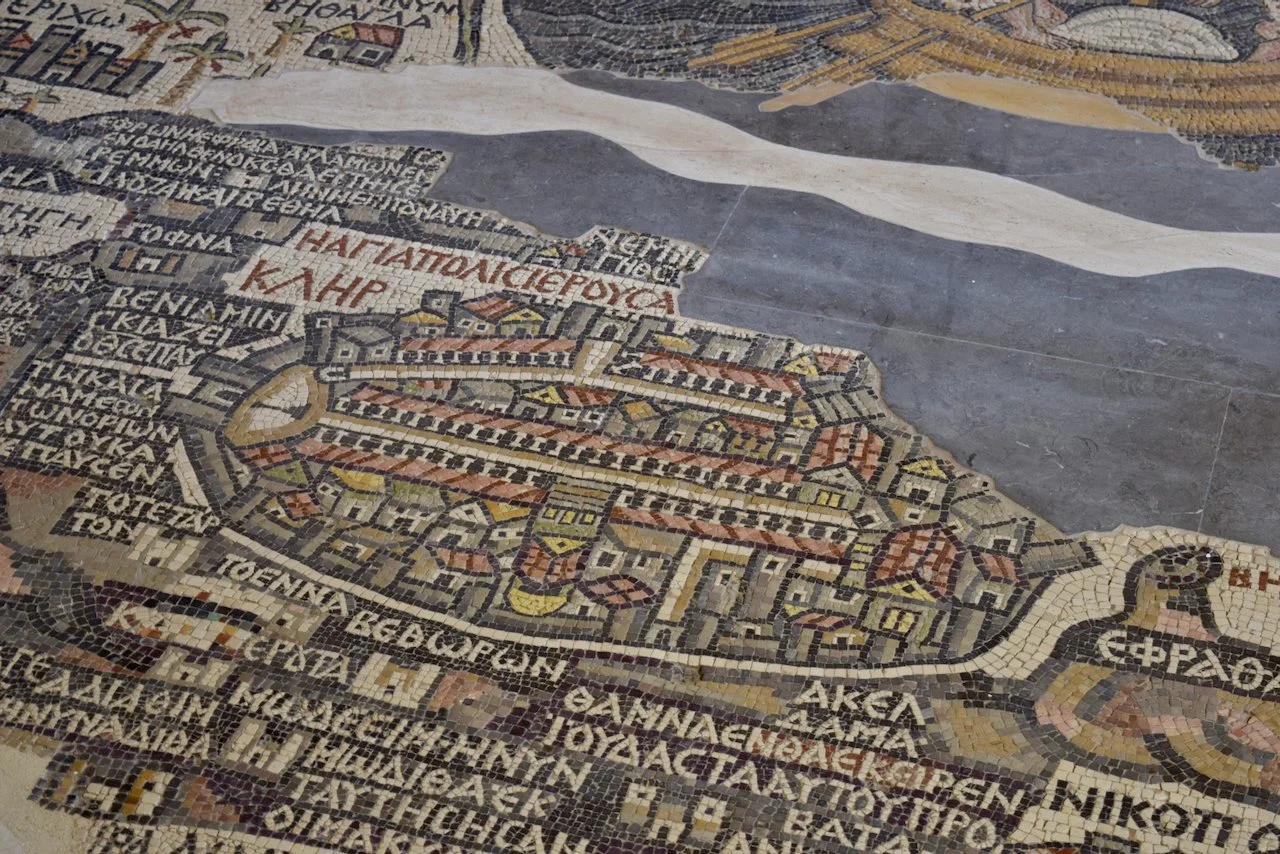
Detail of the 6th century mosaic map of the Holy Land, and (below) some mosaics at the Burnt Palace.
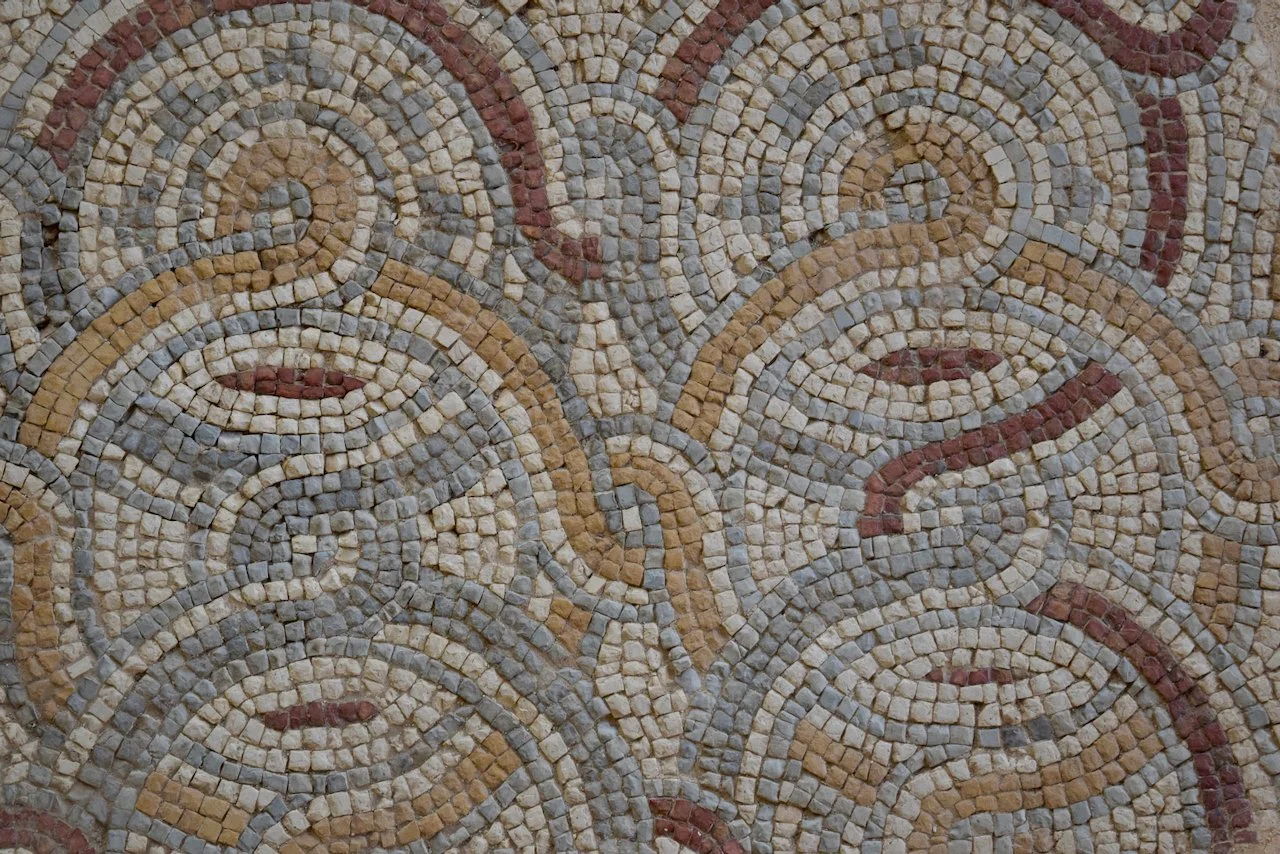
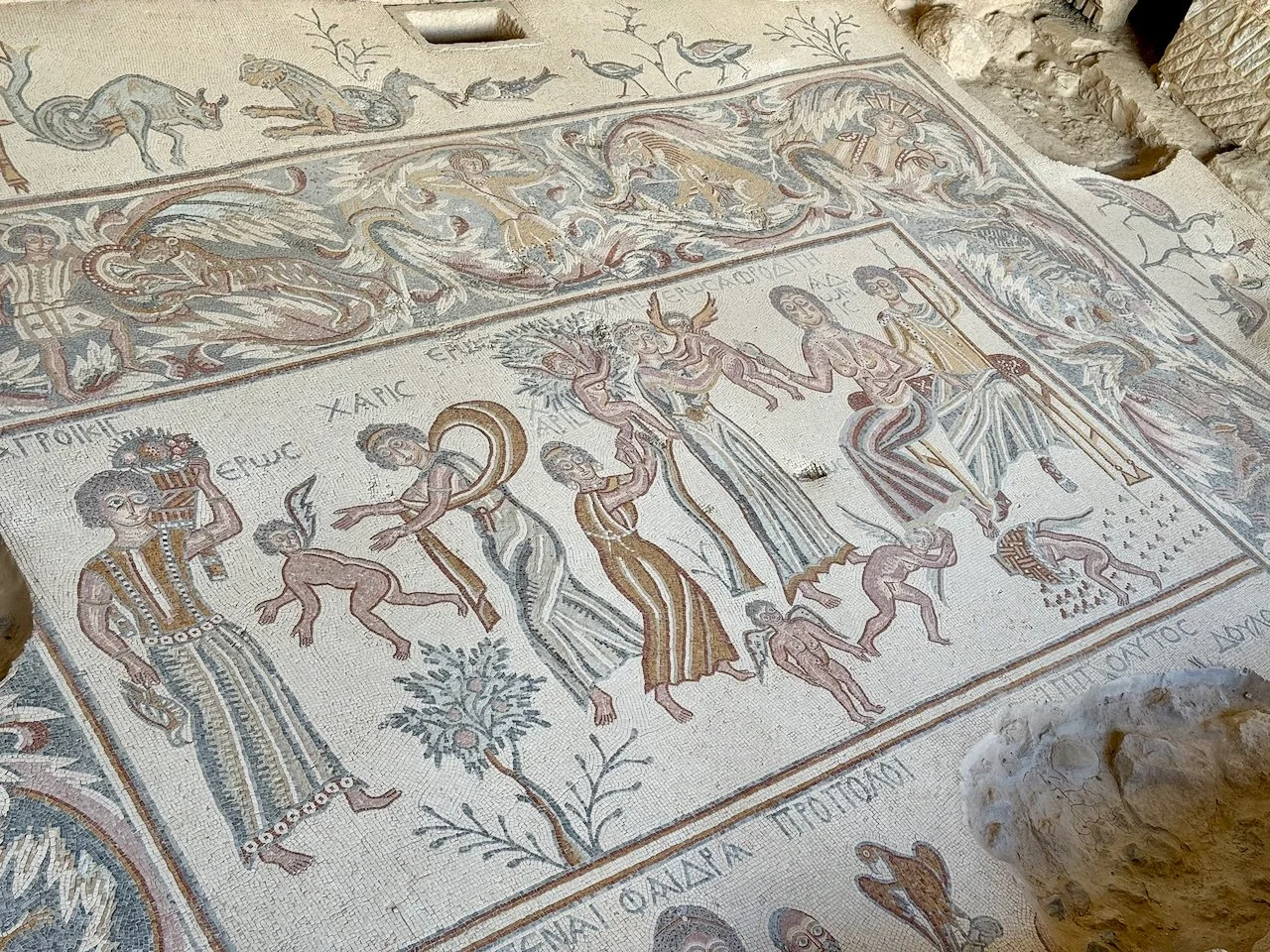
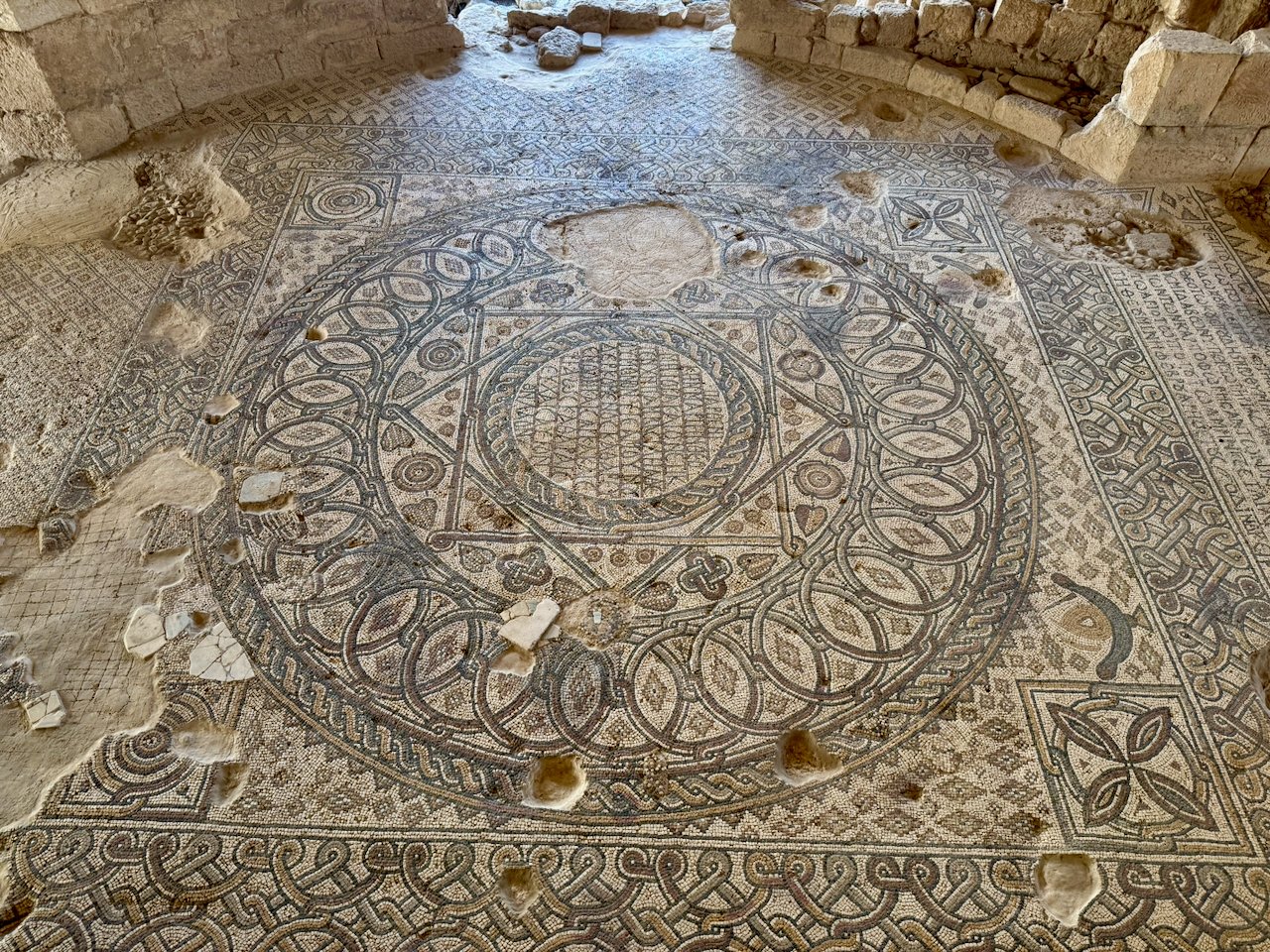
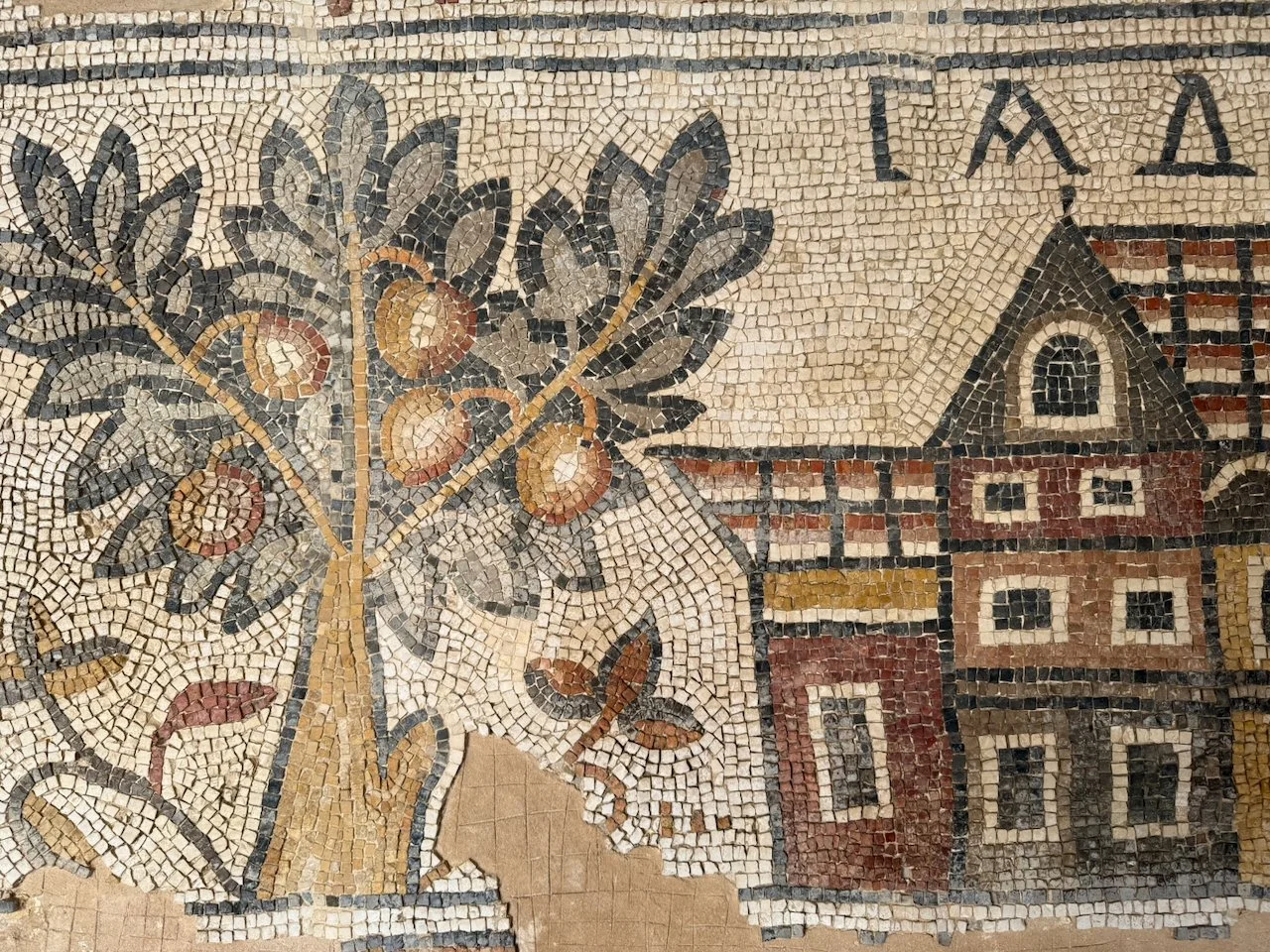
Next was Madaba, a charming little town famous for its mosaics and in particular a 6th century mosaic map of the Holy Land in St George’s Church, the oldest map of its kind in the world. This was the main focal point of the town, the only spot where tourists went. We gave ourselves an hour in the town to explore other mosaics in the area, many of them far more extensive than the map, such as at the Burnt Palace (where H had her name written in Arabic by the friendly guy at the ticket booth) which has several floors spanning a large courtyard of Byzantine-era mosaics with amazing patterns, animals and human figures.
We grabbed some crisps and drinks afterwards in a little supermarket where the man behind the till kindly, and patiently, explained Jordan’s coins to us; we’d had no idea of the denominations.
We were then taken to one of many mosaic workshops in the area; after a quick tour of the young, disabled people in the workshop who create the work from templates (I cynically immediately thought we’re being shown the disabled workers so we’d buy something out of sympathy), we were taken around a massive showroom. The work is amazingly intricate, if slightly tacky, we obviously weren’t going to buy anything. They need to change their style, maybe some in the style of the French artist Invader, famous for his Space Invader retro-80s pixel graphics. Mosaics are obviously the perfect technique for it.
We stopped at a viewpoint where I got a Turkish coffee – which we had all the time in Jordan; black, strong, spicy and so thick and grainy you could stand your spoon up in it – from the authentic ‘Aldi’ Bedouin coffee shop (a German tourist had told them about the ubiquitous supermarket chain and they’d run with it).
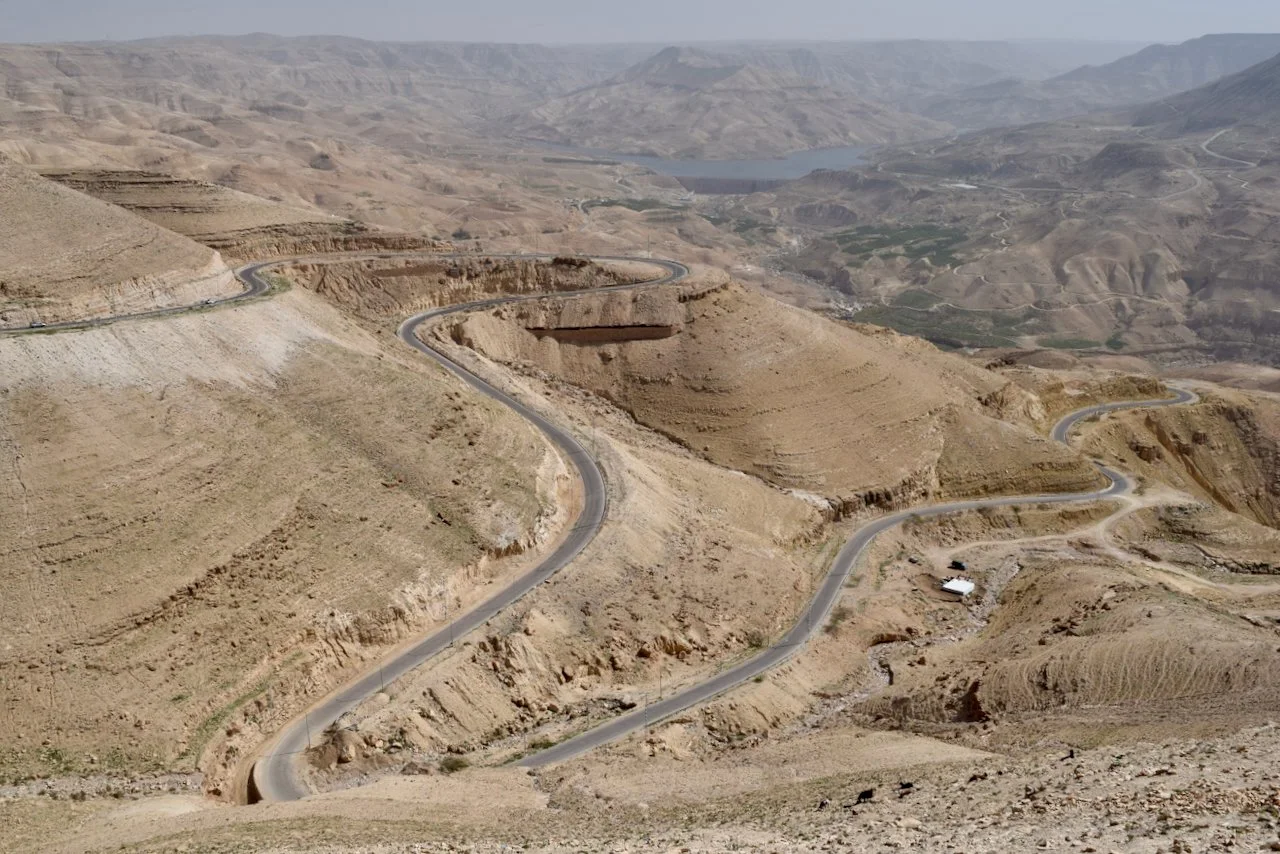
From the Wadi Mujib viewing platform, the twisty King’s Highway. The dam can be seen in the distance.
Next was a ‘photo stop’ at Wadi Mujib Dam. Of all the places. I don’t know why we stopped, I didn’t give a… dam. Abood said something about a lot of water. Yes, it was true. I was far more excited and did get him to stop five minutes later, however, when two herds of sheep and a couple of shepherds were wandering on the road. We got out, Abood never seemed to mind stopping, but it meant we would spend less time elsewhere, i.e. places where tourists go.
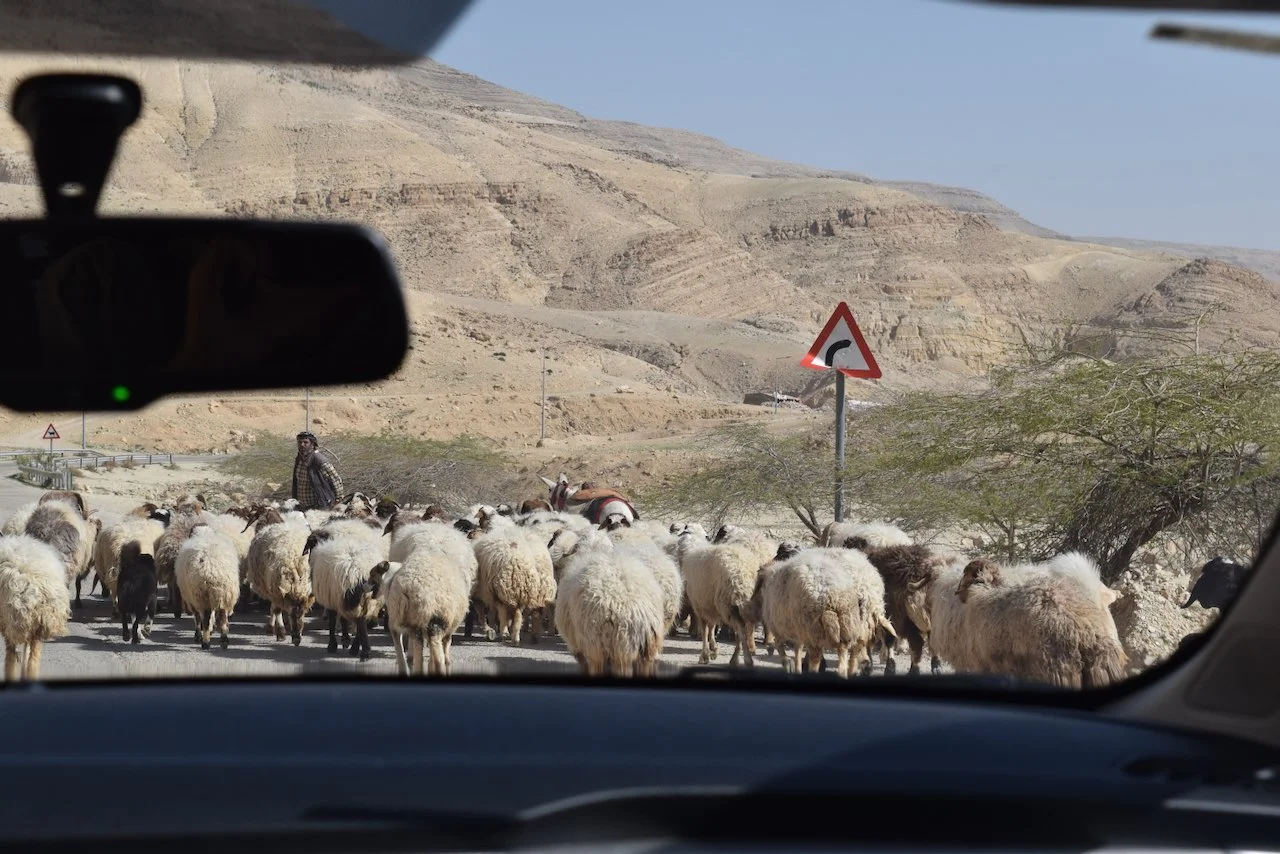
Sheep on road, Wadi Mujib.
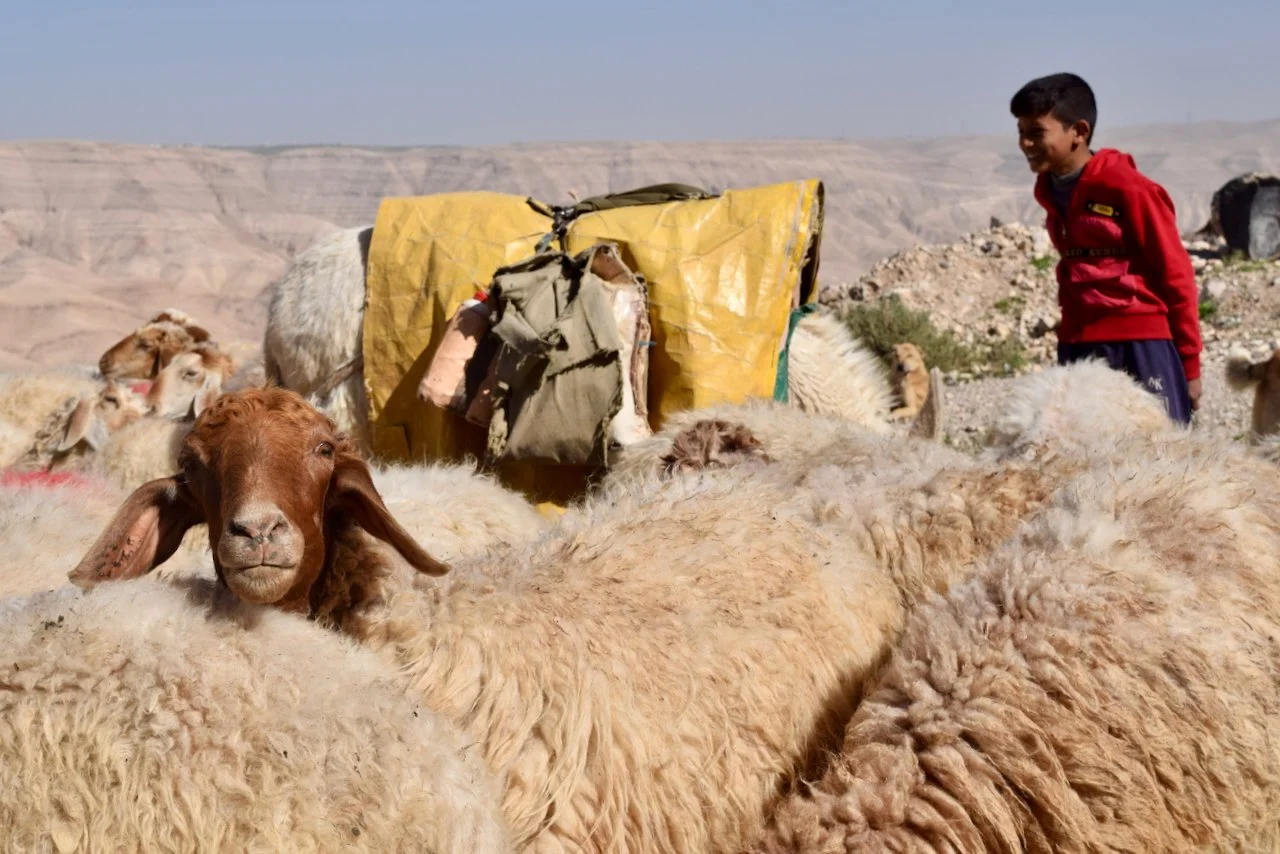
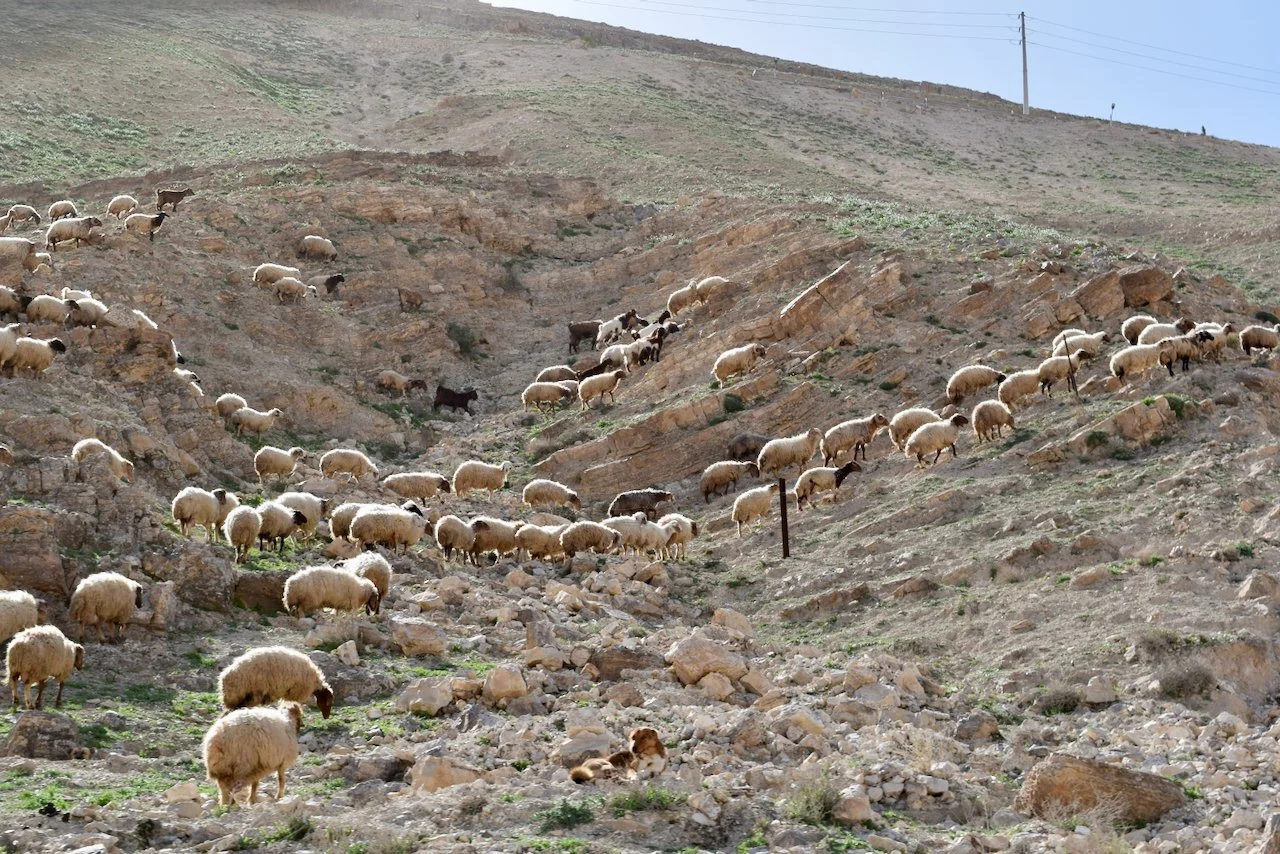
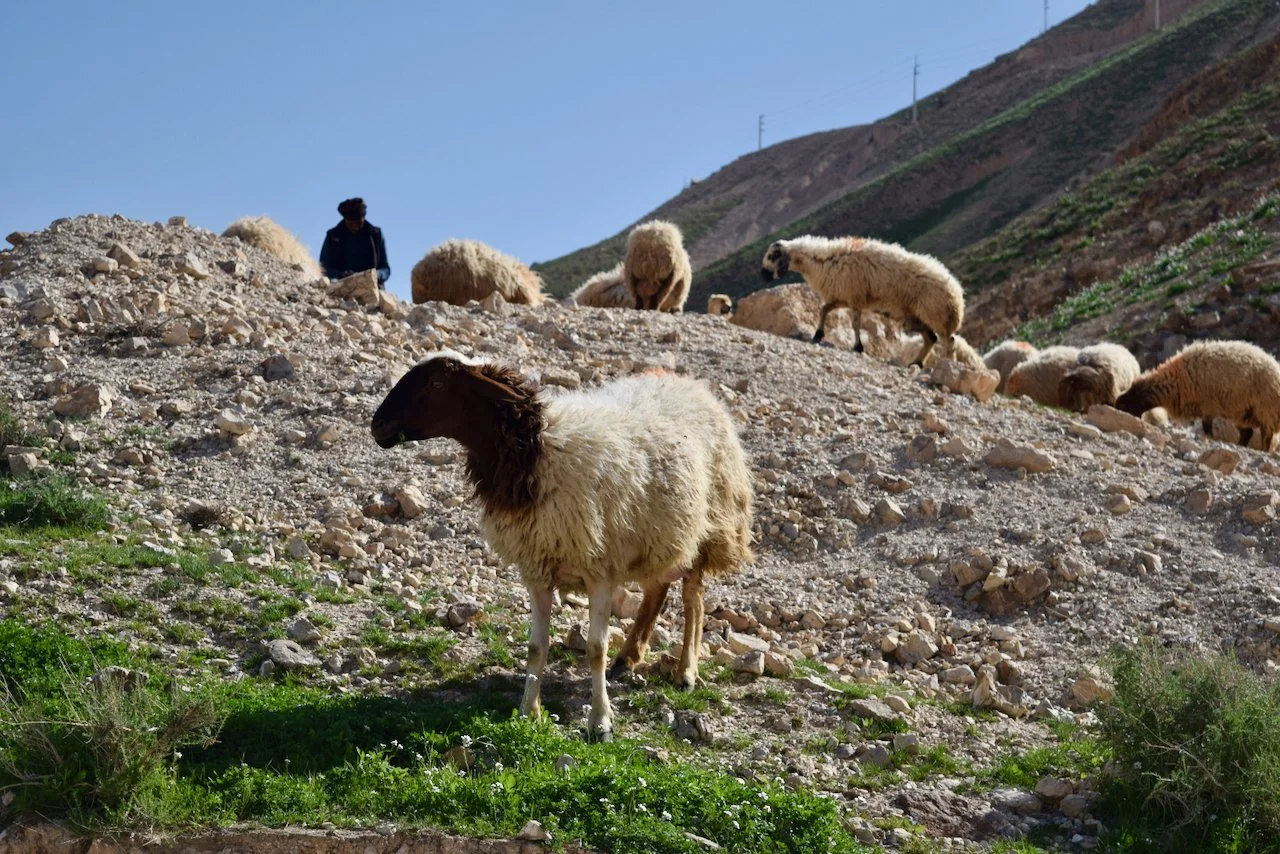
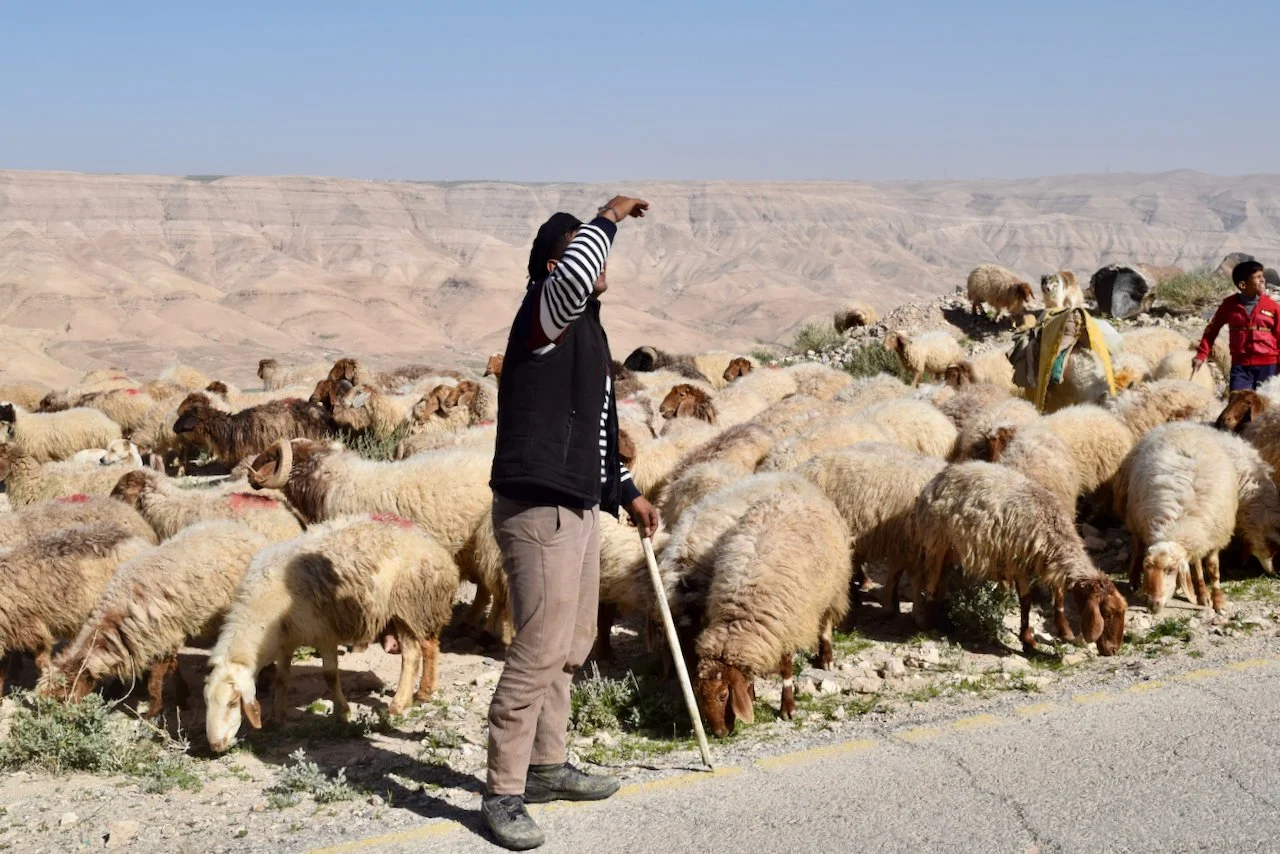
Nevertheless, we spent ages at our next stop, Kerak Castle, a large, medieval, labyrinth of a building, and great for exploring. Then Abood drove like a nutter to get us to some valley for sunset (I was unimpressed, obviously), then onto Shobak Castle; we didn’t have time to go inside but got a good view of it.
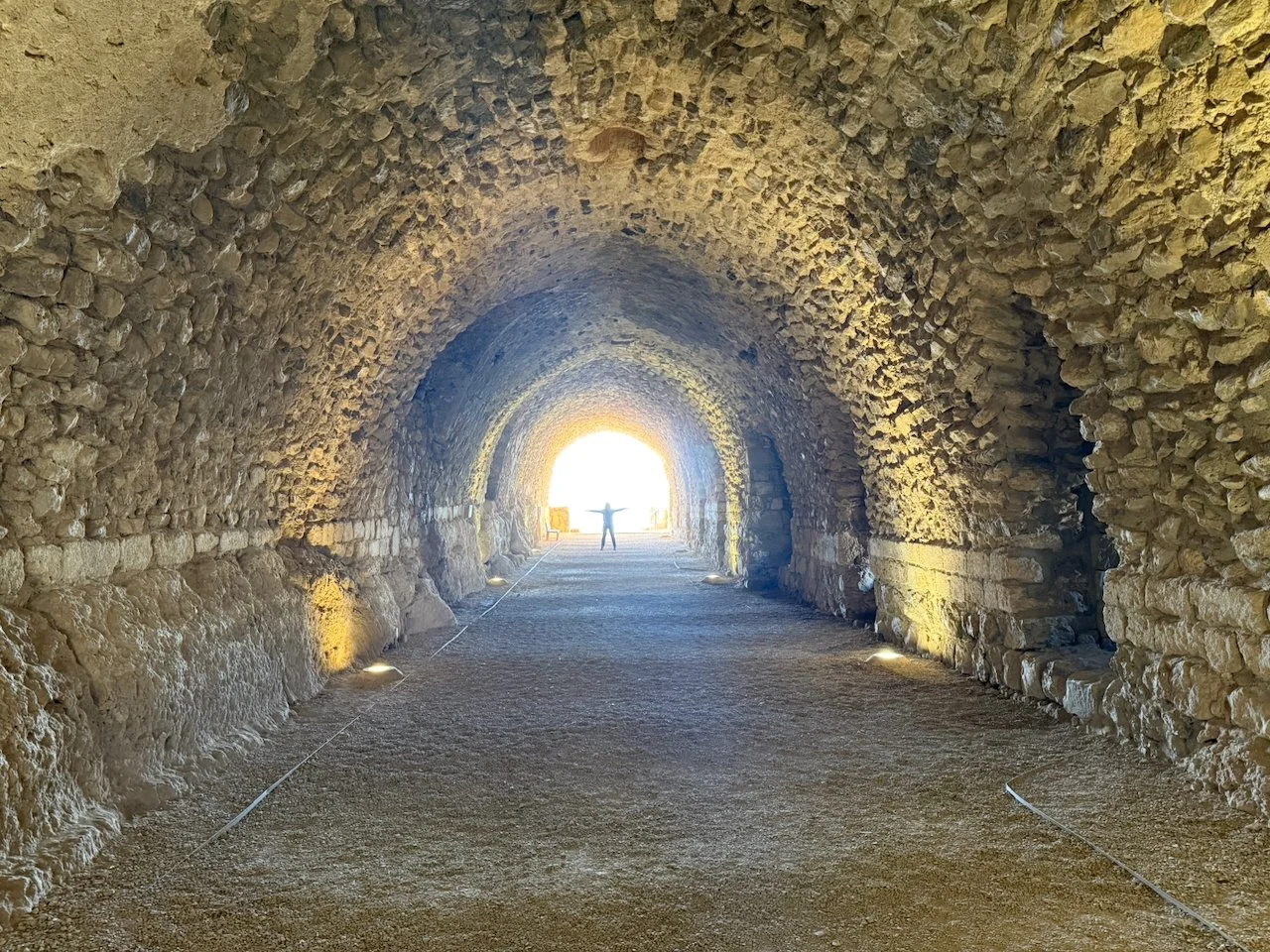
One of the many tunnels in Kerak Castle.
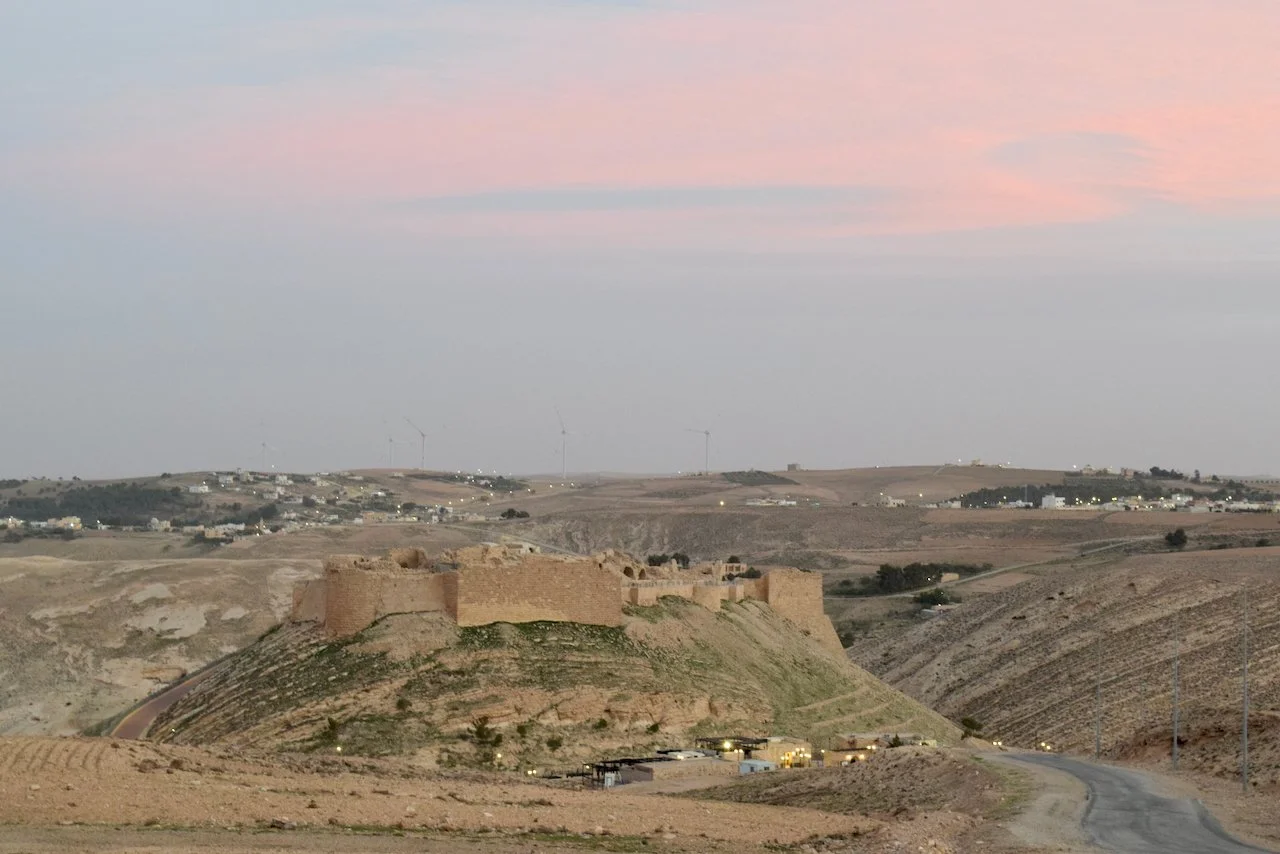
View of Shobak Castle.
I’m not that interested in ‘panoramas’ (as the drivers liked to call viewpoints) or sunsets (especially photographing them) – they all look the same to me. All the drivers, tour guides and hotel owners think all white people want to do is look at boring ruins. Obviously we do, but can’t we do other stuff too? (I can’t decide who are the unimaginative ones, us or them.) I want a tour guide on plastic bags, roadside fruit and vegetable stalls, camels, cats, bus stops, abandoned coffee shops, patterns on pickup trucks (see below), modern ruins… I may sound pretentious but I’m going to say it anyway: I’m all about the places in between the sights, that’s really all I care about (probably only because no one else does). I couldn’t really get the drivers to stop at everything I wanted to photograph (sheep and camels were bad enough, but bus stops? Closed down coffee shacks? Shanty towns? No.), besides, we would have run out of time to see the things we had paid to see, castles and all that stuff for tourists. (I know, the obvious solution is for me to hire a car and stop where I want. I haven’t driven for years but who knows, I might just do that one day.)
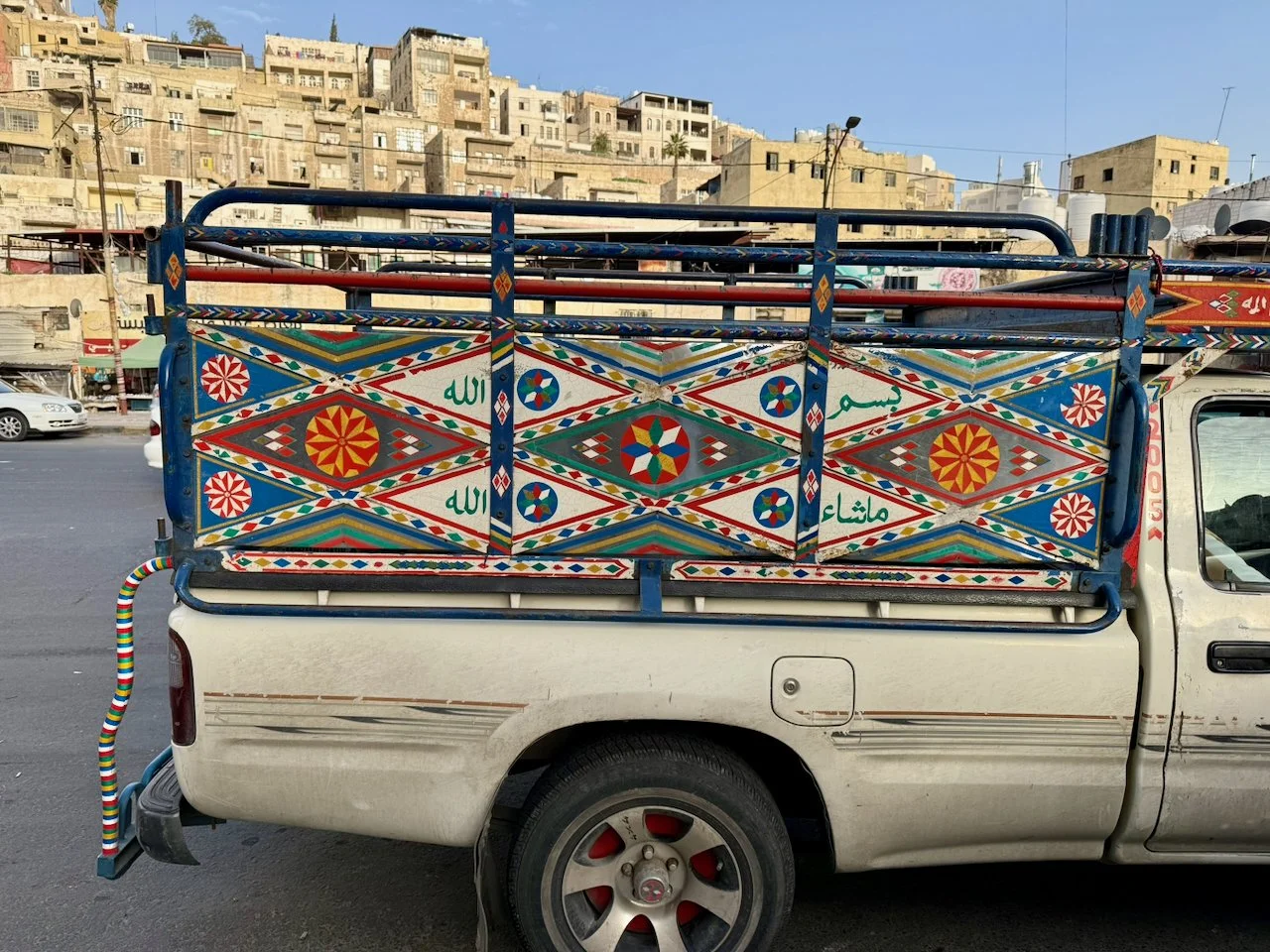
Pattern on pickup truck, Amman.
We arrived very late in the town of Petra, and just couldn’t find our hotel, despite maps, phone calls and asking people. We drove round and round half a dozen times until we were finally able to find the place. Luckily it was worth it, our room was decked out like something from One Thousand and One Nights, and the staff friendly. We walked into town and found a cheap sandwich shop and had a falafel, chips and salad wrap, divine for a few dinah.
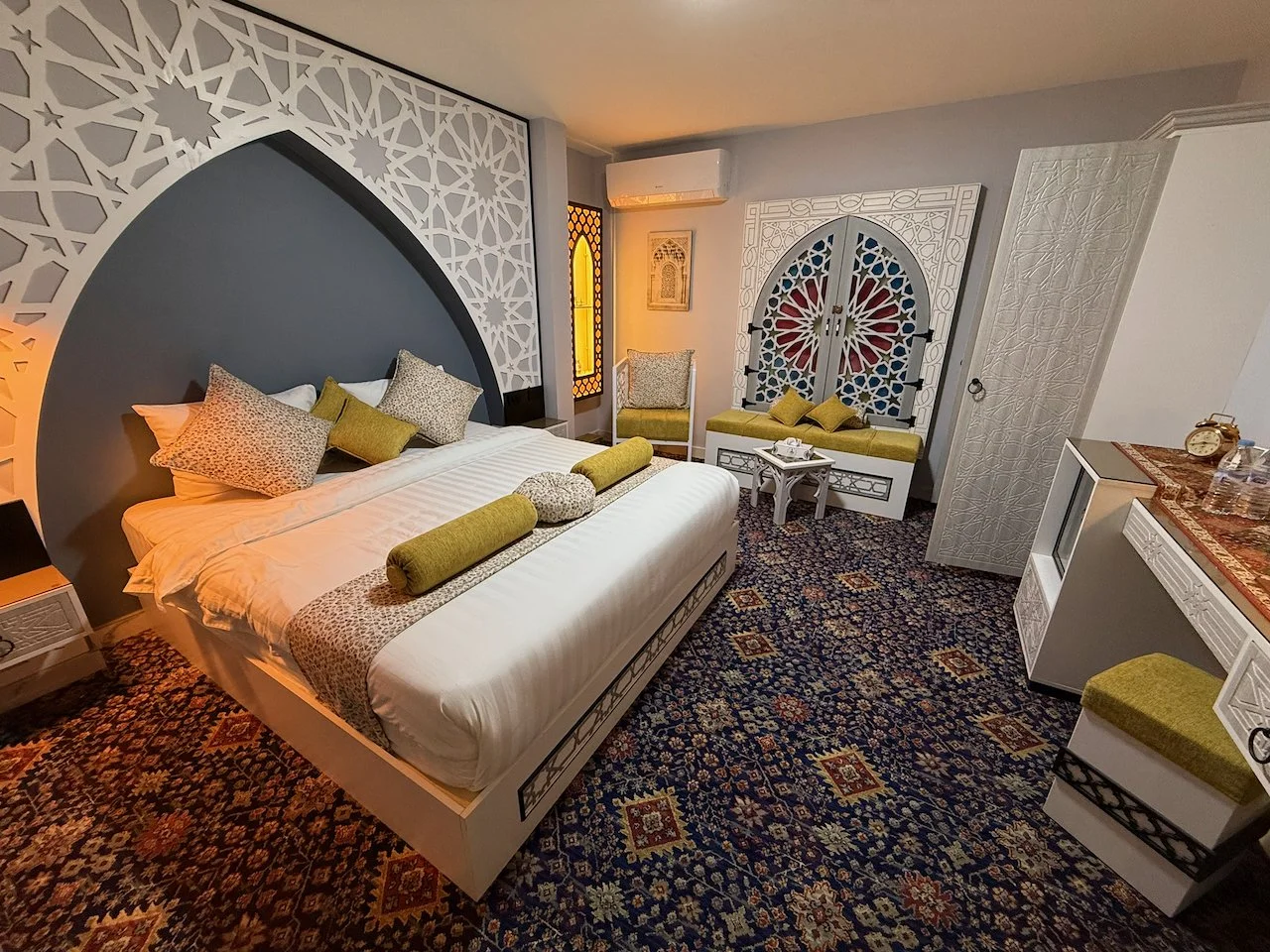
Petra Masterpiece Hotel. We had the Andalusian room.
When we returned we started chatting to an American couple staying there we’d seen earlier. Well, the woman was actually originally from Egypt and the man from Columbia but they were living in New Jersey. Obviously all we spoke about was Trump (I was aware of the irony when I said that all the excessive media reporting of him just encourages him, and here we were, in Jordan, with nothing else to speak about), and how they were looking to leave the States. Less obviously, the man had recently become a Muslim (not related to his partner being Muslim; they met some time after). They were exploring Egypt and Saudi Arabia next (and weren’t aware of Saudi’s questionable (lack of) human rights, including a record number of executions last year). Anyway, the woman went off to plug into an inhaling machine for her asthma.
After only having spoken to Jordanians thus far, it was actually refreshing to speak to English-speaking people. I forgot how quite basic our conversation had become with the locals; besides, they tended not to ask us anything, except where you from? The Americans didn’t ask much either, still, at least I managed to mention my Netflix deal.
Wednesday 11th February 2026
Breakfast in the hotel was like nothing we’d ever experienced. I’ve rarely recommended a hotel to anyone in my life, it’s usually such a generic experience, a place to sleep and that’s it. Petra Masterpiece Hotel was run by three young, constantly smiling brothers – of course we called them Brothers Grin. The elder brother gave H a rose, and me a lemon (both picked from the garden). The symbolism of both seemed heavy. Even when I tried to lose the lemon (I put it on the kitchen table), the brother would pick it up and give it back to me, a smile on his face. What was I meant to do with it, eat it?
The phrase attention to detail springs to mind, and our breakfast, sitting by the window overloooking the dried-up river bed where wild pistachio trees (pistacia atlantica) grew, may have started with fresh bread and hummus, but soon included local honey (we’d met the beekeeper, a friend of the brothers, briefly, the previous evening when he’d called round), flowers, herbs, nuts, dates, jams and indeed wild pistachios, with the older brother showing and explaining to us the contents of various jars of herbs and spices taking up a whole wall in the kitchen. Even after a hearty breakfast, one of the other brothers asked me if I’d like an omelette. The care and detail were truly lovely and so unexpected.
After breakfast one of the brothers gave us a lift to the ancient city of Petra. When we’re away from tourist sites we can blissfully go for ages without seeing a white face, then suddenly they’re everywhere. Compared to other tourist sites in Jordan, Petra was busy. Coach loads of them. With loud tour guides. Tourists seemingly can’t take a piss without one.
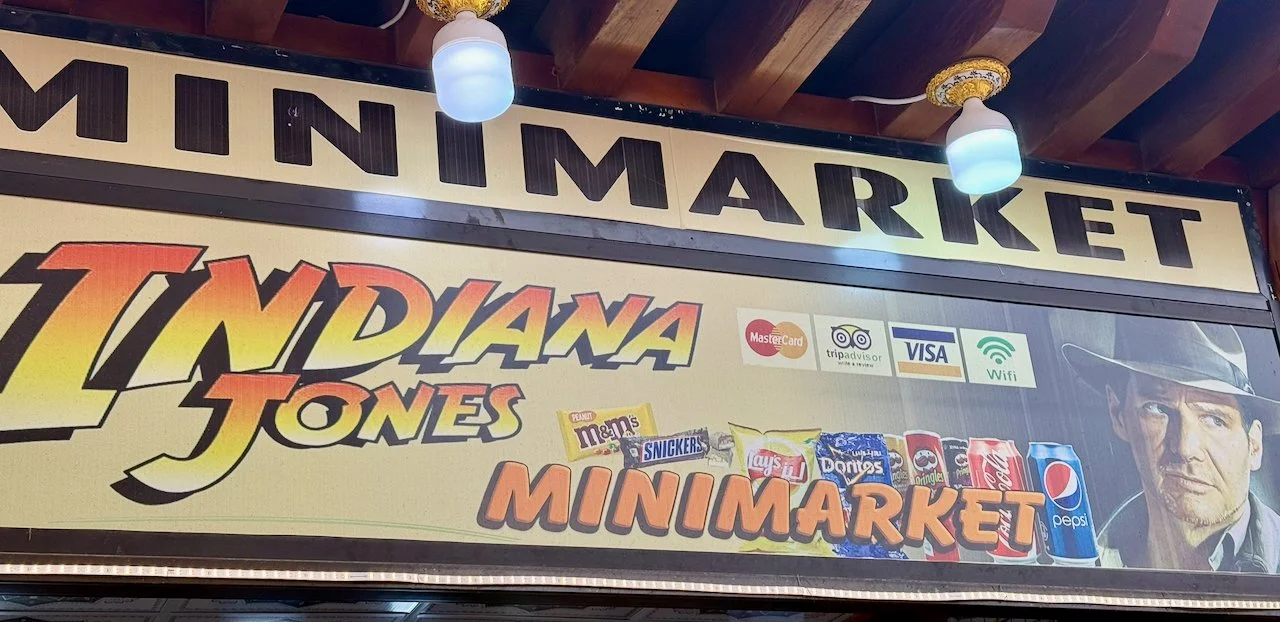
Indiana Jones minimarket at Petra.
Indiana Jones never had to contend with the Temple of Tourist Tat, but we had to. Actually, Jordan is nowhere near as bad as Morocco or other places for hassle but still, it’s slightly awkward. In this day and age, are tourists really into tacky souvenirs? I feel a little sorry for the stall holders still trying to hawk tat like fridge magnets, T-shirts and postcards. Some sellers were almost giving them away to us, but we just didn’t need them.
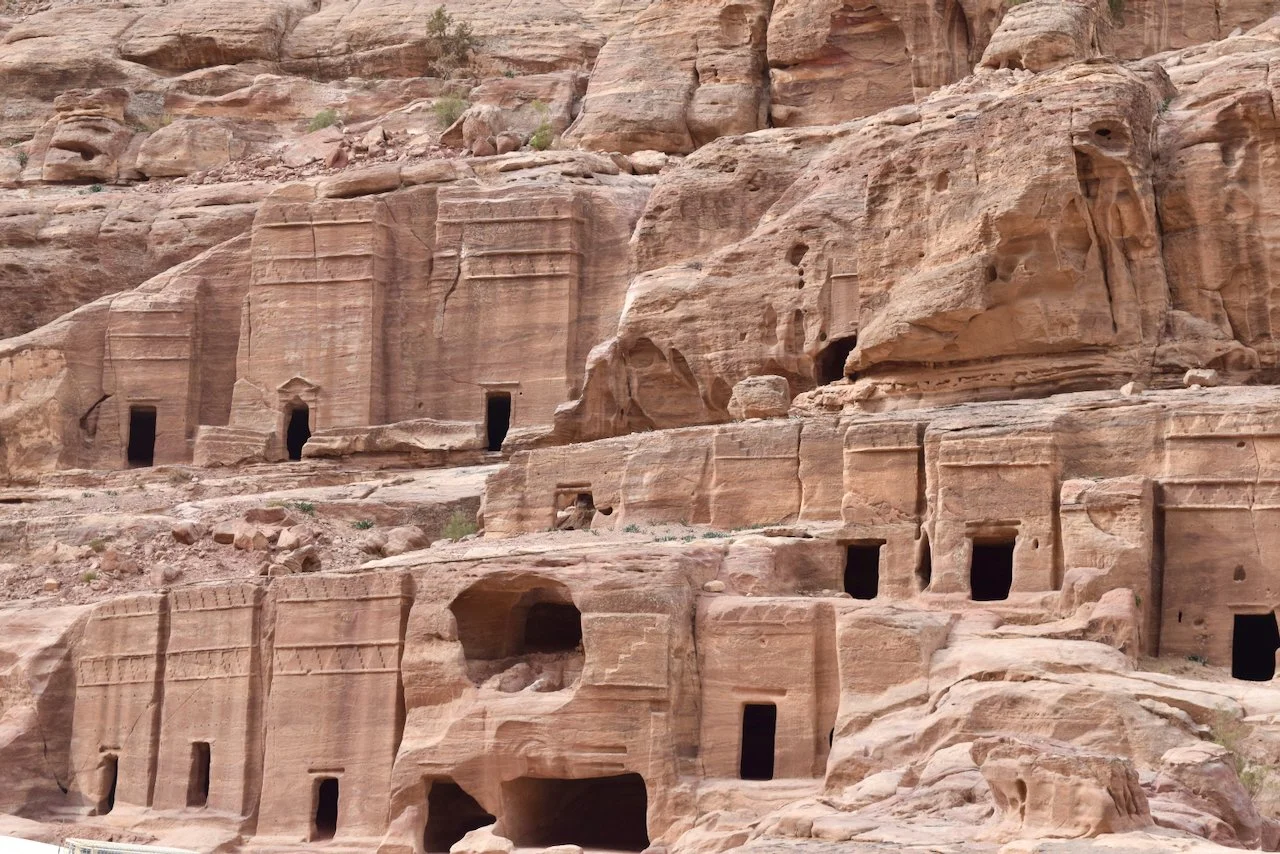
As soon as we got past the stalls and entrance gate we were in another world. It took us an hour just to get to the Siq (a ten minute walk), the famous canyon Indy rides down which leads to the iconic Treasury in Indiana Jones and the Last Crusade. No one had told me there were amazing rocks everywhere, some caves, some temples and tombs chiselled into the rocks, some with amazing patterns on them, plus plants and trees – all incredible. And then approaching the Treasury from the Siq is just one of the world’s most jaw-dropping travel experiences.
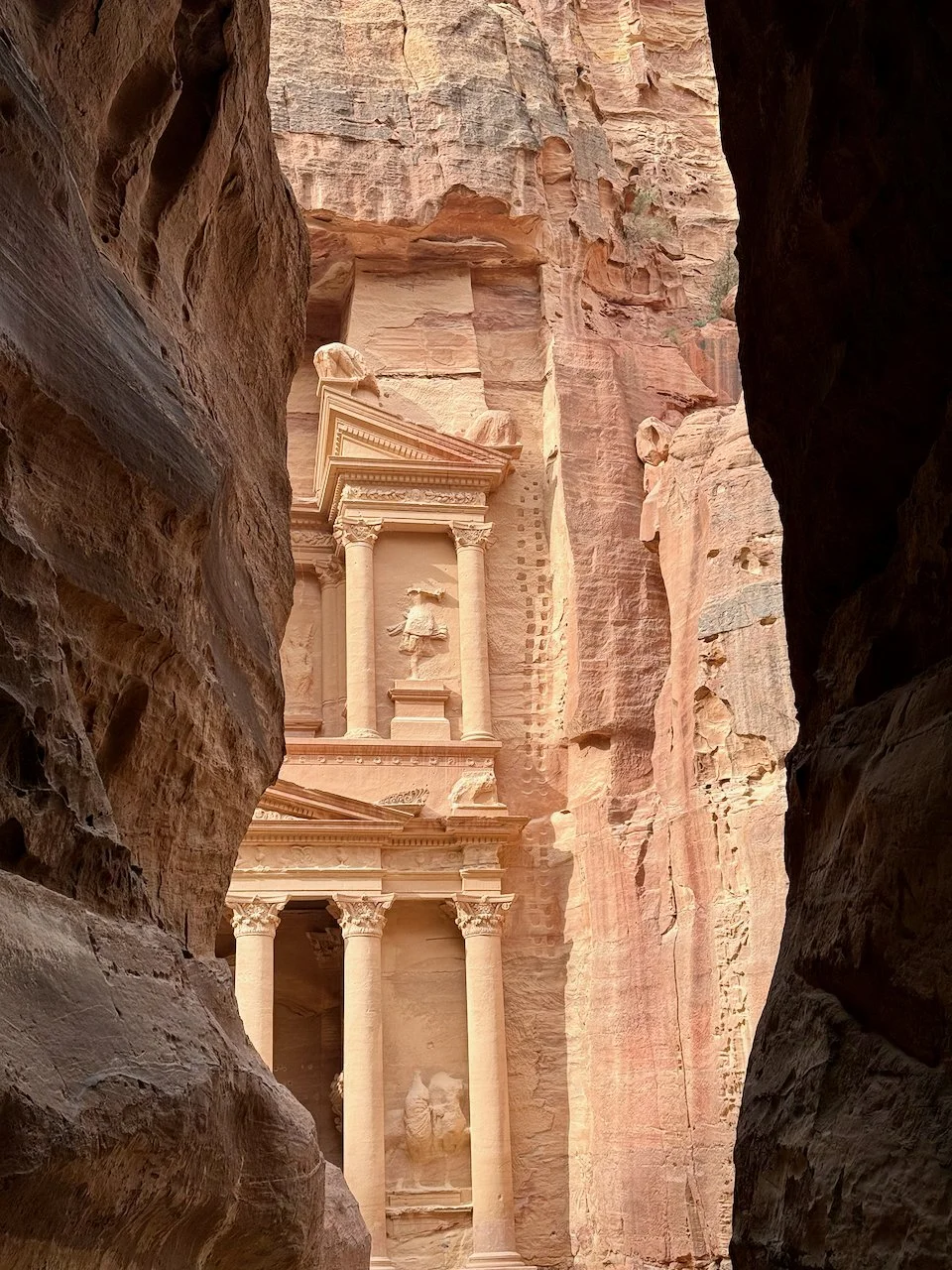
The classic view to the Treasury.
And then coming out into the open space in front of the Treasury, well, 95% of Jordan’s tourists were there too. Plus some camels. There were loud, Italian tour guides, there were tourists who asked me to move out of the way so they could take a photo (I obviously stayed where I was for longer than I would have done, just to annoy them) but nothing could detract from the awesome, ancient city of Petra, capital of the Nabatean Kingdom, built in 300 BC.
We spent the day exploring the city, and barely scratched the surface. We took a lot of photos of rocks. One of the many amazing sights were not carved by Nabateans but a natural phenomenon of the rocks, a pattern created by iron and manganese oxides millions of years ago.
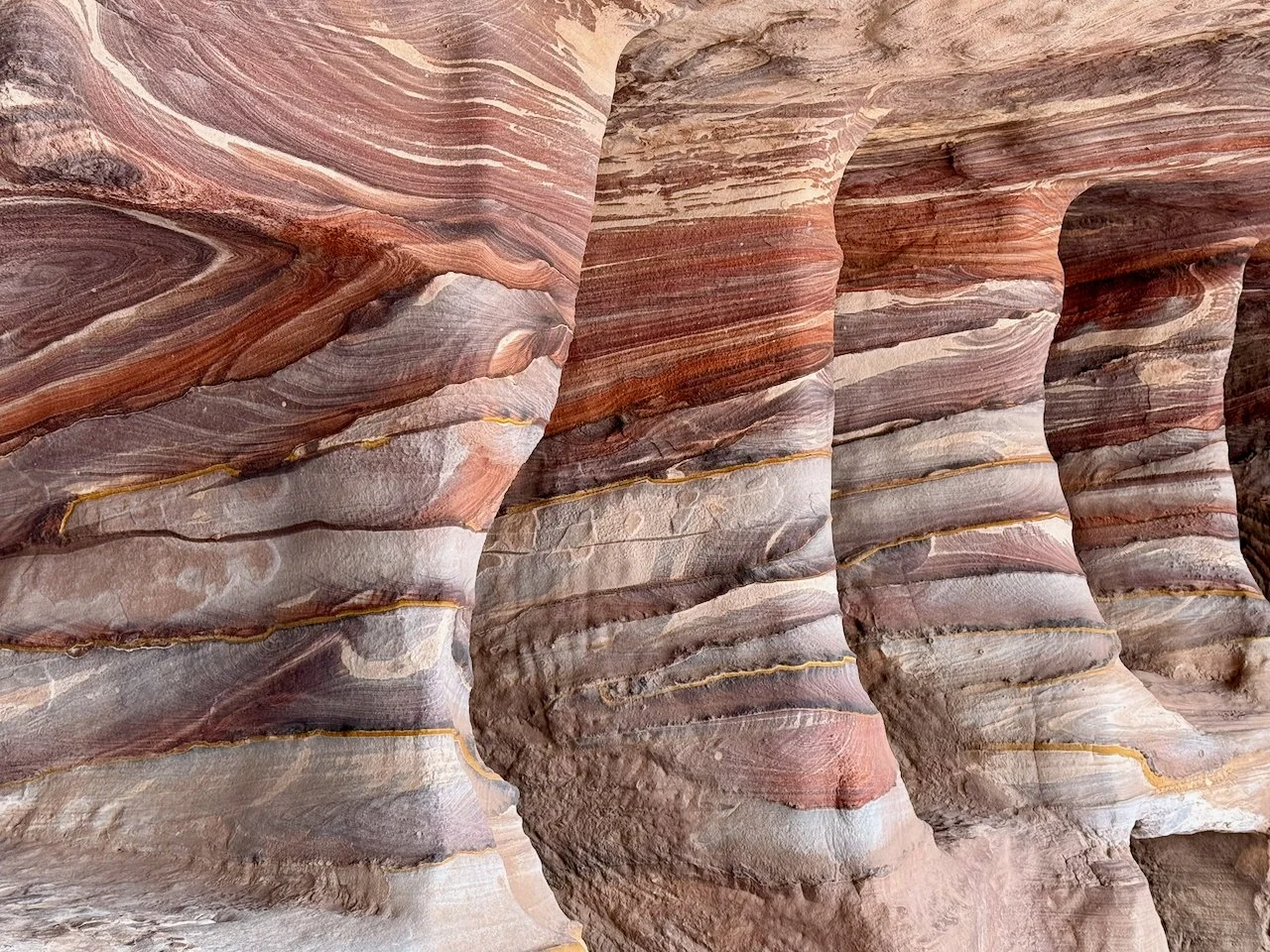
Rock art, Petra style.
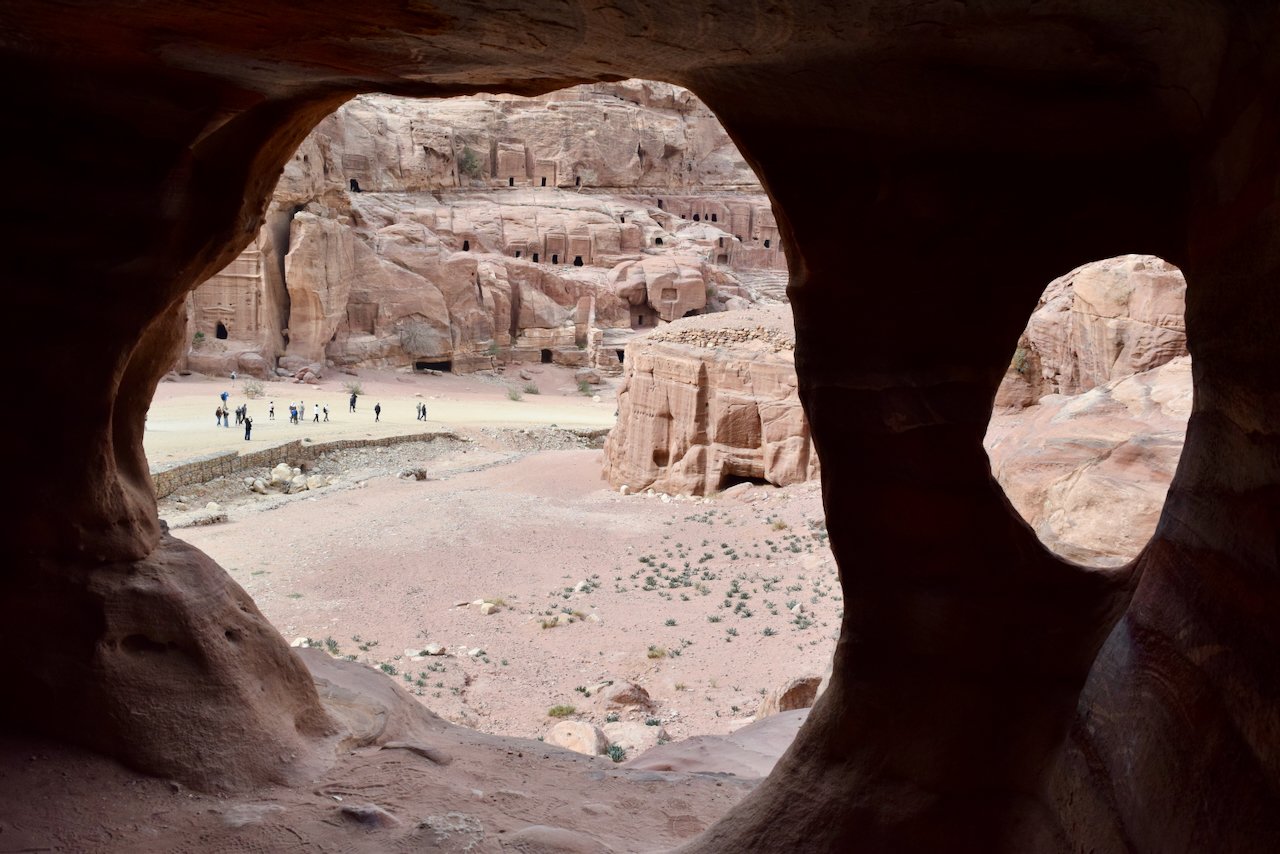
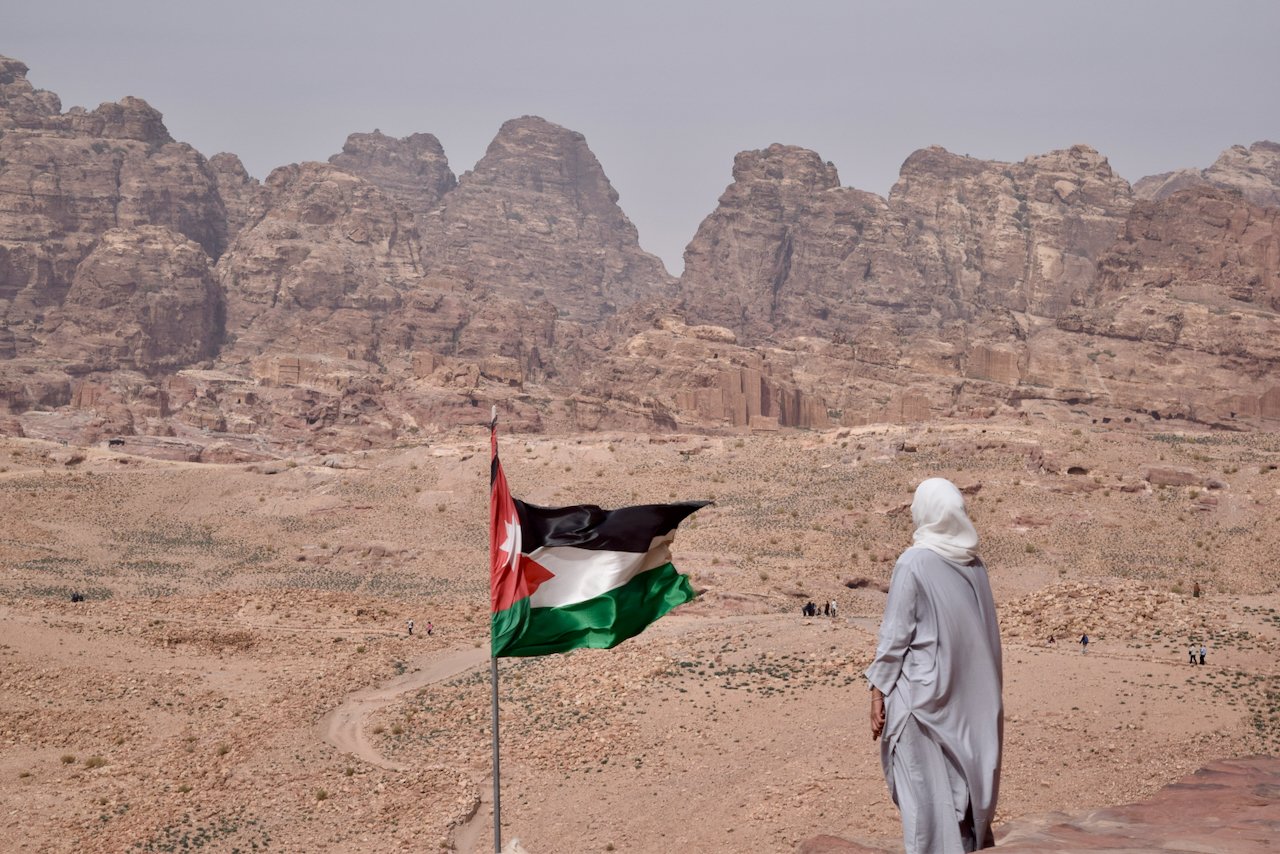
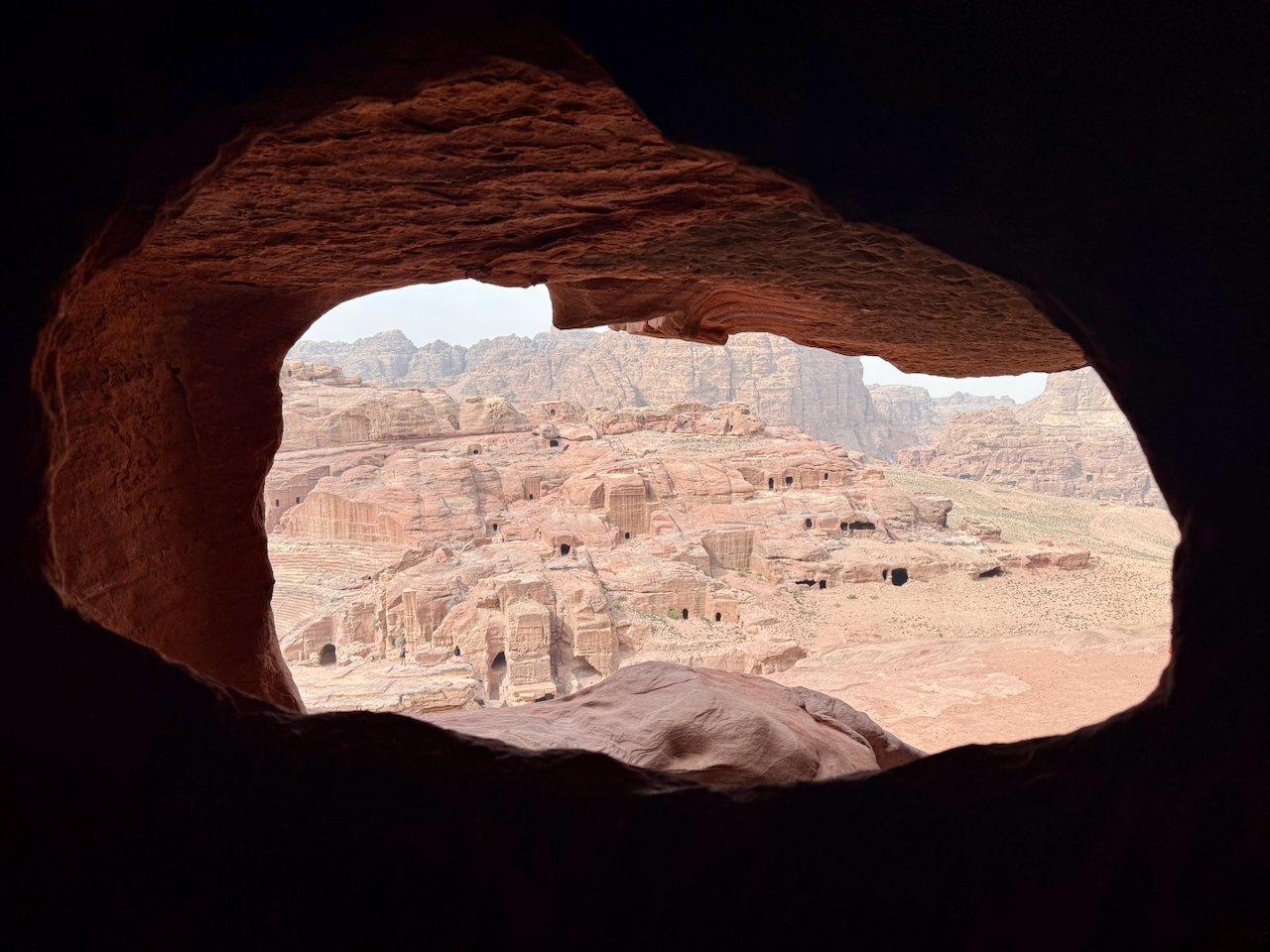
H and I randomly decided to walk up some steps, not realising it was a trek that would take us hours (there and back), also not realising there would be an amazing view looking down on the Treasury from the top. We talked to various tourists along the way, they too didn’t seem know where it went or what was at the top or how to get back down again (one French woman thought there was a natural bridge connecting another mountain, to get back down quicker. Not for about 10,000 years I told her, as a guess. We all had to walk down the same way we came up). It just looked like a path that needed to be trodden (I looked it up when I got home, it was the Al-Khubtha Trail).
It just so happened that we started walking back down the same time as a small herd of wild, though placid and certainly very cute, goats with long, flappy ears (we’d seen and heard them a while ago, bleating precariously on the side of another mountain; how they got over to us so quickly looking so calm I don’t know).
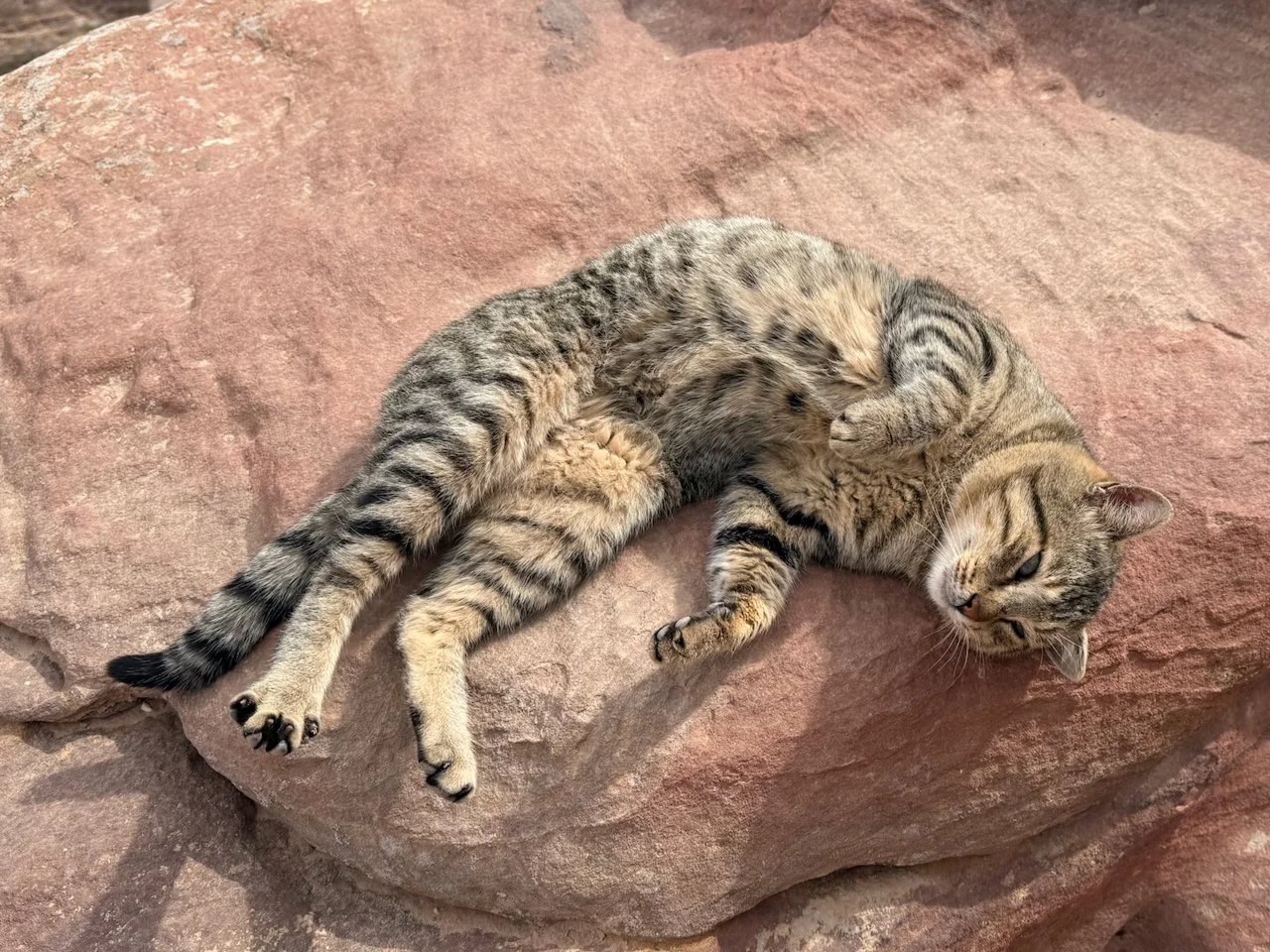
Cat on the Al-Khubtha Trail.
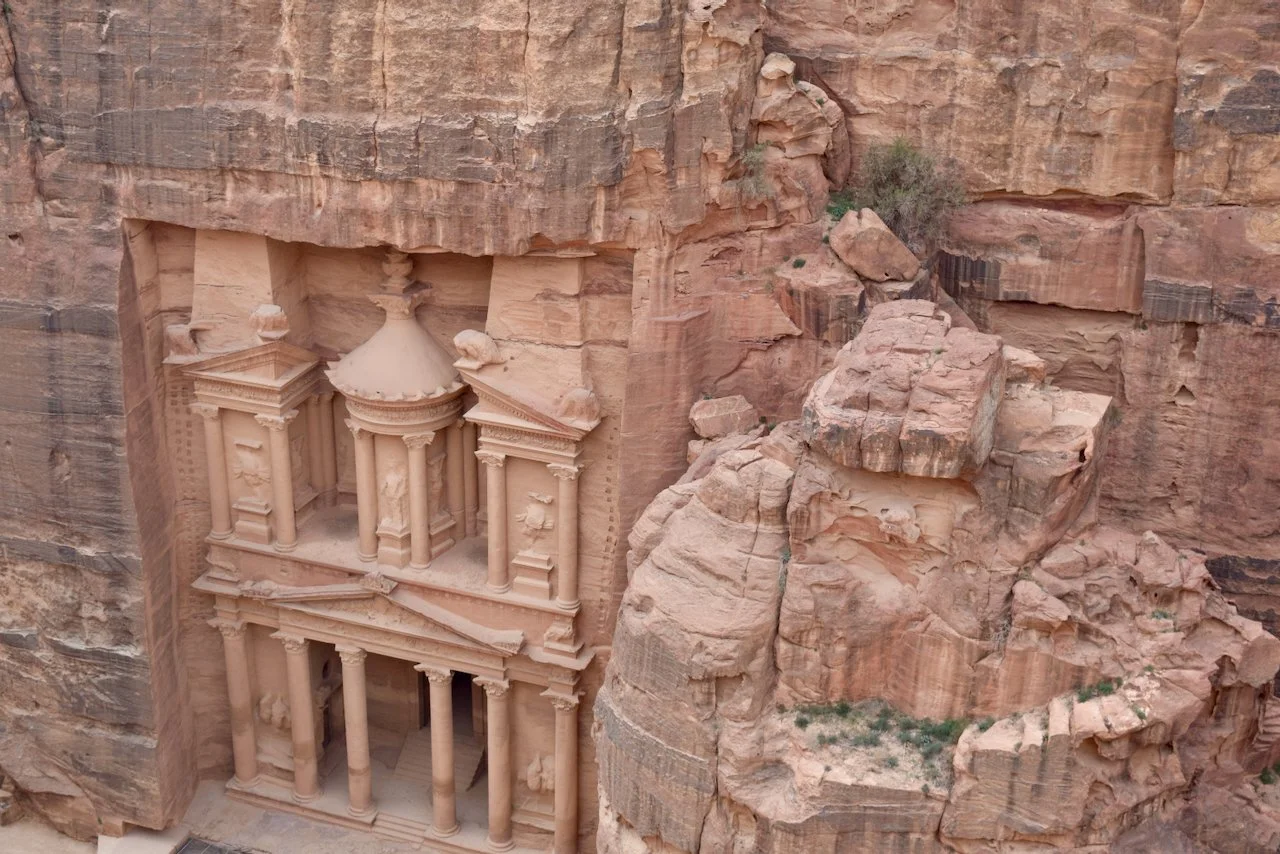
Looking down at the Treasury from the top of the abal al-Khubtha massif.
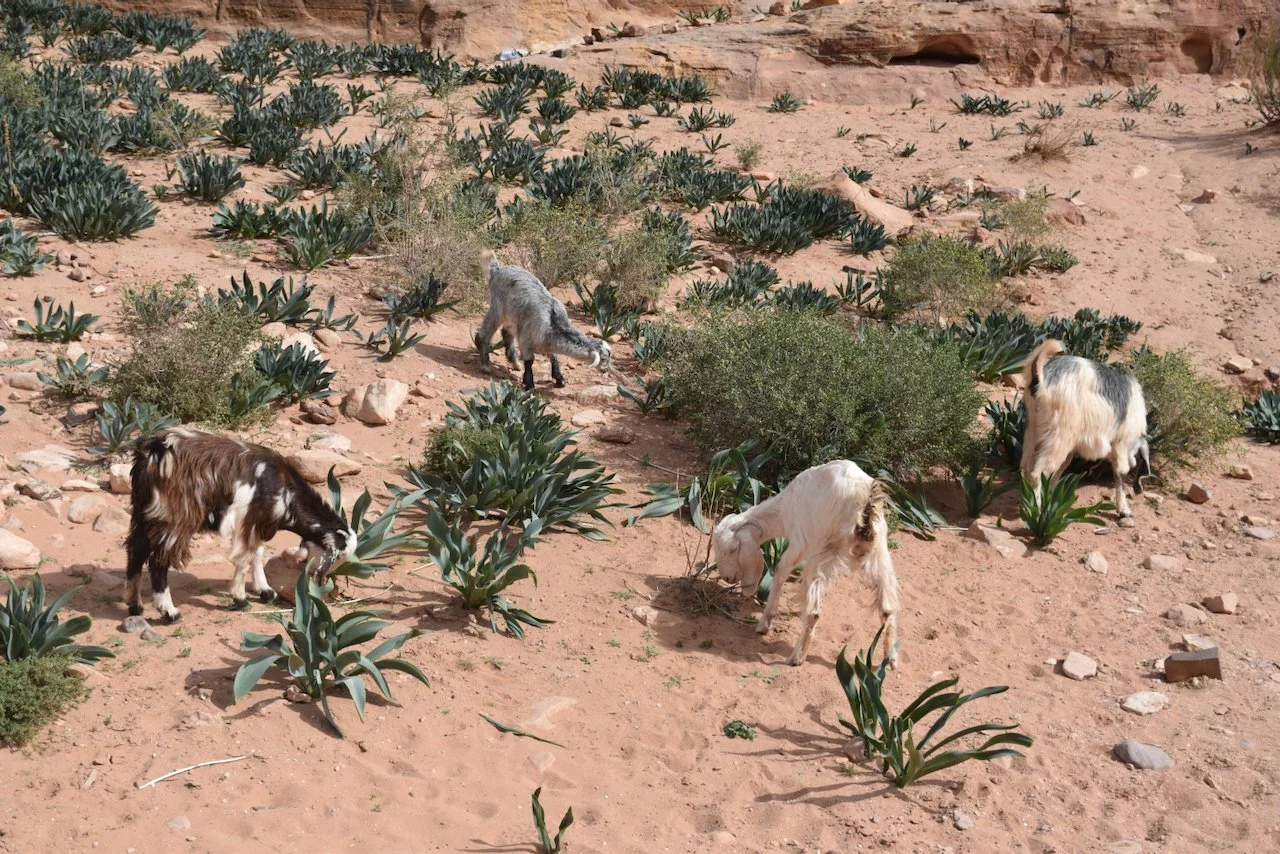
Cute goats with floppy ears.
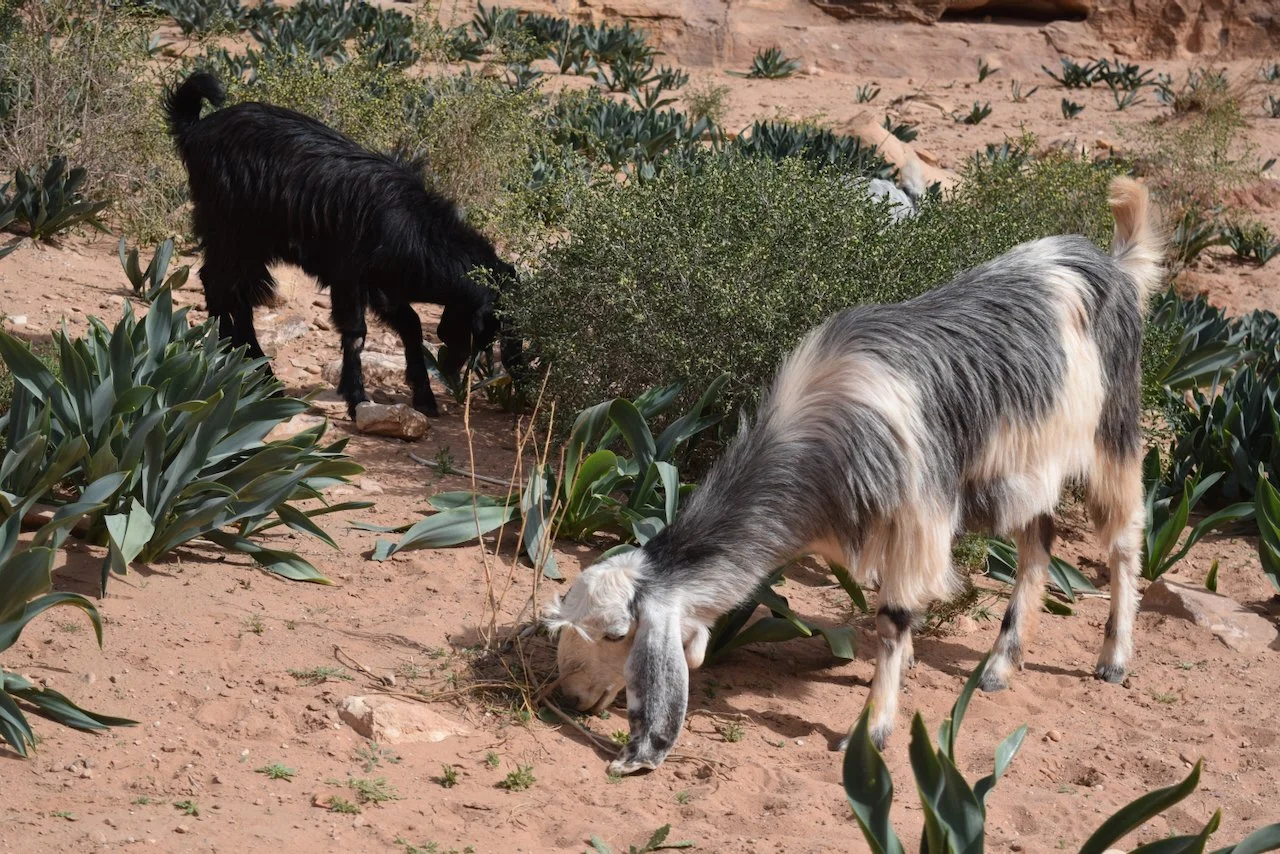
And some more.
When we got back down there was more bleating in the form of kids (as in baby goats), really high up on another mountain, being stolen by a gang of Bedouin kids (as in children). Okay, at first glance that’s what it looked like. They were actually rescuing them as the kids were stuck, it was pretty tense and exciting, H couldn’t even look, nearby there were security guards or police maybe, just standing there, doing nothing. It was such a relief when the kids got the kids down. They were all fine, everyone was relieved. Both the kids and kids just walked off afterwards, cool as cucumbers, like yeah we do this every day to entertain tourists.
We were sensible enough to take a bottle of water each, but food we forgot about until we realised we were starving, and the first place we found was this dirty and crappy-looking cafe shack, where we got an over-priced bag of crisps, a bottle of water and some undrinkable coffee. Five minutes later, down the hill, we stumbled across the Basin restaurant, rated by Lonely Planet as the best place to eat in town, but crisps and water had temporarily done the job.
I thought it strange that, to my knowledge, Indiana Jones and the Last Crusade was the only film to have been shot in Petra, easily one of the most amazing sights I’ve ever been to. Aside from the Nabataean architecture and all the caves, there were also fine Roman remains, and it was there that we did stumble across filming taking place – for an Arabic music video. The director was young and white, the cameraman was podgy, and white. Everyone else was Arab. It was also here, in the Great Temple, that I finally fleetingly saw a little green lizard – I couldn’t believe my eyes it as it flitted into a crack in a Roman column.
We were dusty, knackered and starving when we finally left Petra in the evening, and stumbled straight into the Cave Bar, immediately outside the entrance to Petra. ‘The oldest cave bar in the world’ (how many are there?), it’s carved into a 2,000 year old tomb and exactly what we needed as we collapsed into comfy chairs and ordered beer and food. We assumed it would fill up with tourists but it stayed pretty much empty the rest of the evening, except for an Arab couple next to us. The man completely ignored his wife the entire time, speaking into his phone in English and Arabic about property deals, puffing away on his shisha. The wife, covered in a burqa, occasionally texted on her phone. H didn’t think they were Jordanian.
We hung around the bar until it was time for Petra by Night, which we’d booked earlier. It wasn’t covered by our Jordan Passes and was pretty expensive but we were looking forward to seeing Petra, well, by night. Of course we should have looked at reviews online beforehand, but that would have spoilt it (besides, reviews are always so polarising).
It started off atmospherically with lanterns lining the sides of the Siq, all the way to the Treasury, which was lit up red, with more lanterns in front of it. Pretty stunning. But then we realised we had to sit down on chairs in front of the Treasury, and be presented with a Bedouin miming the flute. This set off alarm bells but nothing prepared us for the main event, what can only be described as a potted history of Petra seen through a 1990s PowerPoint presentation designed by a child, and projected against the Treasury. At least we got a free cup of tea.
What was even more annoying, though, were the hundreds of moronic tourists filming and photographing every second of the experience, before, during and after the presentation. I mean, just non-stop. And posing, and some even dressed up and acting. They all looked totally pretentious, like they were on a Vogue photoshoot or auditioning for the latest Spielberg production and not just filming their lame Instagram Reel.
The best thing was the candle-lit lanterns but next morning one of the brothers in the hotel even mocked these. ‘Do you know what they are held in, the candles?’ he asked us. We didn’t know. He holds up a finger to indicate wait a sec, goes in the cupboard under the sink, has a good rummage, eventually finds some small brown paper bags. ‘These! Falafel bags!’ Yes, the lanterns were falafel bags. He found it very funny.
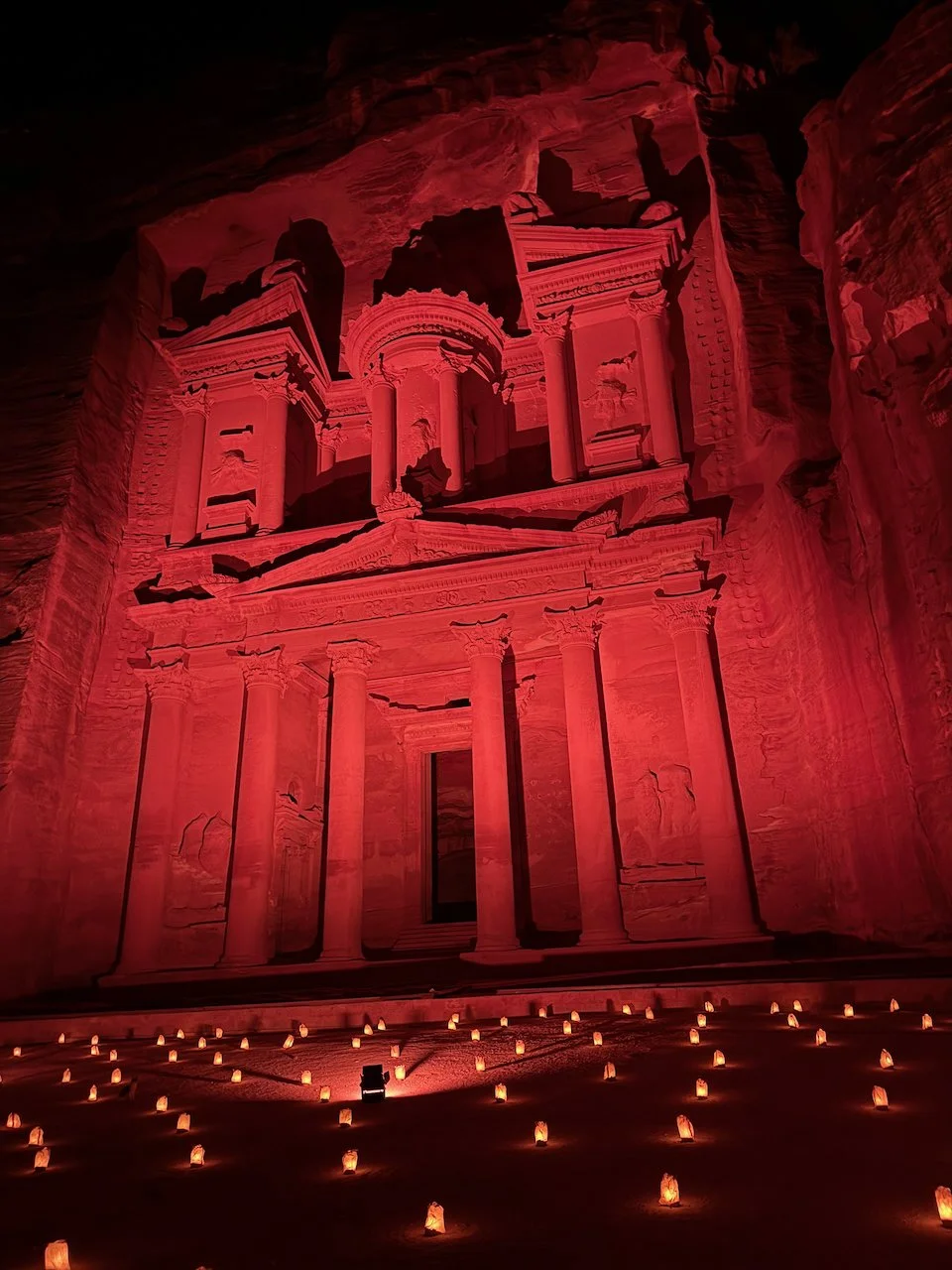
Petra by night.
Thursday 12th February 2026
After mother’s freshly baked pastries for breakfast, we decided on a quick visit to Little Petra; we were leaving for Wadi Rum in the afternoon (we’d long debated whether to spend an extra day in Petra or Wadi Rum – in the end deciding on neither and spending the time exploring the King’s Highway instead. Time is so short, travel is all about prioritising). We’d heard we could get a free minibus from near the entrance to Petra to the visitor centre close to Little Petra, so we waited under a tree for the bus to fill up so it could go.
We had good banter with the young guy wearing a baseball cap back to front who was checking tourist’s Jordan Passes. We actually hadn’t yet talked football with anyone, obviously the whole world is football crazy, apart from us. We got to talking about the England football team, “a good team who never win”. The guy was all mocking “I’m sorry, so sorry about England”, with his hand on his heart. He was very funny.
The bus took us to a visitor centre but then we didn’t know what to do next – mostly what tourists do is hire jeeps from Little Petra to go to (big) Petra’s Monastery, but we didn’t have time for that; we just wanted to go to Little Petra, and back again. Apparently the minibus didn’t go back to Petra, so we wasted half an hour trying to get a straight answer about how to return. I shrugged and said things tend to work out. In the end we just asked a random person where the Little Petra site was. He pointed in one direction, across a barren, rocky plain, and we started walking. Ten minutes later of aimless wandering, an old Bedouin kindly helped us down a gully onto a path, almost crashing into an English couple who had done the same thing we had (got lost, tumbled down…), and told us which way to go, and to look out for the 2,000 year-old mural (which we otherwise wouldn’t have known anything about).
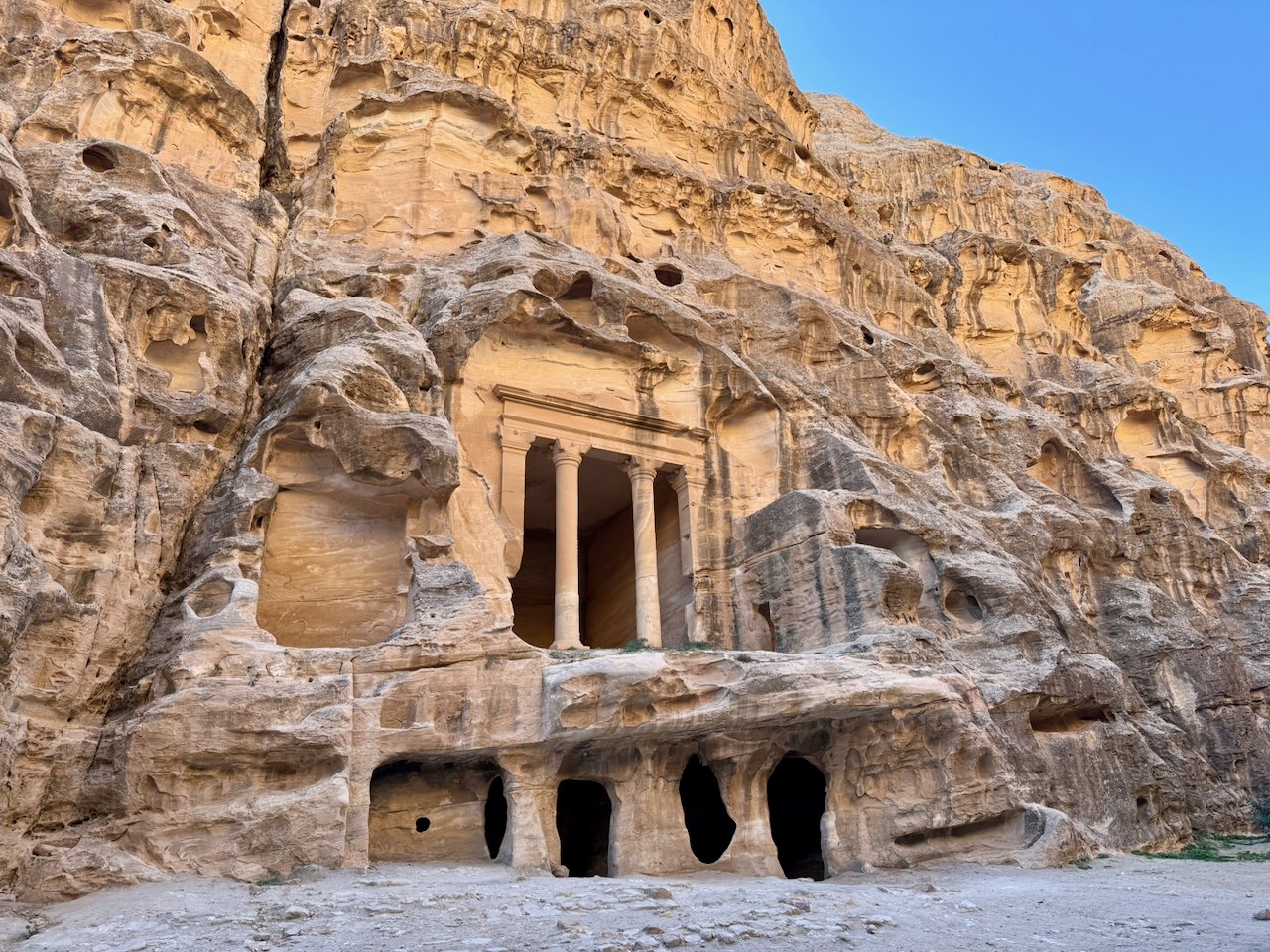
Little Petra.
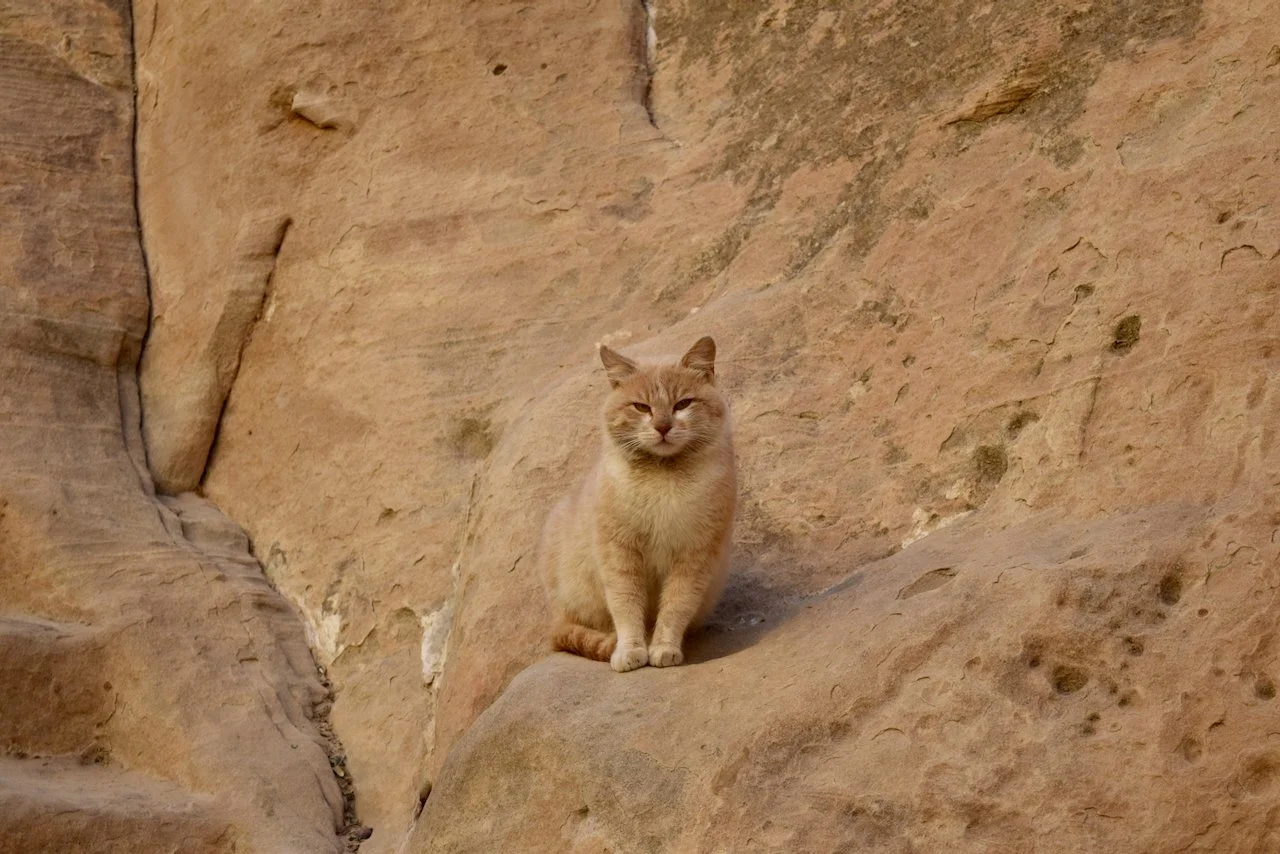
Cat guarding one of the greatest treasures of Petra.
Actually Little Petra, the smaller overlooked sister suburb of (Big) Petra, was beautiful, peaceful and empty, except for cats, as usual, keeping guard. There was a small cluster of cafes and shops, then a short siq or canyon leading up to the main building but also other structures and caves to explore.
There was a cute cat by some stone steps, I stopped to stroke it, it jumped on my lap for ages and did not want to move. Finally I walked up the steps. Further up still, a cave with railings outside it. Then we remembered what the Brit couple said, and peeked inside. A few other tourists walked up the initial steps, but not as high as us and missed on what has been described as one of the greatest treasures of Petra, though there’s no information about it at the site. On the ceiling behind the railings was an intricately detailed mural of grapes, branches and leaves, birds and cherubs. It was hard to believe they were 2,000 years old and the “most important and largest example of Nabataean mural painting in situ”, presumably dedicated to the cult of Dionysus. They had more fun back then.
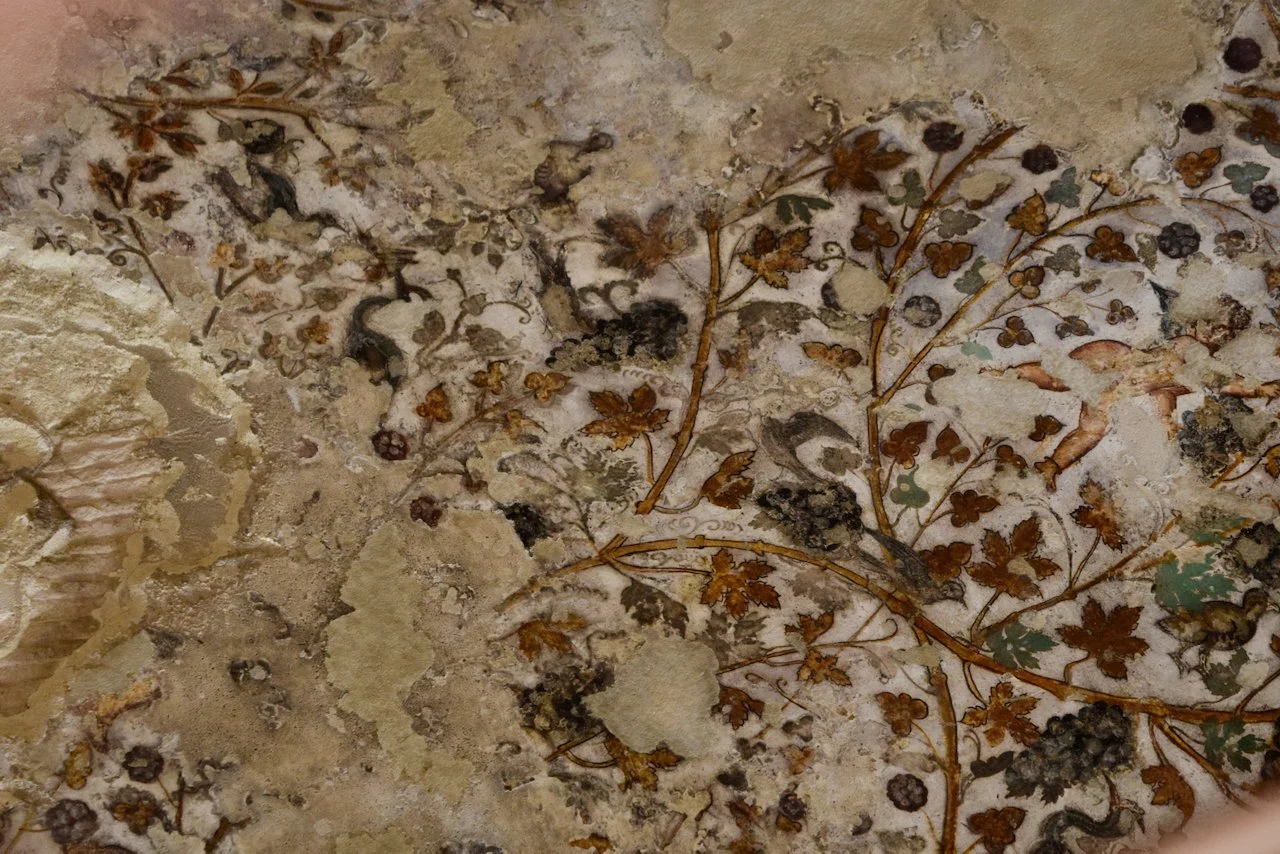
Detail of the intricate mural painting from AD 1, cleaned in 2010 by British conservation specialists.
We walked as far as we could go through the narrow canyon, eventually coming to a cafe on top of a cliff, and a dead end. It was time to head back. We walked back to where the cafes were, looking for a taxi. We asked one guy the price, it was too much and we just started walking along the road. And walking. They’ll come to us, H assured me. I know, but it’s been five minutes, I said. They’ll come to us. Then a car, a different one, did come to us. It pulled up. Inside was the Bedouin pirate, mentioned previously. He talked about the reliance here of tourism, about tough times, living in caves.
We were dropped off at the entrance to Petra and decided to have a quick look around the museum there. For the second time in a day we were engaged in conversation regarding football, and fell flat. We thought the receptionist at the museum asked us, ‘What’s your favourite tea?’
Mint tea, replied H.
Eh? The receptionist said, perplexed, your favourite football team is mint tea?
Anyway, the museum was interesting with many stunning artefacts found in Petra. There was a fascinating video about farmers and shepherds living in the caves in Petra.
Back at the hotel we sat in the garden where the weekly family meet up was taking place. The mother didn’t speak and the other women soon made themselves scarce. It was father and sons. One of the sons was keen on living in Costa Rica, as he had met a woman online from there. We had been the previous year, and told him all about it.
We were picked up at 4pm by another driver who took us all the way to Wadi Rum – our only stop off was a coffee shop, where we all got over-priced coffee because there was a gift shop attached. H haggled over the price of coffee, I stood outside looking off into the distance.
Whenever we asked anyone – local or tourist – what their favourite area of Jordan was, the reply was always, without a beat, ‘Wadi Rum’. I loved that answer as it was almost a state of mind. Wadi Rum. There’s nothing there but rocks and sand. No ruins, no monuments, no resorts, no shops, no entry fees. Red sand and sandstone mountains. And, yeah, there might be petroglyphs (probably fake) and of course Lawrence this and Lawrence that and various ‘activities’ (yawn), but we’re really all here for the absence of human presence (as much as is possible in a popular tourist destination), to stand before the vast emptiness of existence, to look for God, Allah, whoever, or just enjoy the extraordinary light, space, colour and beauty.
Me? I was here for the film locations.
Though I rarely research any country I visit until after I’ve been, I was interested beforehand in the various films shot in Wadi Rum. Lawrence of Arabia (1962) was the first, and one of only two (the other being Theeb, made in 2014) to use Wadi Rum as the actual setting for the film (rather than a stand-in for somewhere else). T.E. Lawrence used the desert as a base in 1917-18, describing it as “vast, echoing, and God-like”, and much of the film was shot on location there.
Since Lawrence, well, there were no films shot there that I know of until the millennium, when it started being used as a stand-in for Mars or indeed any alien planet. So we have the terrible Red Planet, the awful Mission to Mars (both 2000), the derivative Last Days to Mars (2013) and the average The Martian (2015), directed by Ridley Scott (the British filmmaker must be a fan of the place; he’s shot three films there so far).
Mars is, of course, the Red Planet, and Wadi Rum has red sand and an alien, surreal landscape, making it an ideal stand-in. Maybe. There are those who think NASA feel strangely compelled to make Mars look more Mars than it actually is. Its images of the planet, even recent ones, appear to use a combination of red Photoshop filters, composites, ‘enhanced-color’ and ‘mosaics’ to give us a completely artificial image of the red planet (that never stopped Hollywood, of course). The red planet may not be red at all. Brown at best, with blue skies, and looking a bit like Arizona.
Aside from Mars, Wadi Rum also features as the alien planet (with some help from CGI) in Ridley Scott’s so-so Alien prequel, Prometheus (2012). As an in-joke, presumably, the film has Michael Fassbinder (an actor born to play a replicant) watching David Lean’s Lawrence of Arabia on repeat.
It was great to watch Theeb (2014), made with non-professional Bedouin actors, the only film except Lawrence of Arabia to use Wadi Rum as Wadi Rum; unfortunately it’s a rather simplistic and obvious revenge film. Set during WWI, the coming-of-age story features a Bedouin boy surviving in the Jordanian desert. The film was nominated for the Best Foreign Film Oscar. Matt Damon was in the desert at the time shooting The Martian and saw the trailer, exclaiming, “This looks incredible, man!” Theeb’s filming was delayed by several years due to the Jordan film industry’s “preoccupation” with the shooting of Zero Dark Thirty, Kathryn Bigelow’s ugly terrorist drama, partly shot in Amman (as was her earlier film, The Hurt Locker) and near the Dead Sea, where bin Laden’s compound was recreated.
Even though a Star Wars film wasn’t shot in Wadi Rum until 2016, for me the whole of Jordan has the feel of the Skywalker Saga – from the architecture in the desert (for example, the domed Quseir Amra, mentioned above, looks like the Mos Eisley cantina, which was actually filmed in Tunisia. Anyway.) and the caves in Petra to the sound camels make (sort of like a tauntaun from The Empire Strikes Back). Rogue One: A Star Wars Story uses Wadi Rum as the location for the desert planet Jedha, which gets blown up by the Empire. It was also used for the planet Pasaana for the conclusion of the ‘trilogy of trilogies’, Star Wars: The Rise of Skywalker (2019). Aside from spaceships and other effects added, the distinctive landscape is very recognisable in both films.
In fact, George Lucas, Steven Spielberg and Harrison Ford are probably entirely responsible for my interest in the country. Between them, Indiana Jones and Star Wars offered a world of adventure and desert landscapes.
It feels right that the recent trilogy of Dune films (2021 and 2024, with the third part being released at the end of 2026) were partially filmed in Wadi Rum (portraying the desert planet Arrakis), for author Frank Herbert was influenced by (amongst other things): Lawrence of Arabia, the Arab world and Bedouin tribes. I love both Dune and Star Wars, the costumes and architecture, desert settings, epic stories; and both franchises have that fusion of ancient and futuristic (though the Dune films are far too serious to the point of being dull; Star Wars is far funner).
We approached Wadi Rum late afternoon and we saw more camels. Yes, I was still exclaiming ‘Camels!’ and pointing every time I saw one. You will see lots of camels, our driver promised with a smile, in a tone like a father to his over-excited child. I think it’s because they’re so noble but funny and awkward-looking at the same time that I like them so much. And just so evocative of the desert. They can survive weeks without water and store fat in their humps.
The car stopped on the edge of the desert, and we were picked up by a 4x4 jeep to take us over the sand to our camp, a ten minute drive. Our driver was a ridiculously handsome Bedouin with flowing robes and a twinkle in his eyes. He was very nice, and turned out he was the owner of our hotel. Ours was one of the old-fashioned Bedouin tent designs. Since The Martian (2015) was filmed here, space domes became all the rage. One of the first things he told us was not to be worried: there were no snakes, scorpions or anything poisonous in the desert. I was hugely disappointed.
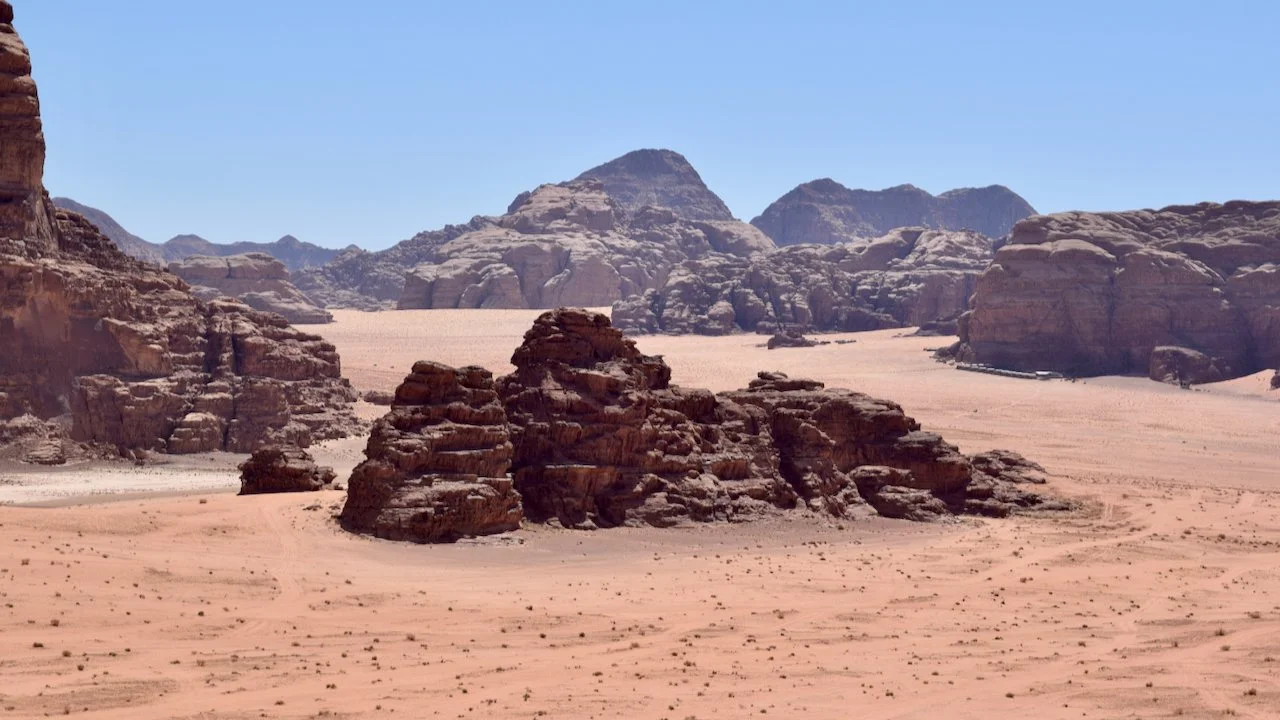
The desert of Wadi Rum – also known as the ‘valley of the moon’ – is a unique one; though it is sandy, it lacks the rolling golden dunes of other deserts. Instead, it has dramatic sandstone mountains rising from its red sand, as well as gorges, natural arches and valleys.
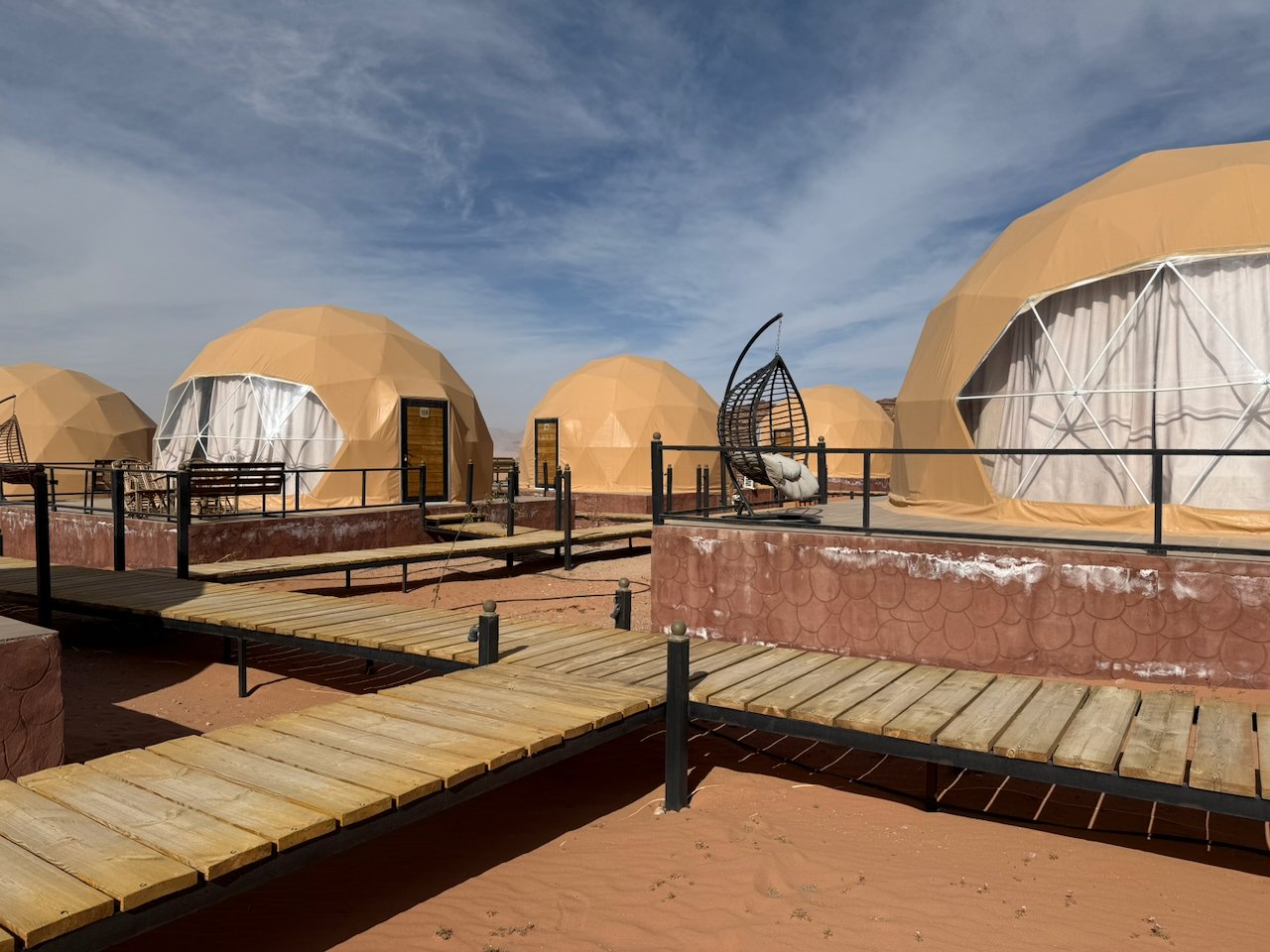
Space domes in Wadi Rum.
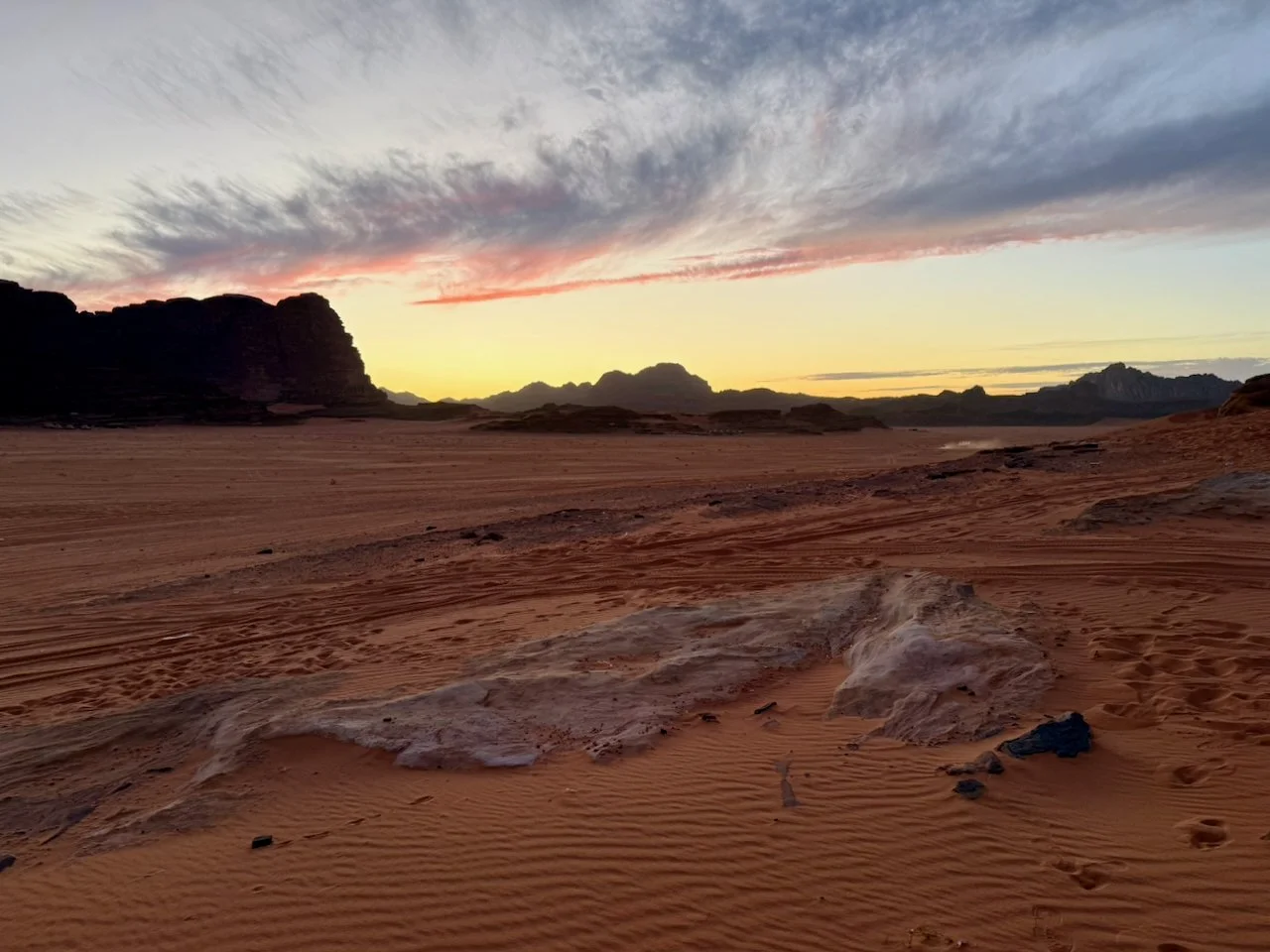
Sunset in Wadi Rum.
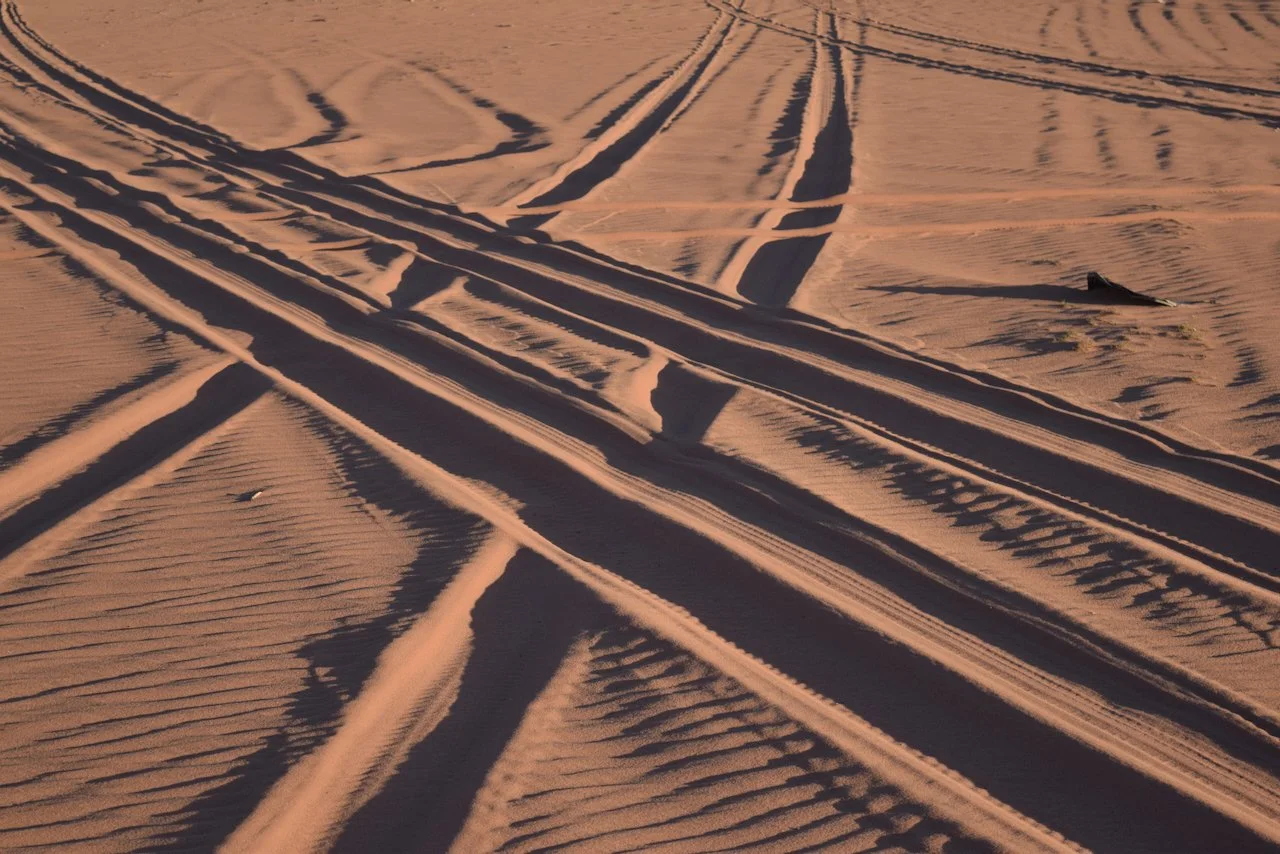
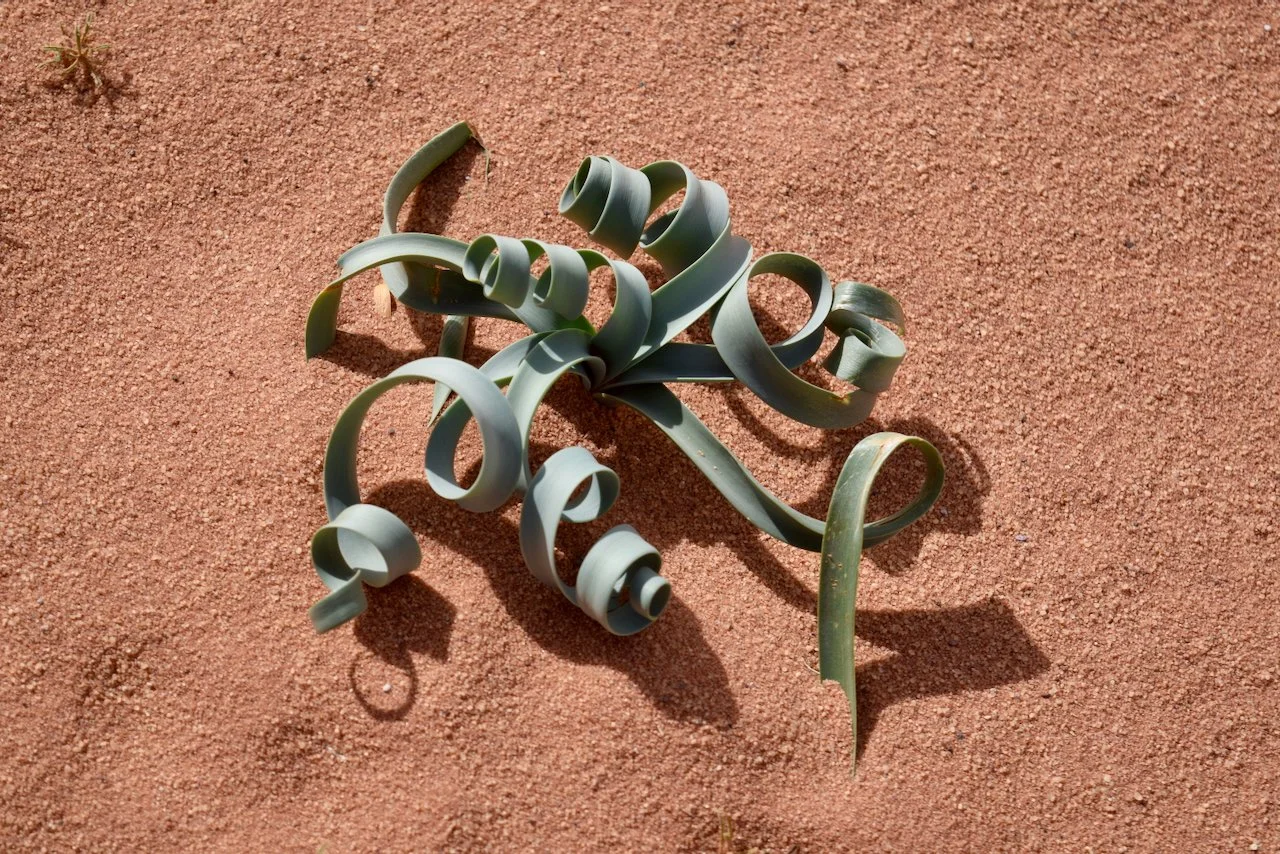
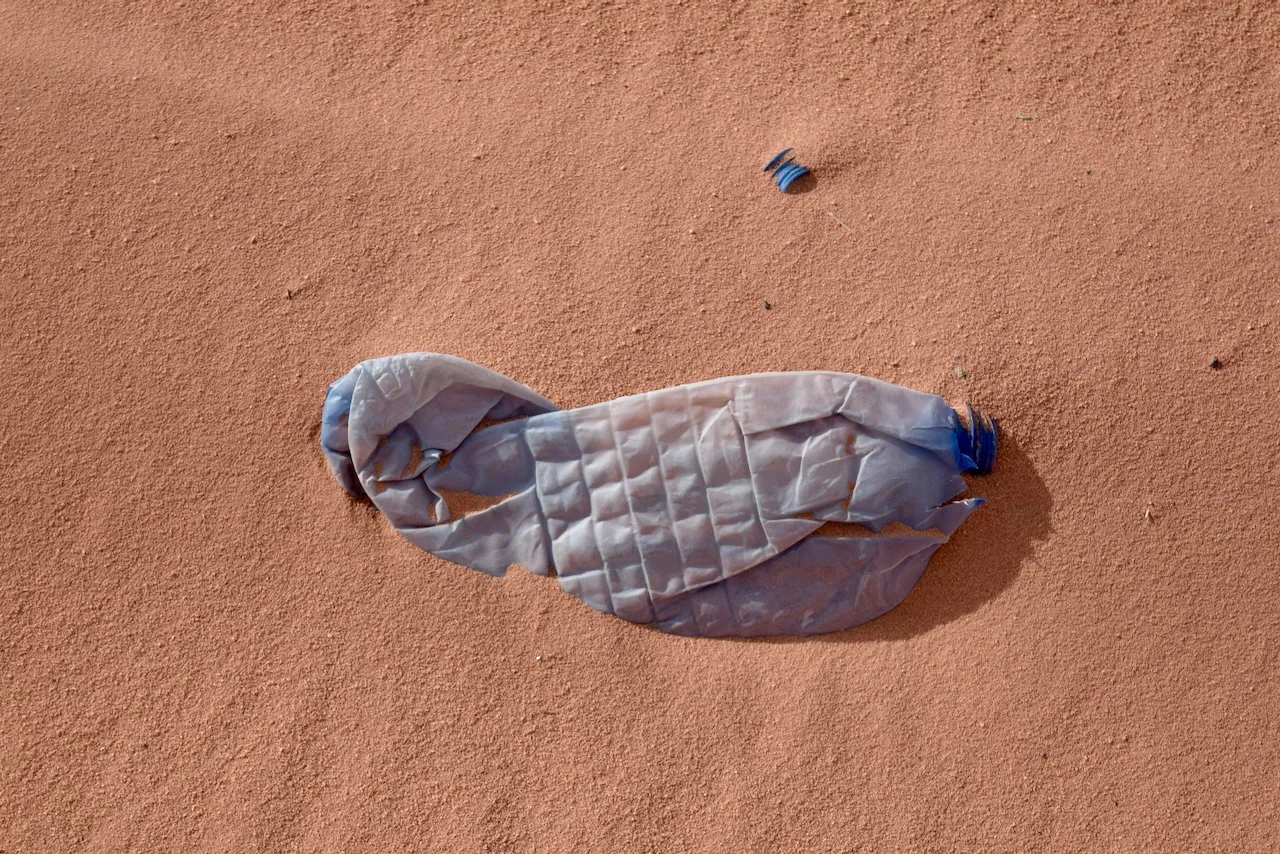
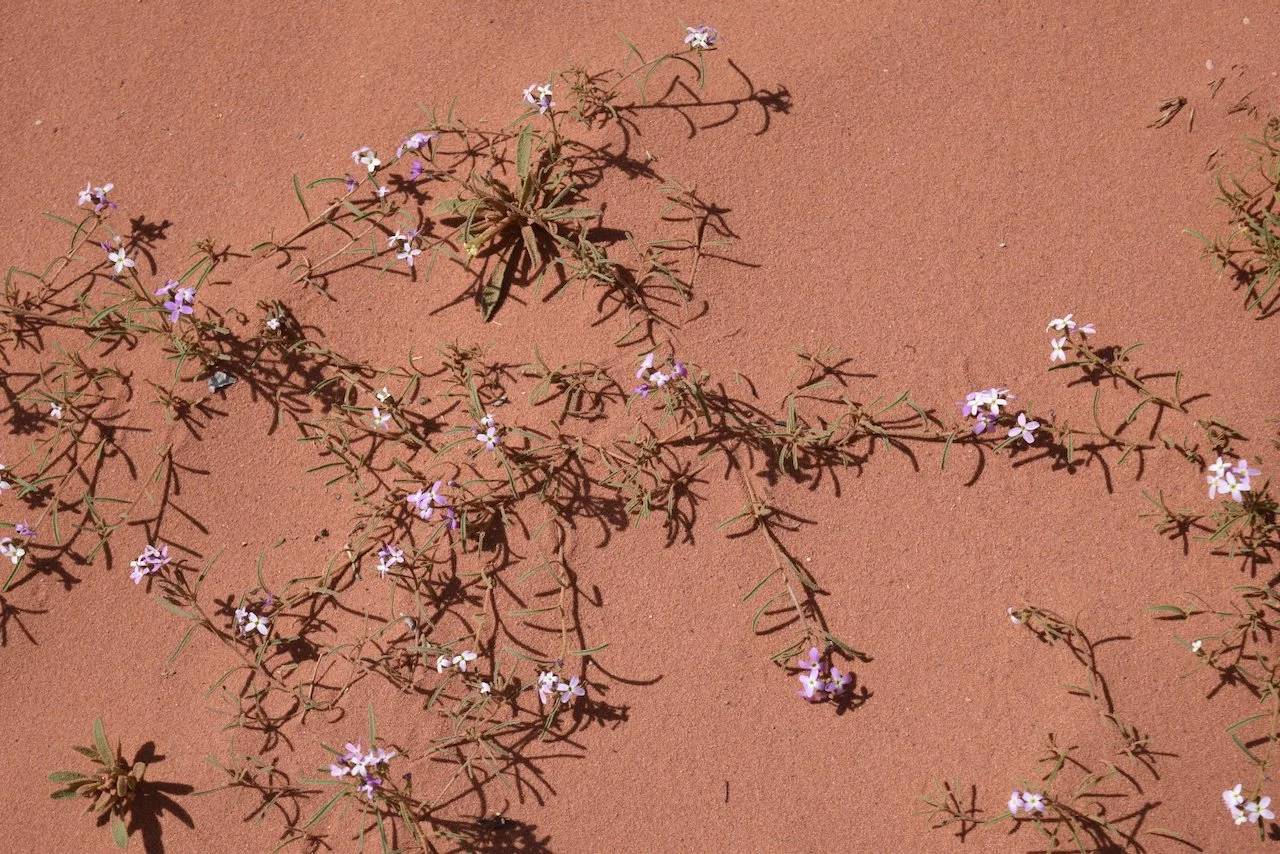
After dropping off our bags we immediately went out to explore. The idea of the desert being a place of tranquility was soon shattered by the unexpected sight and sounds of dozens of jeeps roaring and tourists yelling as they tried to get the last glimpse of sunlight and that all important sunset. This area is called – without irony – ‘Wadi Rum Protected Area’. With some 300 ‘camps’, otherwise known as hotels, it’s certainly not protected from tourists, traffic or litter (though on this count it’s not bad compared to the rest of Jordan).
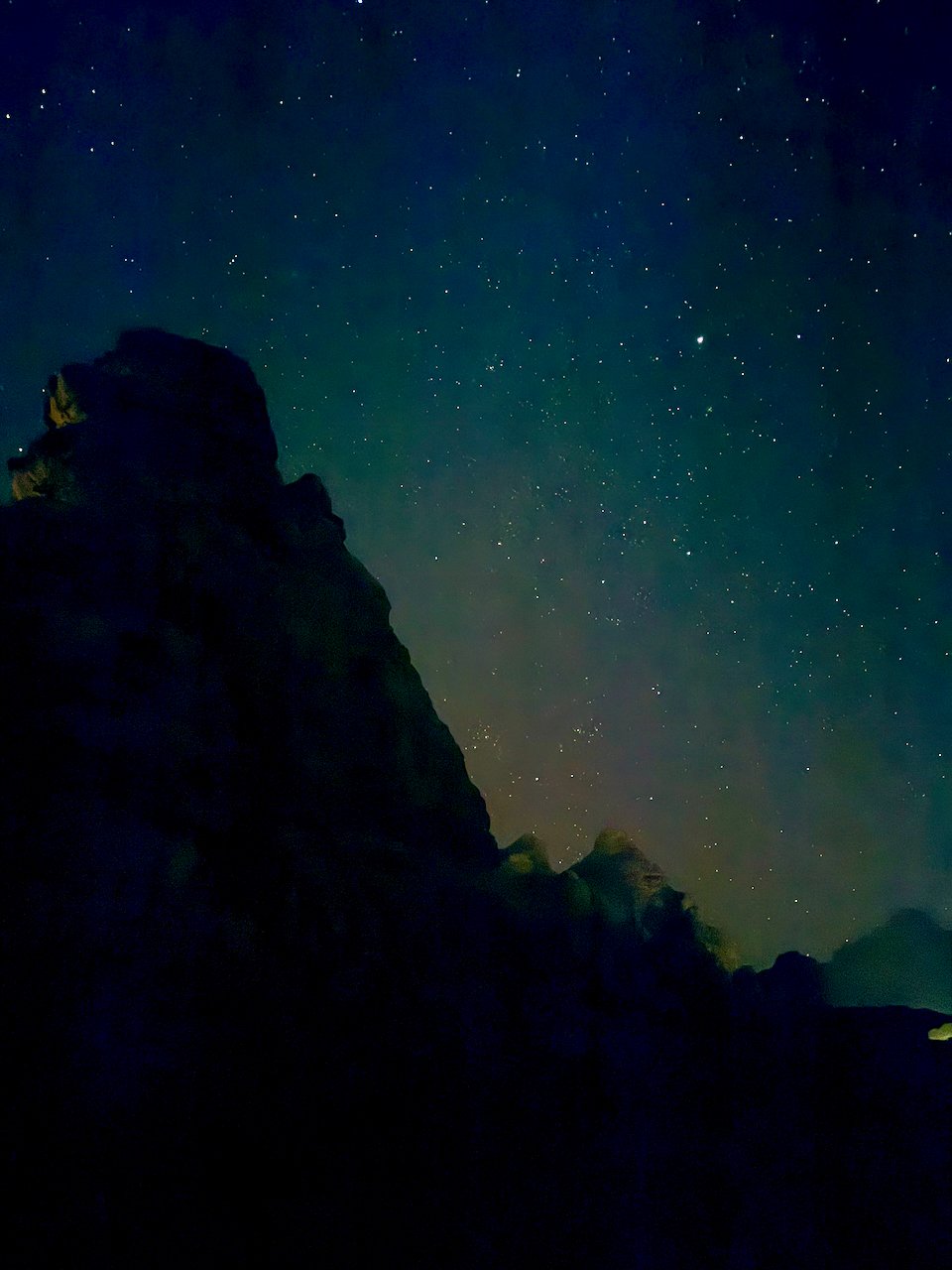
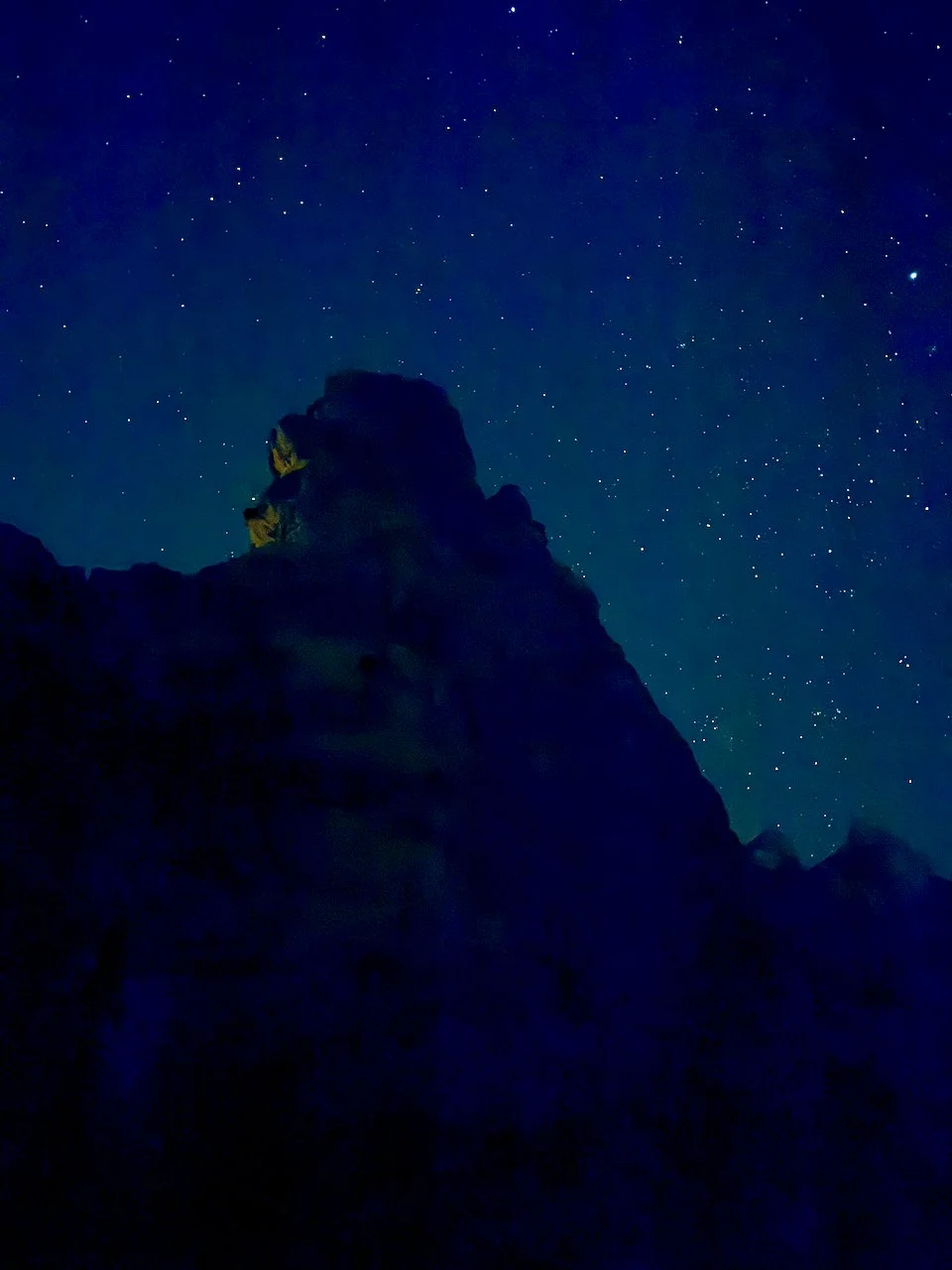
We took photos, climbed rocks and dunes, and soon it got dark and we soon got lost. I’d lost my bearings entirely; luckily H hadn’t and we managed to find out way back to camp, to be greeted by cats, of course.
Friday 13th February 2026
We were ready at 6am for a six-hour sunrise desert tour with Omar, our driver and guide (I know, we’re usually against guides, but in the desert we didn’t have a choice; we wouldn’t get very far exploring on foot). We sat in the open back of the jeep, a bumpy yet invigorating experience. Omar was in a rush to get us to a sunrise hotspot, so to speak. Some other tourists were sitting looking at it already.
I get so bored sitting around waiting for anti-climatic sunrises/sets I usually just walk off (the sun has risen and set every day for about four and a half billion years; watching it is not the most original thing to do; it tends to look the same no matter where you are), so I missed this one, and didn’t care. I was too busy “chasing a camel” as H later remarked (actually she was taking a lovely video of the sunrise when a 4×4 drove right in front of her shot, ruining the ambience somewhat). It’s true, the light was amazing looking away from the sun, and there was a random camel walking around I wanted to get a picture of.
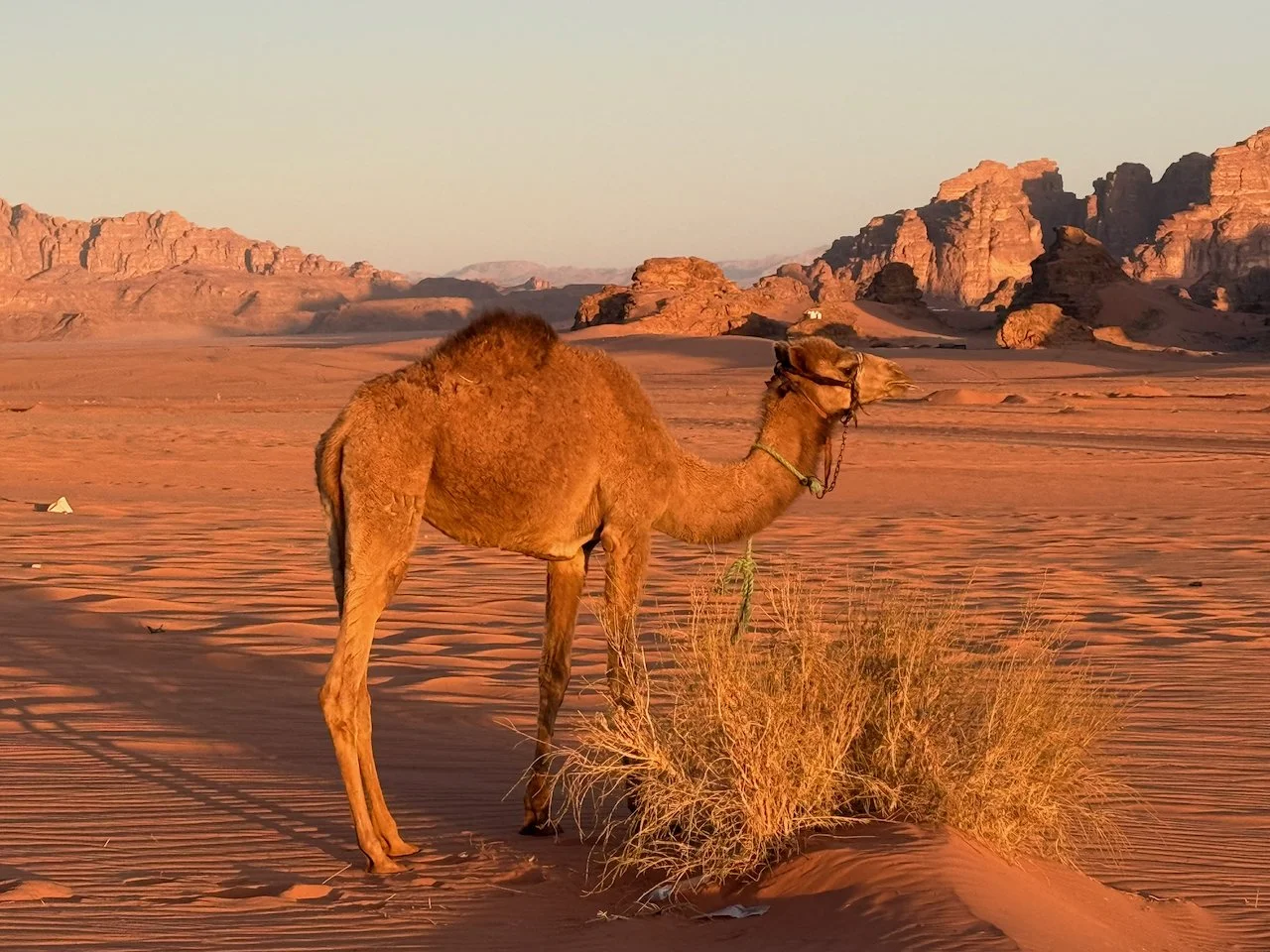
Most tourists chase the sun… I chase the camel.
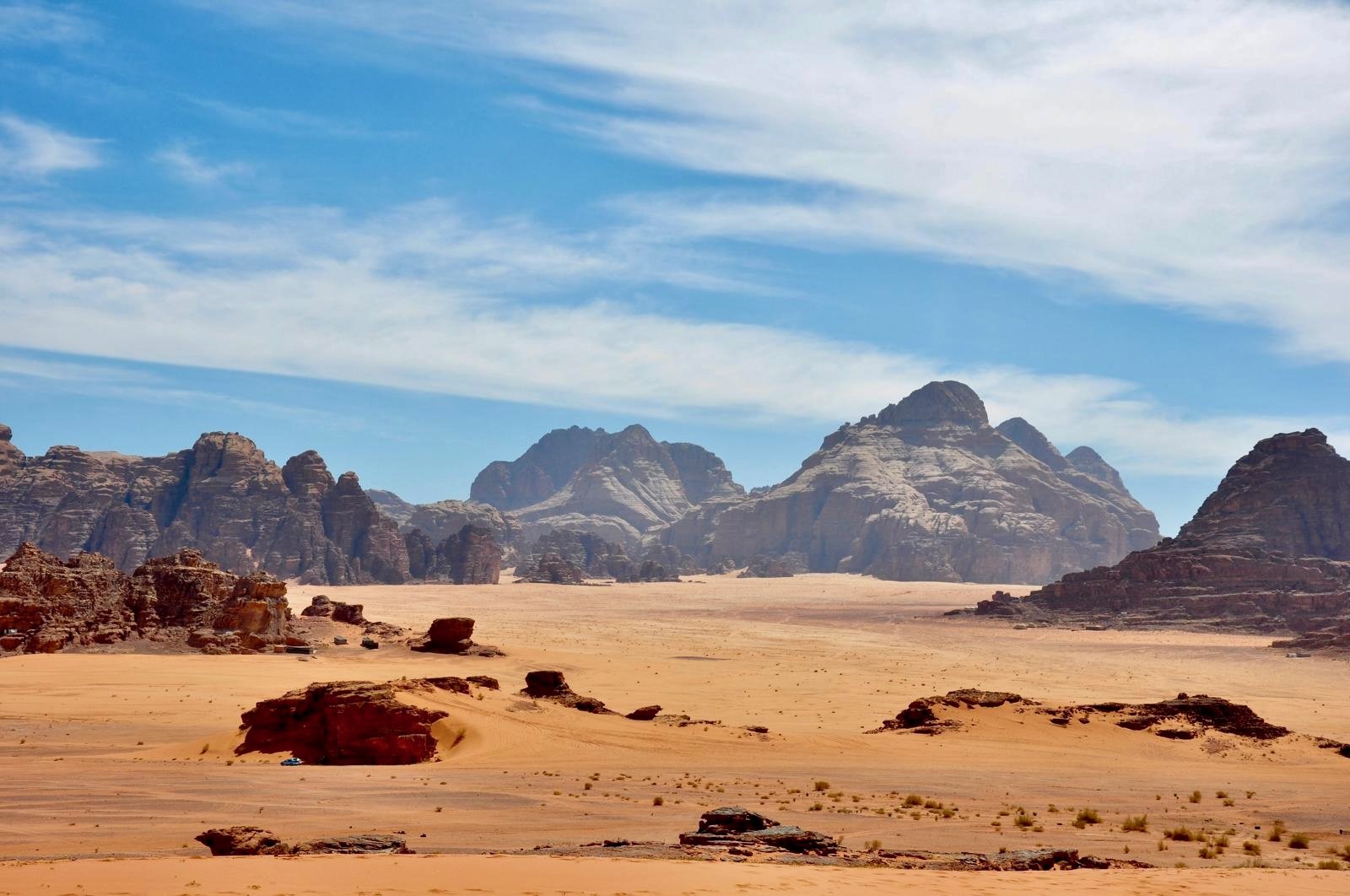
Photo of Wadi Rum by Helen Tanner.
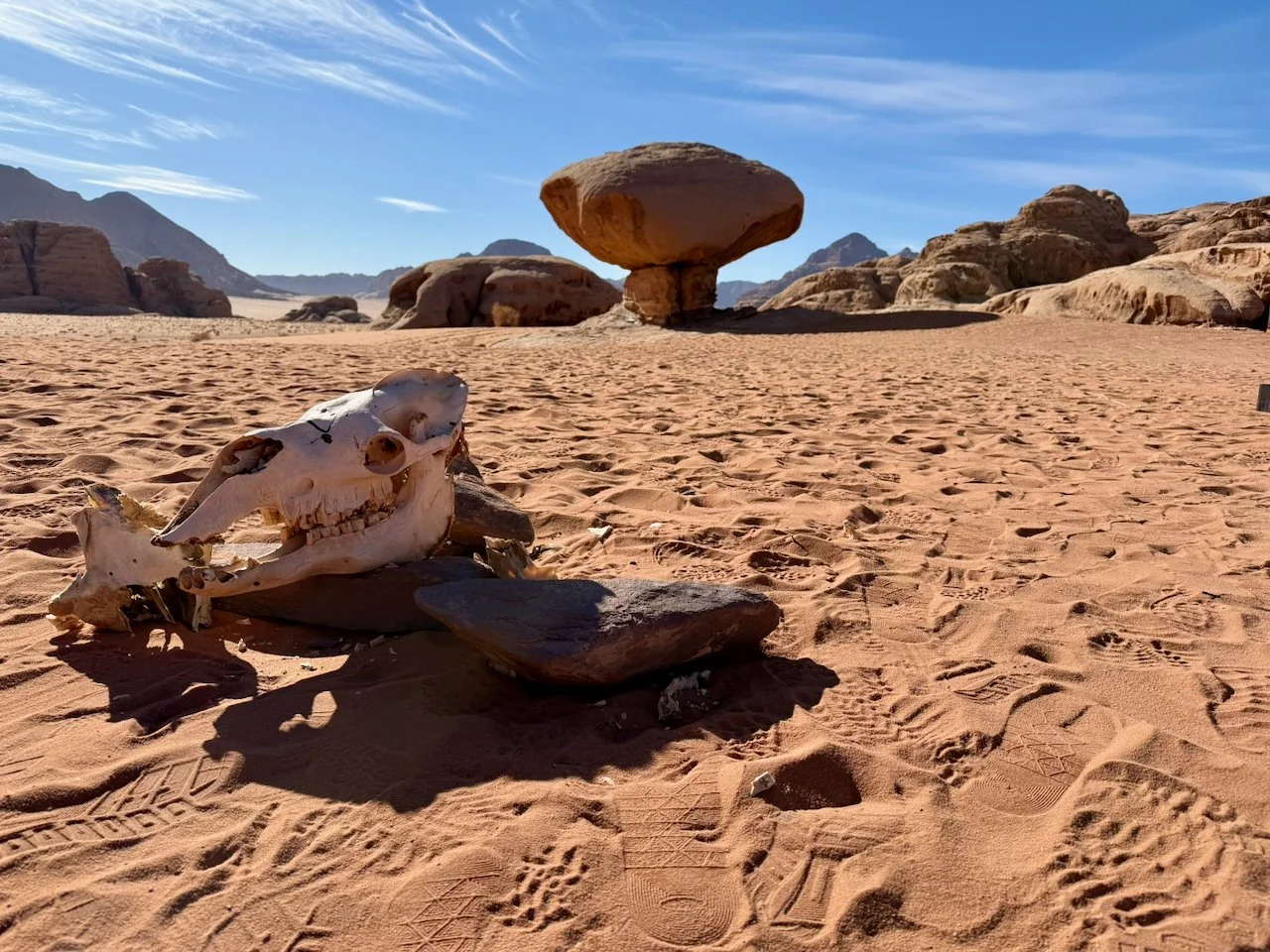
Mushroom rock and camel skull, Wadi Rum.
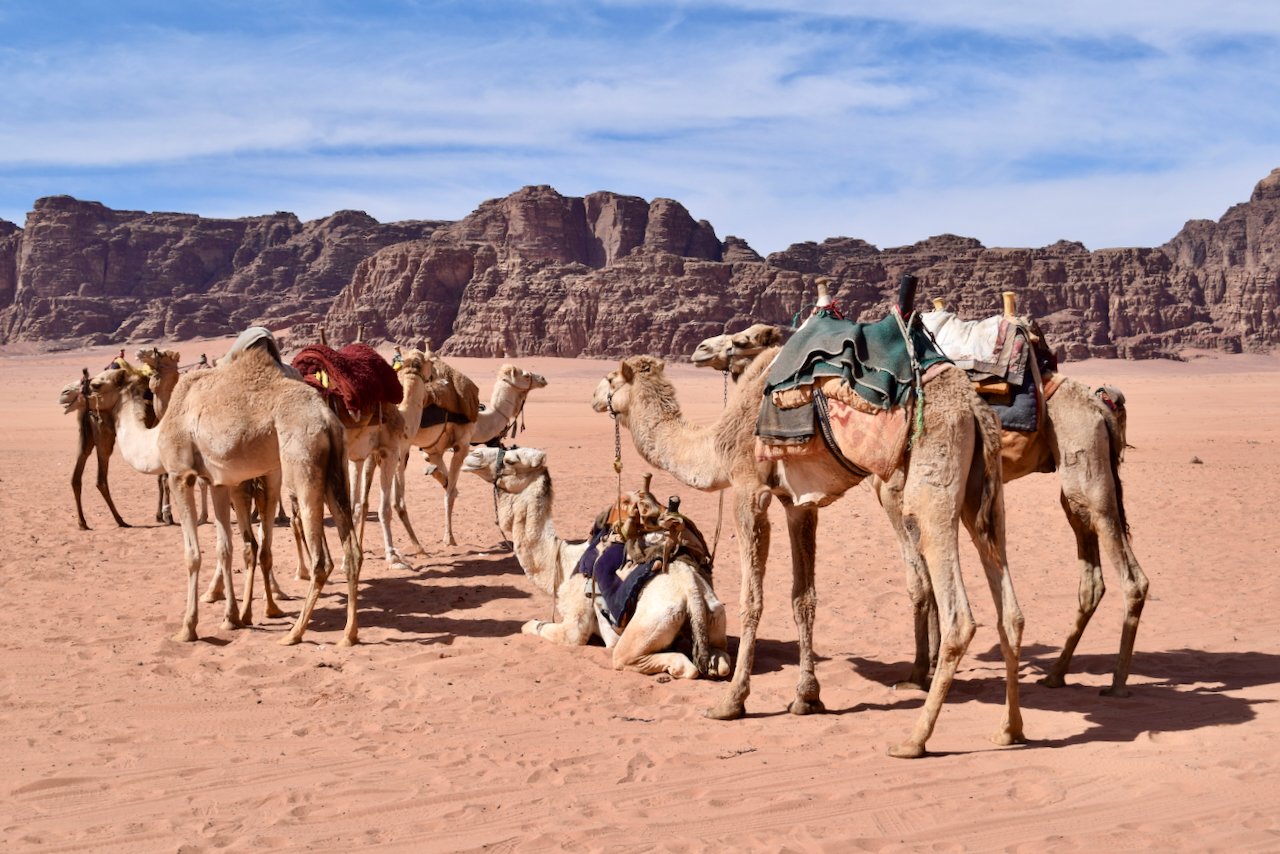
Hanging out with the camels, Wadi Rum.
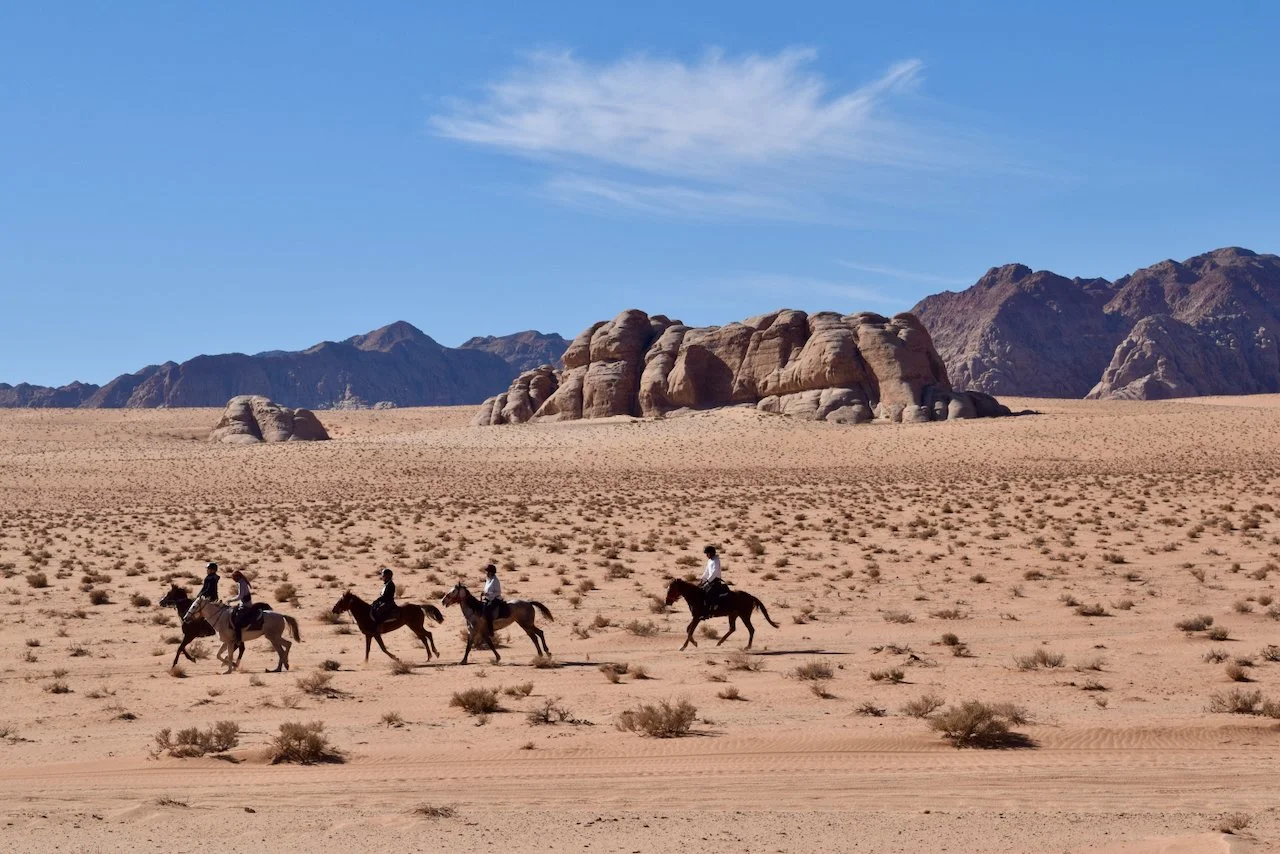
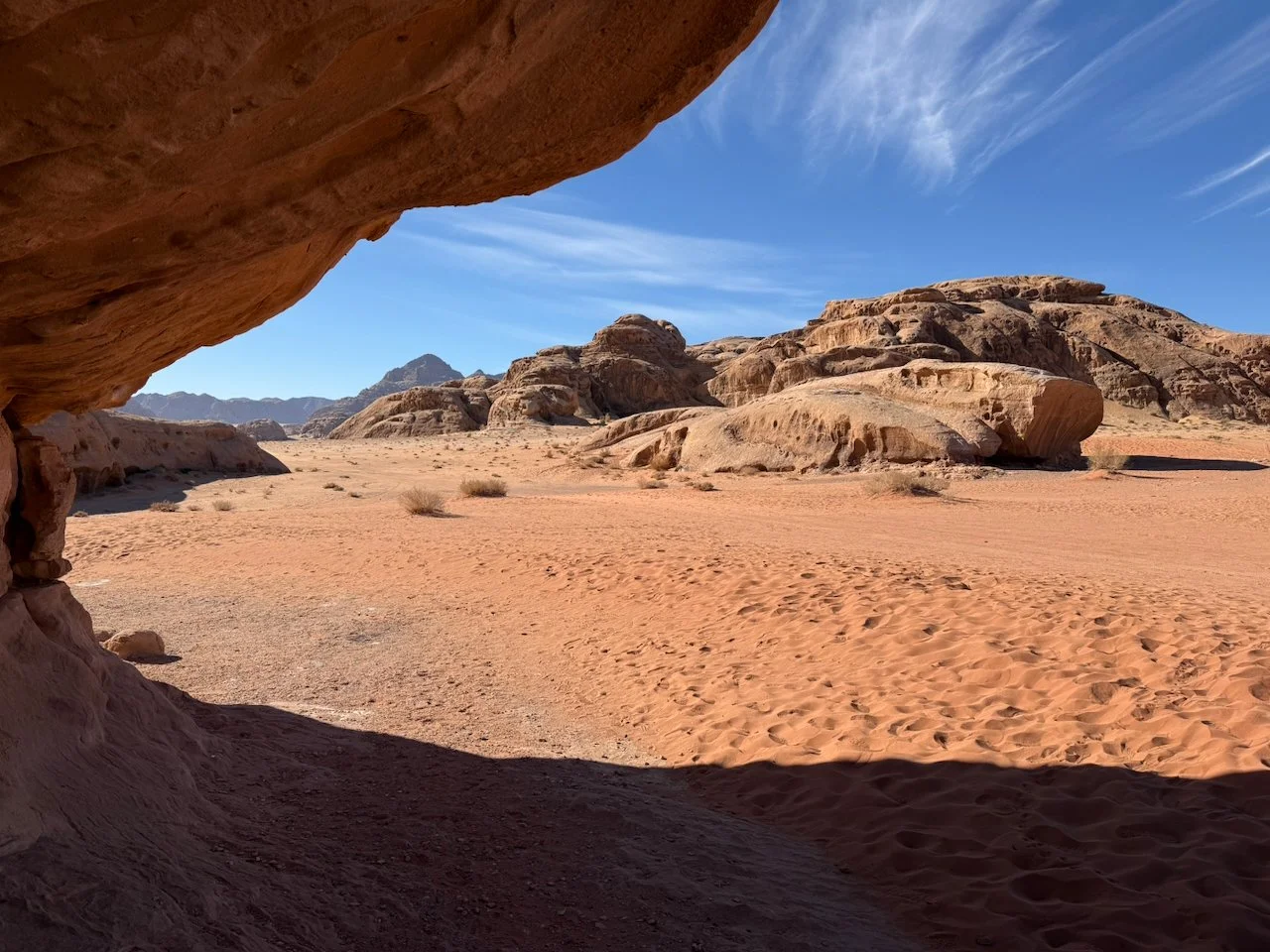
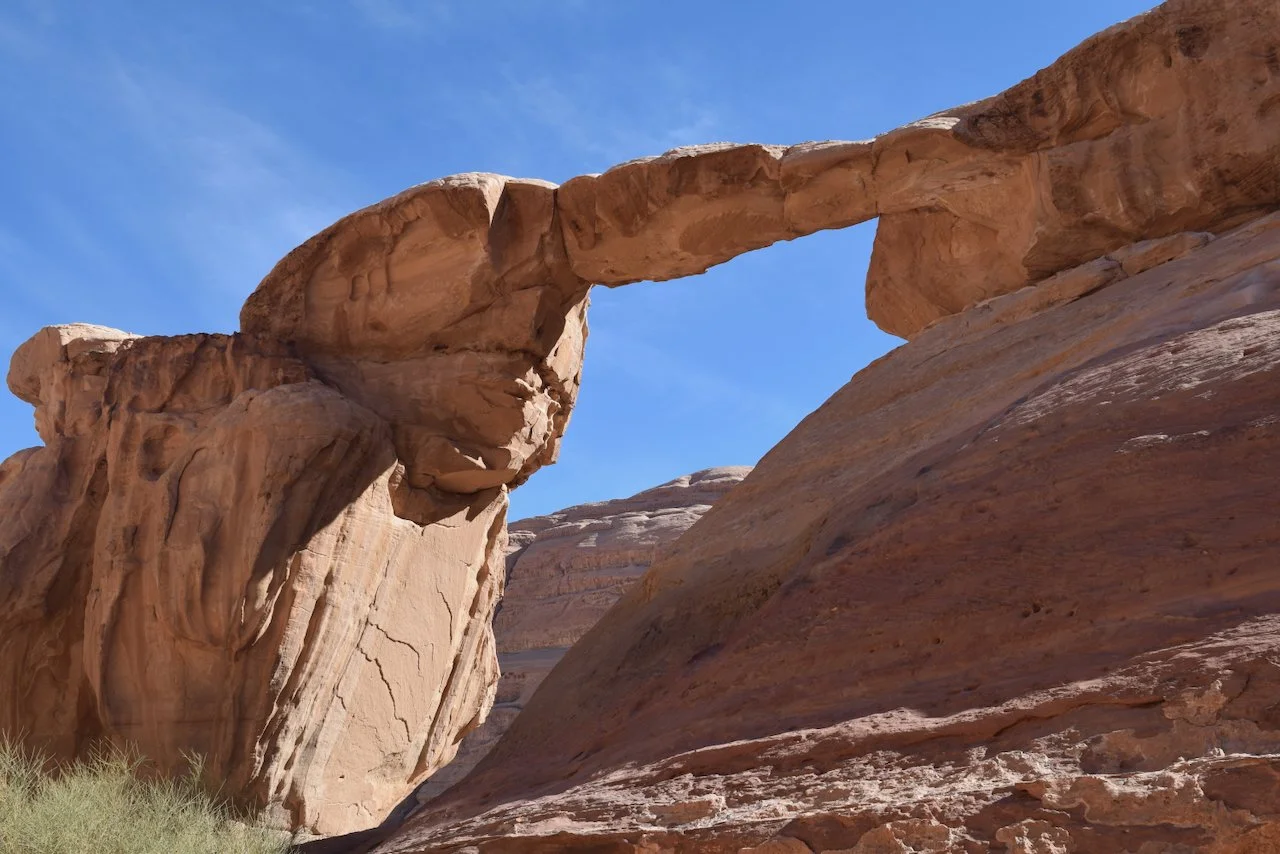
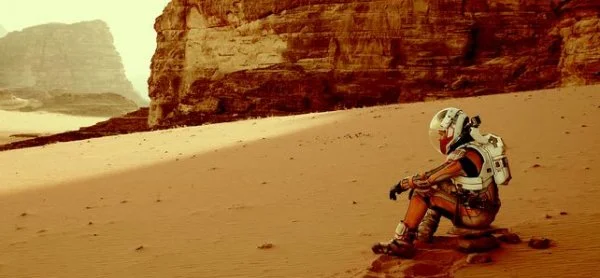
After I climbed over the Um Frouth rock bridge (above, right), part of the tour, we stopped in a Bedouin tent for refreshments. Over coffee, I told Omar and some other Bedouins there that I had a proposition. Eh? They said. That is, I clarified, I have a business deal. Ah. They didn’t seem too interested to hear but I told them anyway. They should rent out spacesuits for tourists, so they can look like Matt Damon in The Martian. Silence. I asked a passing German tourist if he’d be interested. No I wouldn’t, he said, barely pausing to answer. Anyway, I think they’re missing a trick. They’ve got the space domes, why not the spacesuits?
Later, I asked Omar if he’d ever eaten camel (they do in other countries but they’re mostly too valuable to eat). Would you eat your cat? He retorted, then showed me really cute videos on his phone of him returning home from being away a while and his camel running to greet him. I would love a pet camel.
Literally half an hour after Omar told us everyone here loves tourists, a shepherd was pointing his finger in my face and shouting aggressively at me in what I could only presume was a non-stop barrage of abuse. I actually couldn’t guess what he was so upset about (even Omar thought at first he needed our help) until he stormed off five minutes later and I asked Omar. ‘He’s stupid’ he said. Okay, I replied, but what did he say? He doesn’t like his photo being taken, he doesn’t like social media. Stuff like that. Okay, I get that, but in our photos he was just a speck in the distance. We joked that we have to have one cultural embarrassment per day. This one was pretty early in the day.
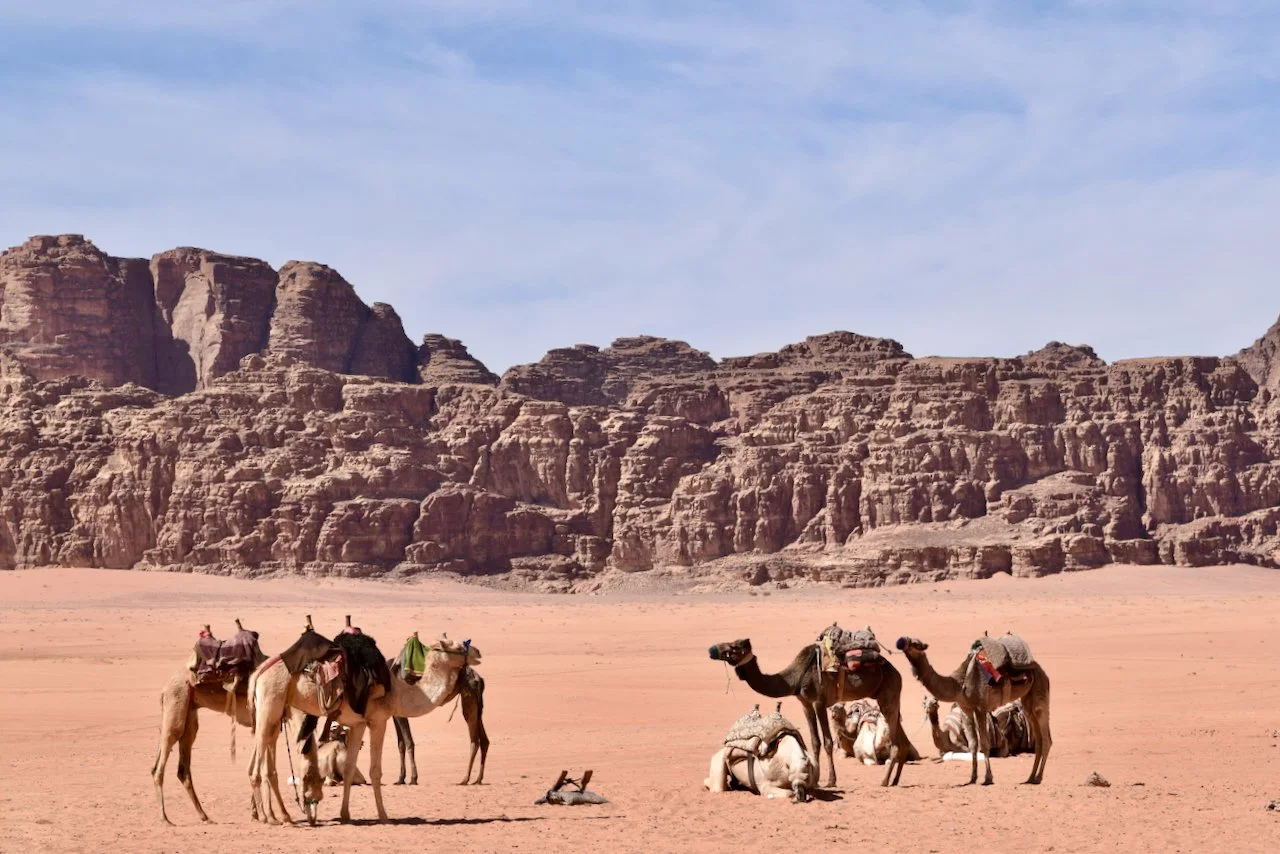
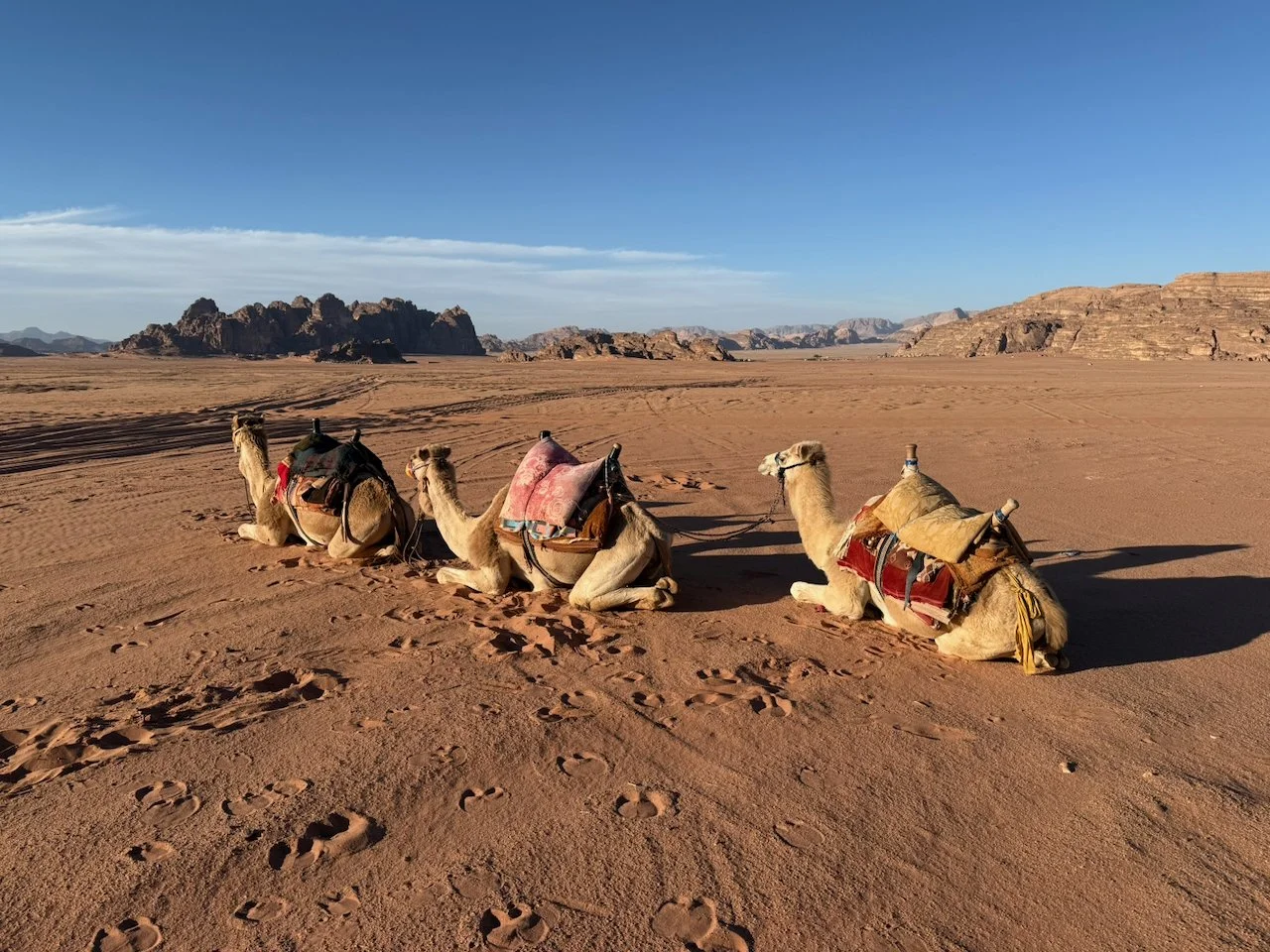
We were driven to various famous rocks and viewpoints, but it didn’t matter, it was all incredible, the light, the silence (actually very few other jeeps early in the morning), the red sand and the vast rocks. And the cats and the camels (neither wild anymore). And small, mysterious footprints in the sand (possibly desert hedgehogs or foxes). I could spend a month just here. We had eight days to do the entire country.
One of the last sights on the list was the rock now called the Seven Pillars of Wisdom, to honour the title of Lawrence’s autobiography. The rock itself has no significance to Lawrence and doesn’t even have seven pillars. Each location we stopped at we’d spend longer than we should and Omar would holler ‘Yalla, Habibi’, an informal way of saying, ‘Let’s go, Darling’. It became a running joke, and I would say it as often as I could for the rest of the trip.
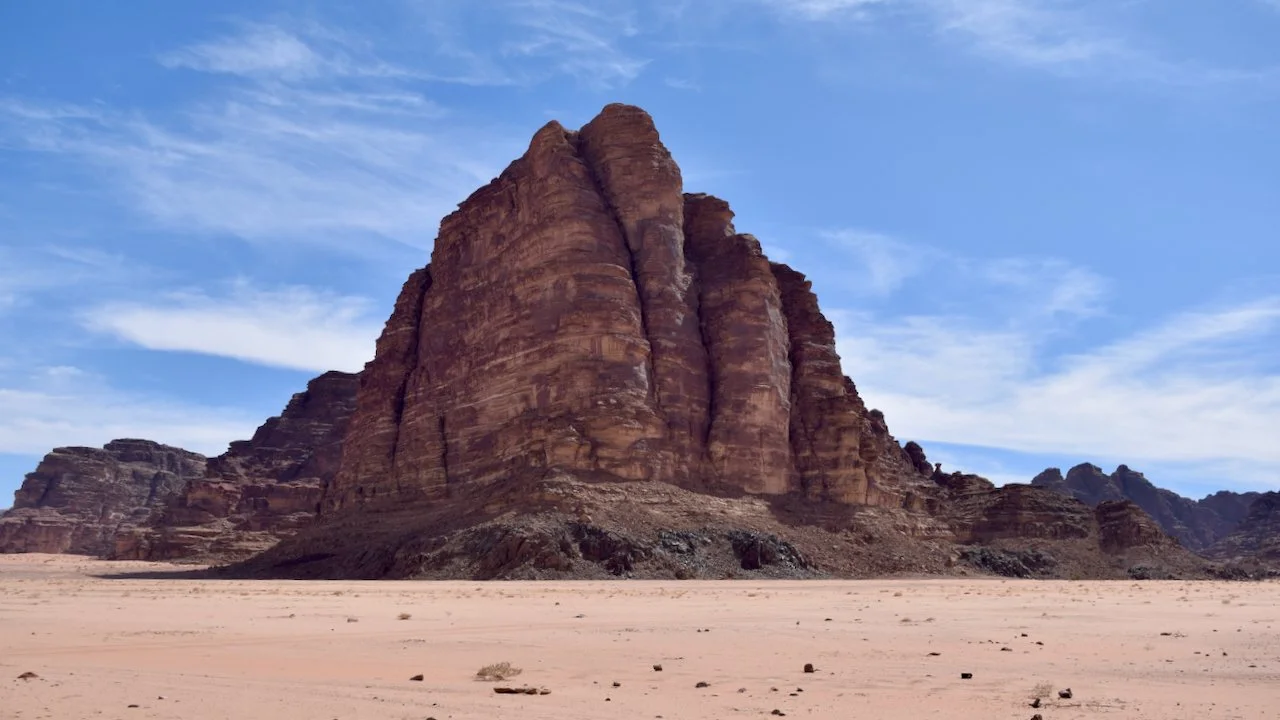
The Five Pillars of Wisdom?
We ended with a treat for me, one of the locations of The Martian, now ruined, ironically, with dozens of space domes dotting the landscape. Anyway, as I said, being able to hire spacesuits seems pretty essential to me to fully capture the Mars ambiance.
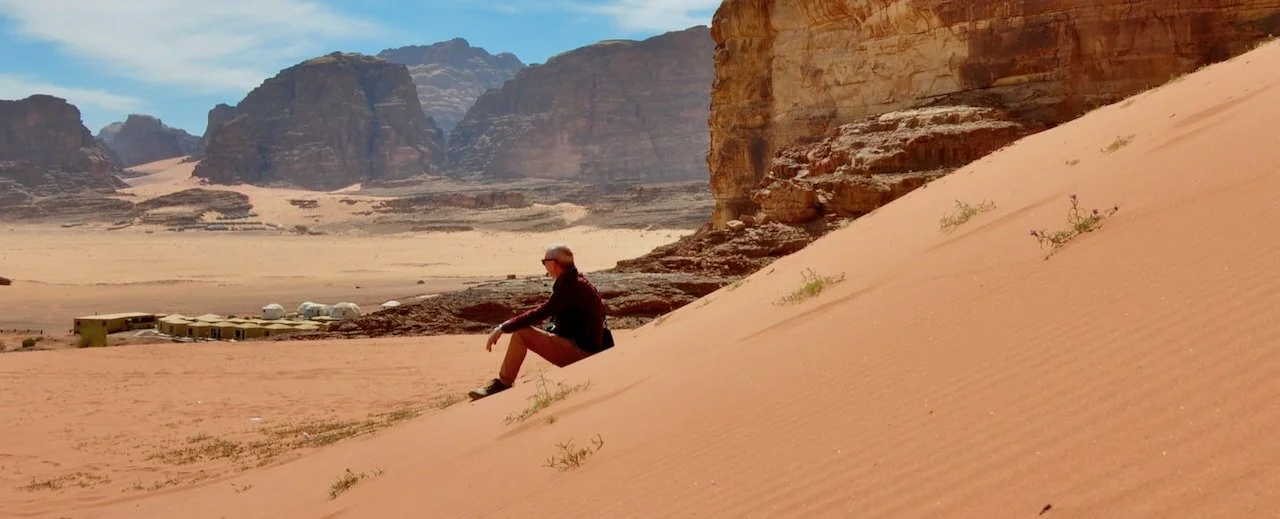
When we returned to our hotel, we knew lunch was included as part of the tour. Expecting a sandwich, we had no idea it would look like this (they were really confused by Helen being vegan; for the tour breakfast all she got was fruit (I obviously shared mine with her). For lunch she got fish. Go figure).
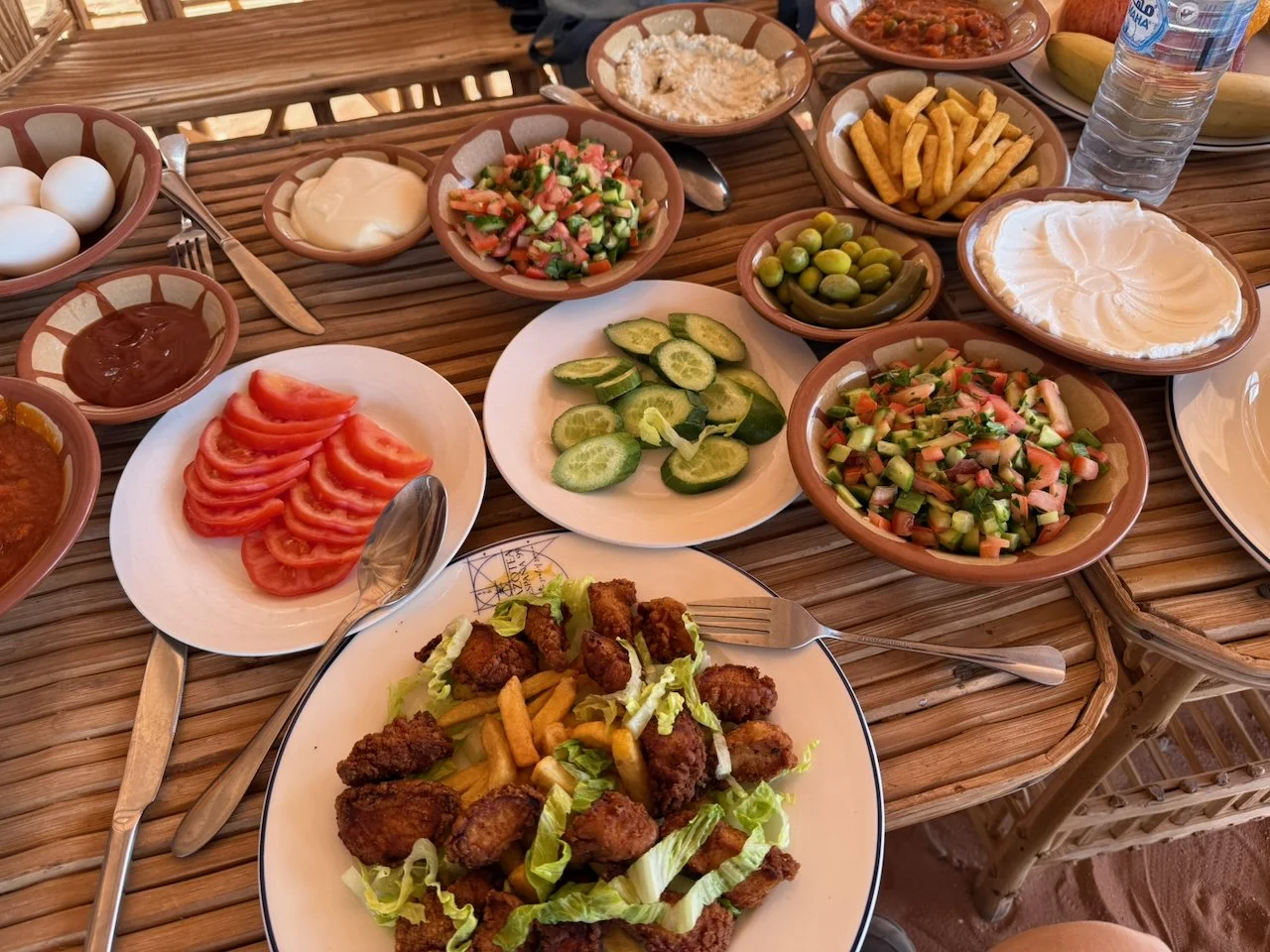
Post-desert tour lunch.
The dashing hotel owner took us in his 4×4 to the bus station, where we slummed it with other travellers, a very long, cramped bus journey back to downtown Amman. We got a taxi to our hotel from the bus station, and the old taxi driver tried to con us by pretending we’d given him the wrong note. It left a sour taste.
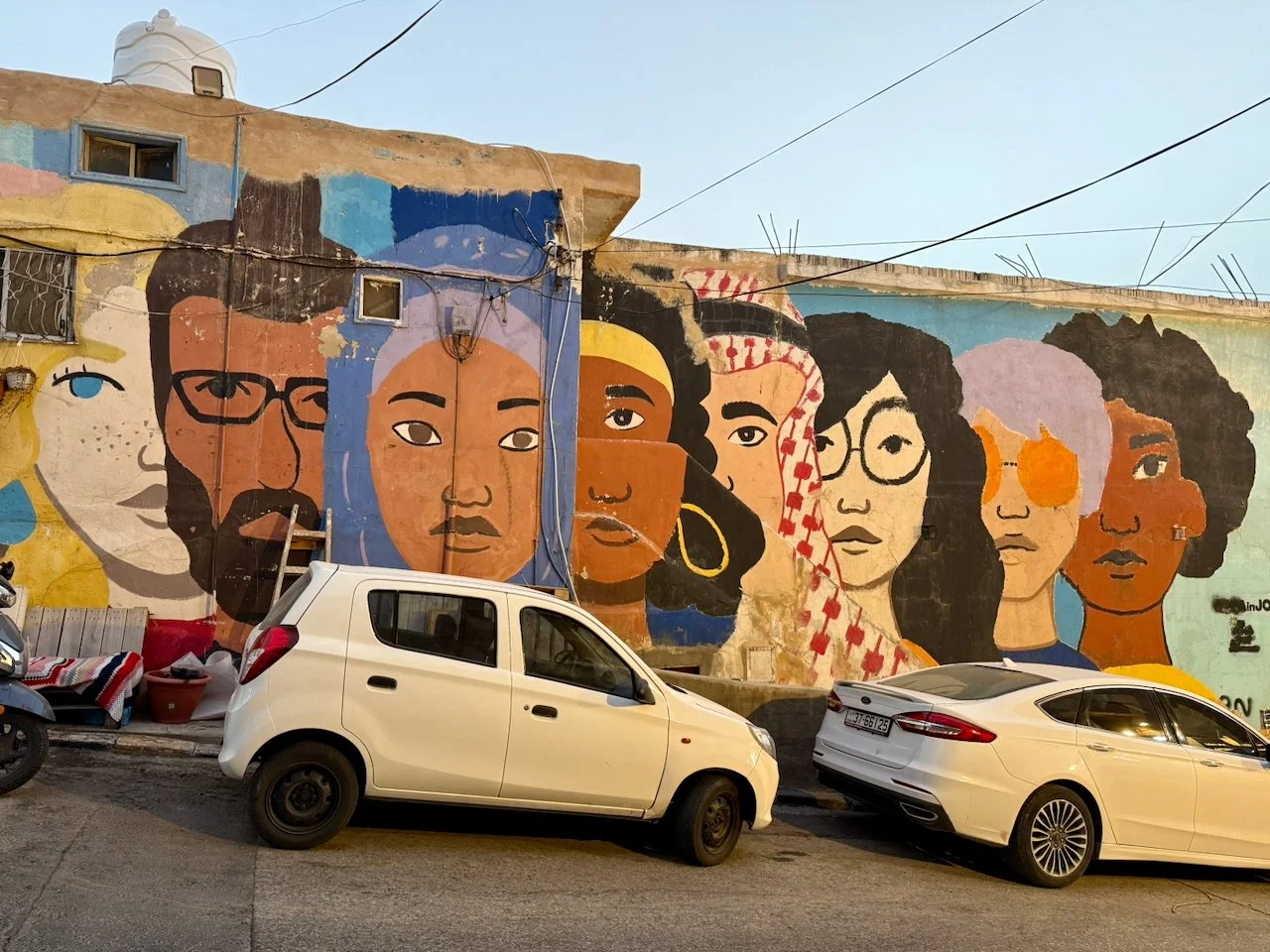
Mural near our hotel, downtown Amman.
Saturday 14th February 2026
We shared a minivan for a day trip to Mount Nobo, Madaba and the Dead Sea with three young South Koreans, a couple and a quirky woman travelling on her own. Apparently she was a travel blogger or something, and had been everywhere. She chatted to absolutely everyone she came across, drivers, security guards, other tourists, but never even looked at H or me for the entire day.
Though we’d already been to Madaba and Mount Nobo (briefly), a day tour was best value as the only way to go to the Dead Sea was by booking through a hotel (until I realised afterwards we could have gone to a locals beach for free), and it was just as cheap to do a day tour.
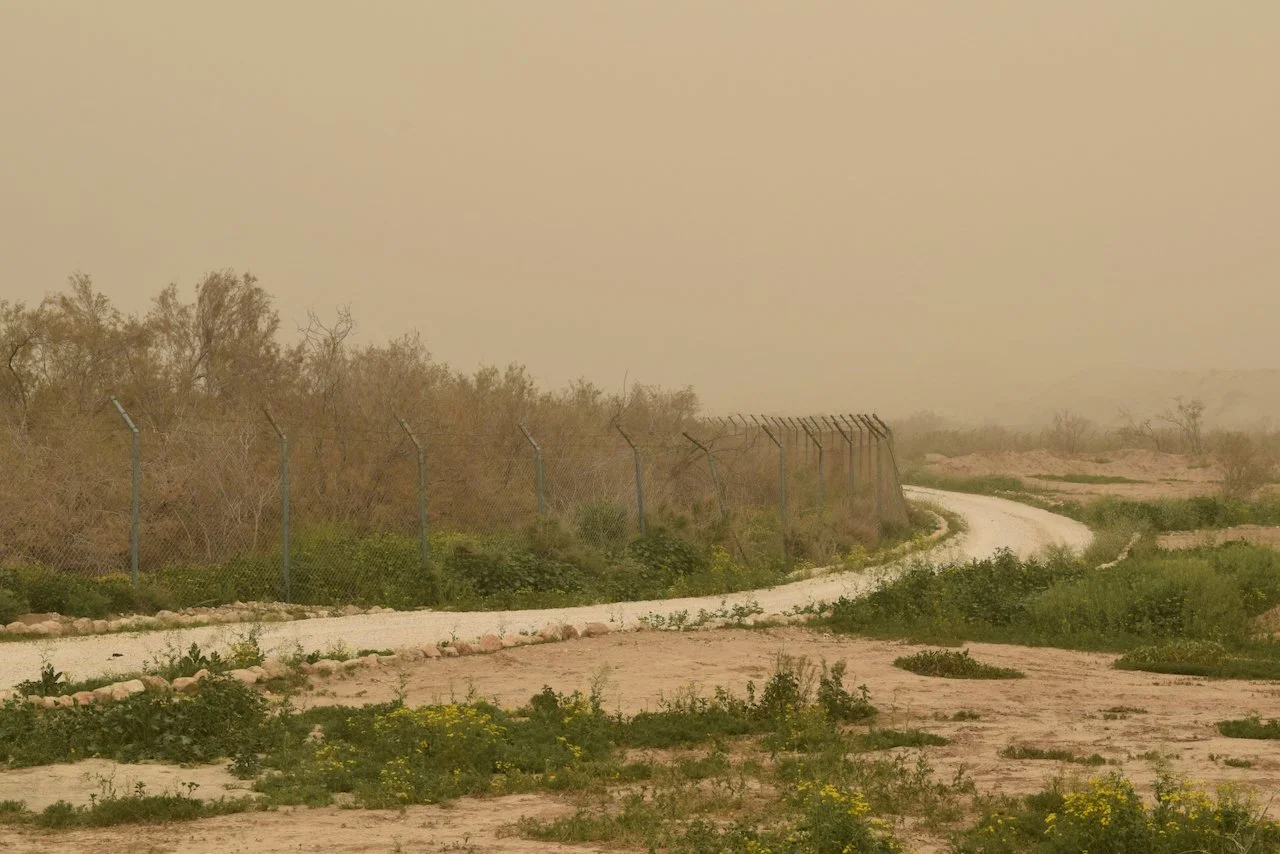
It was a dusty day and visibility was low, everything a haze of sand. We didn’t spend long in Madaba, then went onto Mount Nobo, the site where Moses is said to have died after viewing the Promised Land. There were fine views when we last went, but now completely hazy. In the Memorial Church of Moses there were wonderful 6th century mosaics.
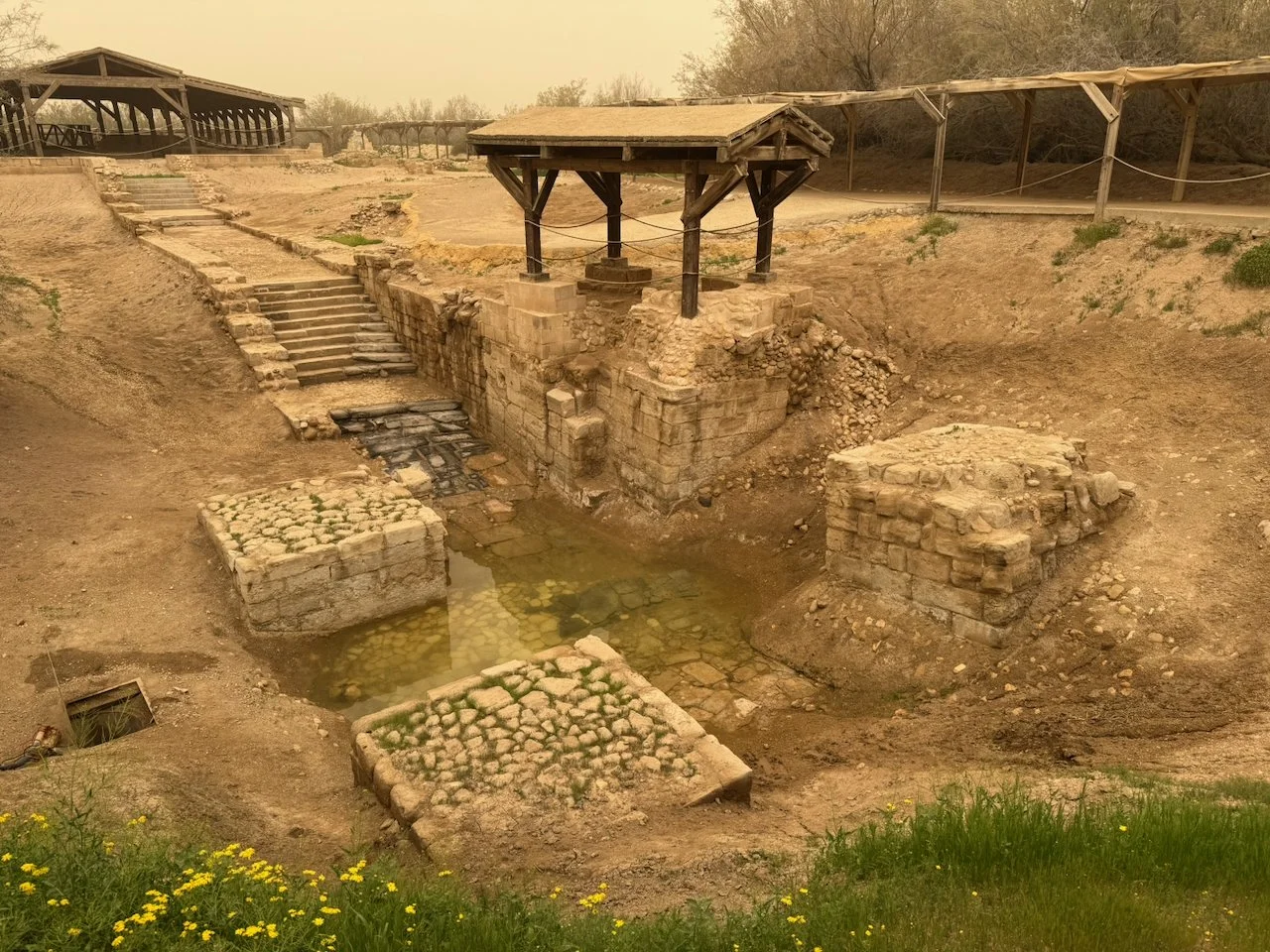
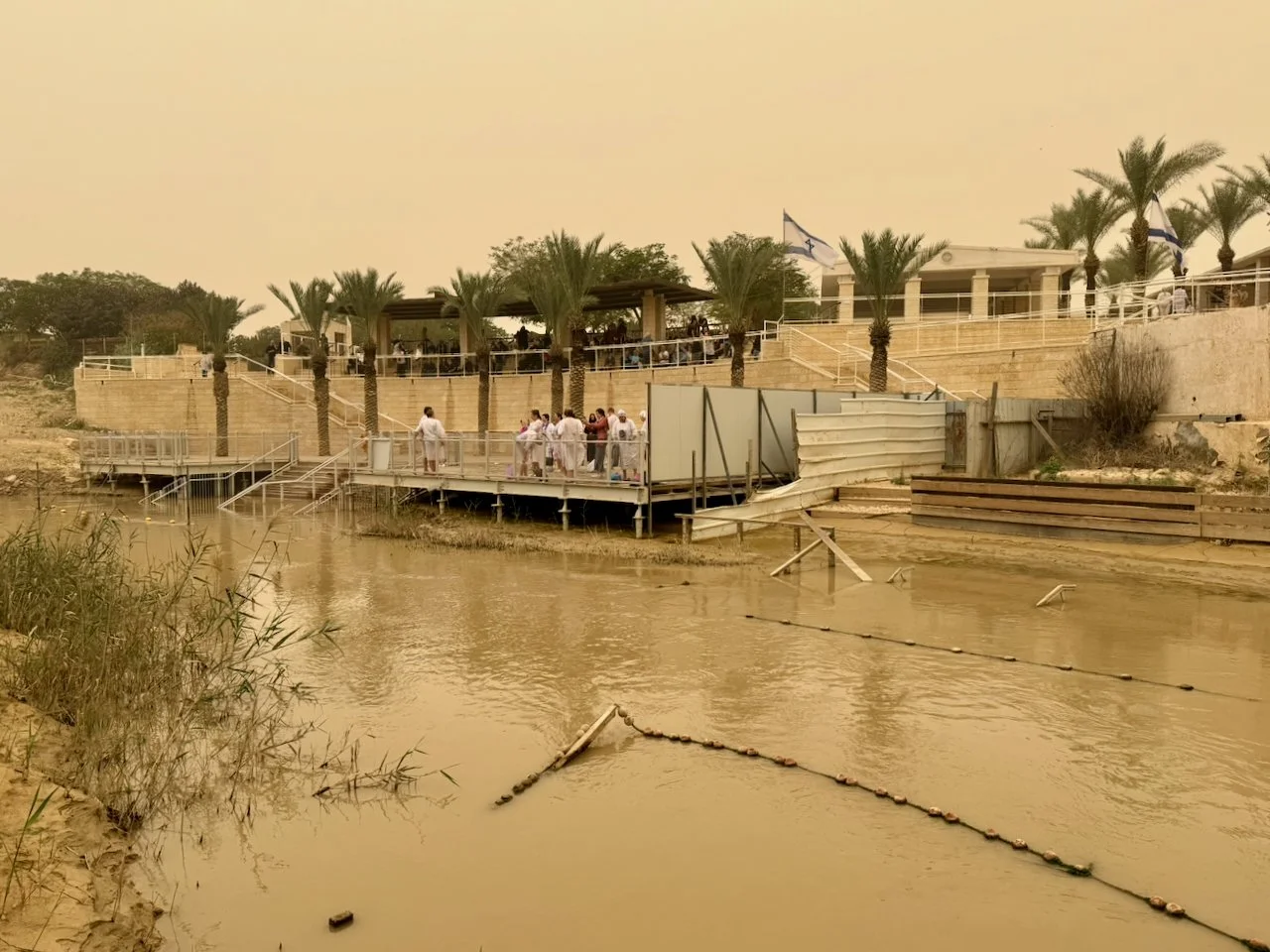
From there it was a tour to the Baptism Site ‘Bethany Beyond the Jordan’, the location where Jesus was baptised by John the Baptist. Then we walked to the river Jordan. Due to the hazy weather, the day had a surreal, almost apocalyptic feel but surreal didn’t come close to describing watching Isrealis on the other side of a narrow stretch of the Jordan river on the West Bank, having a jolly as if genocide wasn’t being committed a few miles away from them.
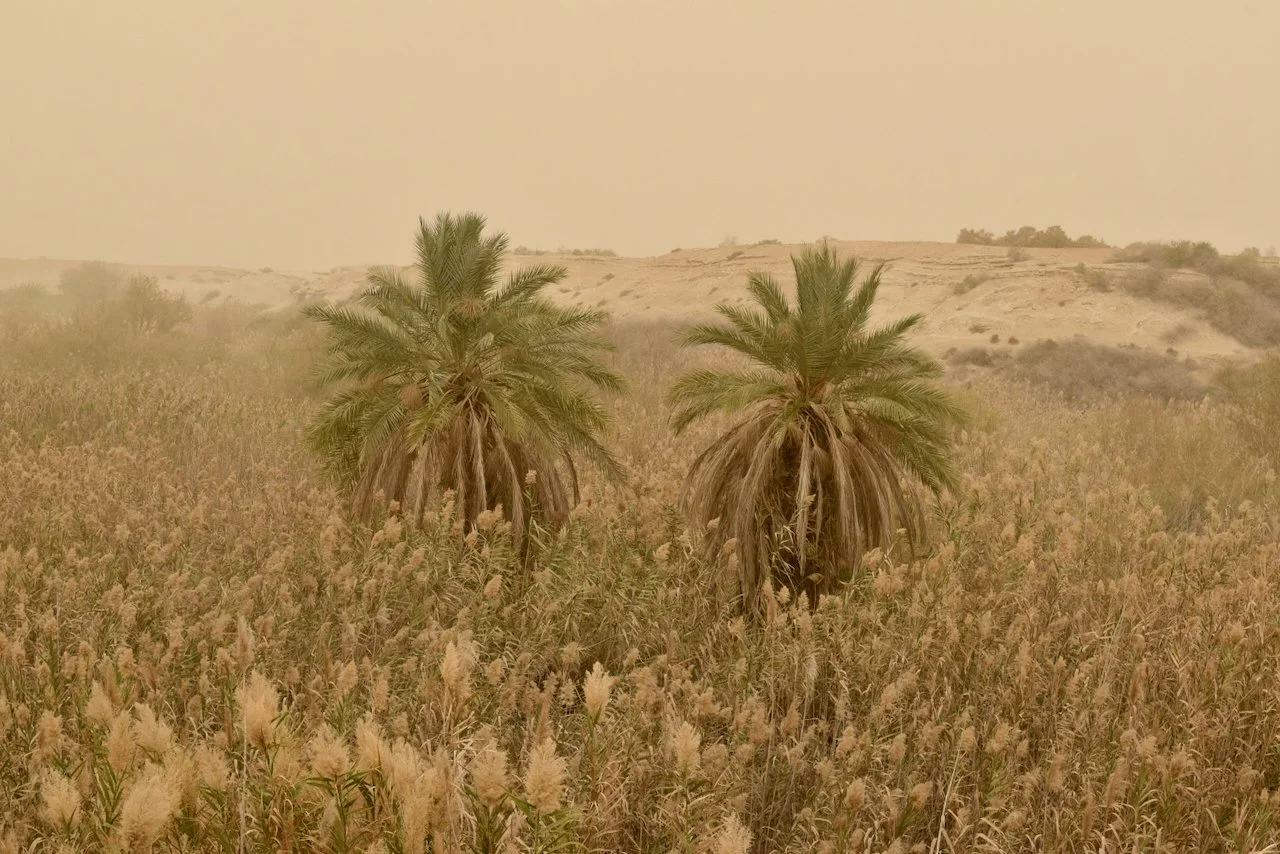
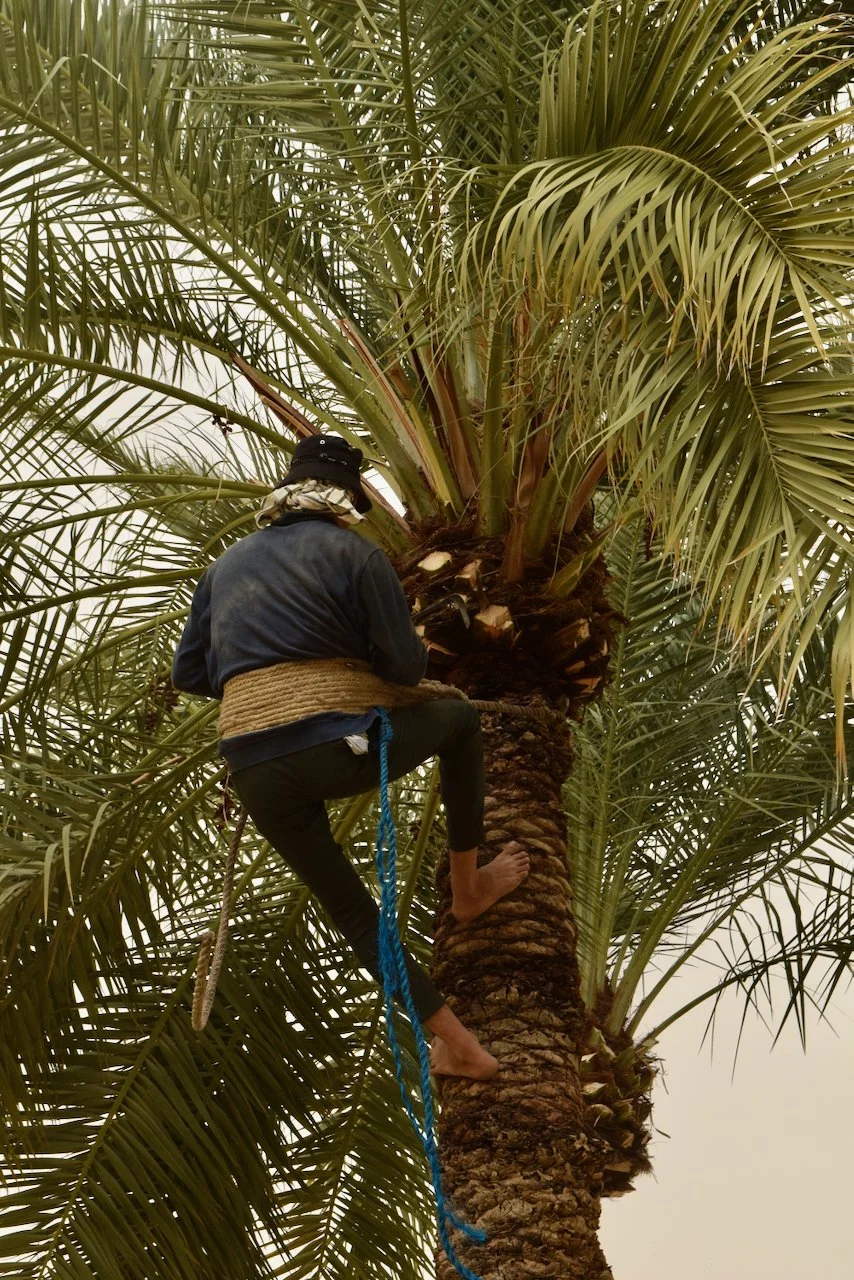
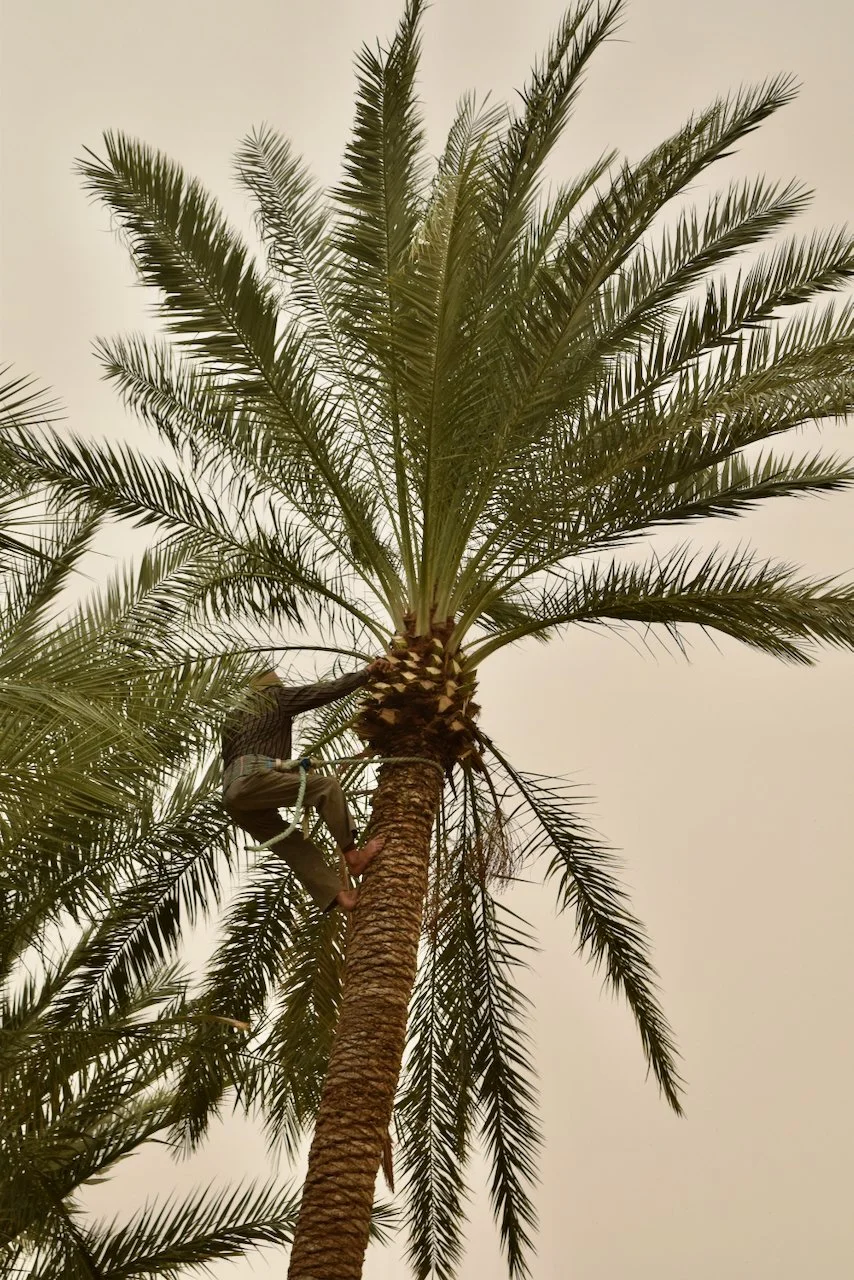
Anyway, what I liked best after all that was actually watching two guys climbing up palm trees with just a bit of rope and cutting off the fronds.
I can’t remember why but we dropped the solo South Korean off at a random restaurant whilst the rest of us went to a luxury resort. I’m never properly hungry when presented with an all you can eat buffet, and this one was one of those occasions and also one of the best I’ve ever seen. Whilst everyone else had dainty salads and healthy stuff, I filled my plate with as much meat and cake as it could hold, but could only manage to eat two plates. We sat with the South Korean couple, lucky my knowledge of South Korean cinema is pretty good and we chatted Bong Joon-ho and Park Chan-wook over ribs. The woman enjoyed theme parks and they both travelled the world visiting them. They lived in Seoul and had good jobs. They too found the solo woman, well, quirky, and had only met her today.
We were literally at the lowest point on earth – the Dead Sea is 400 metres below sea level. And contains ten times as much salt as a regular sea, hence the dead bit, and the floating bit. The hotel may have been a luxury resort but the beach was like a building site, with rubble. We slapped mud on each other, waited for it to harden until we both felt like the Tin Man from The Wizard of Oz, then washed it off by floating in the sea. As I say, a surreal day.
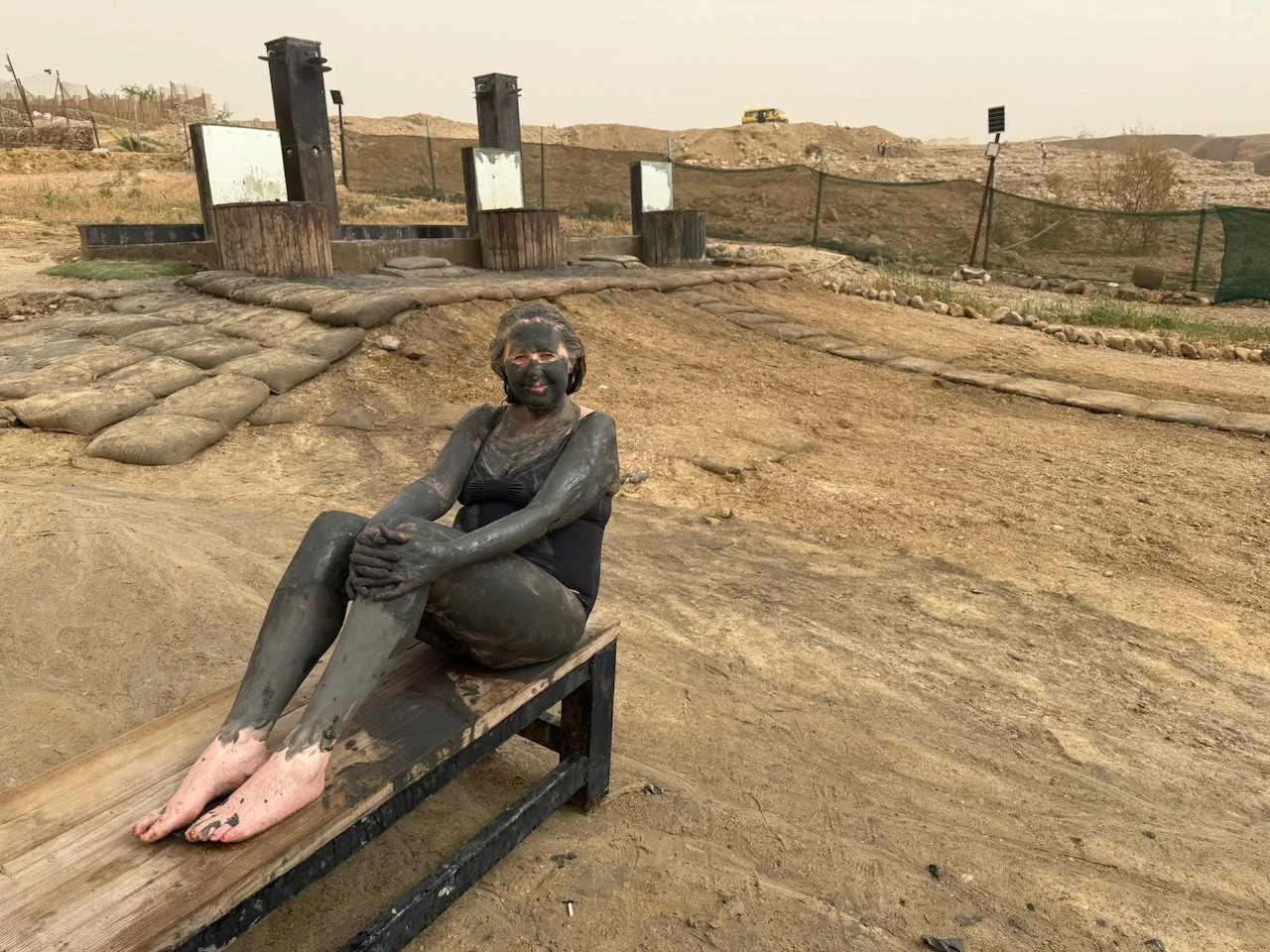
An all-over mud pack, madam?
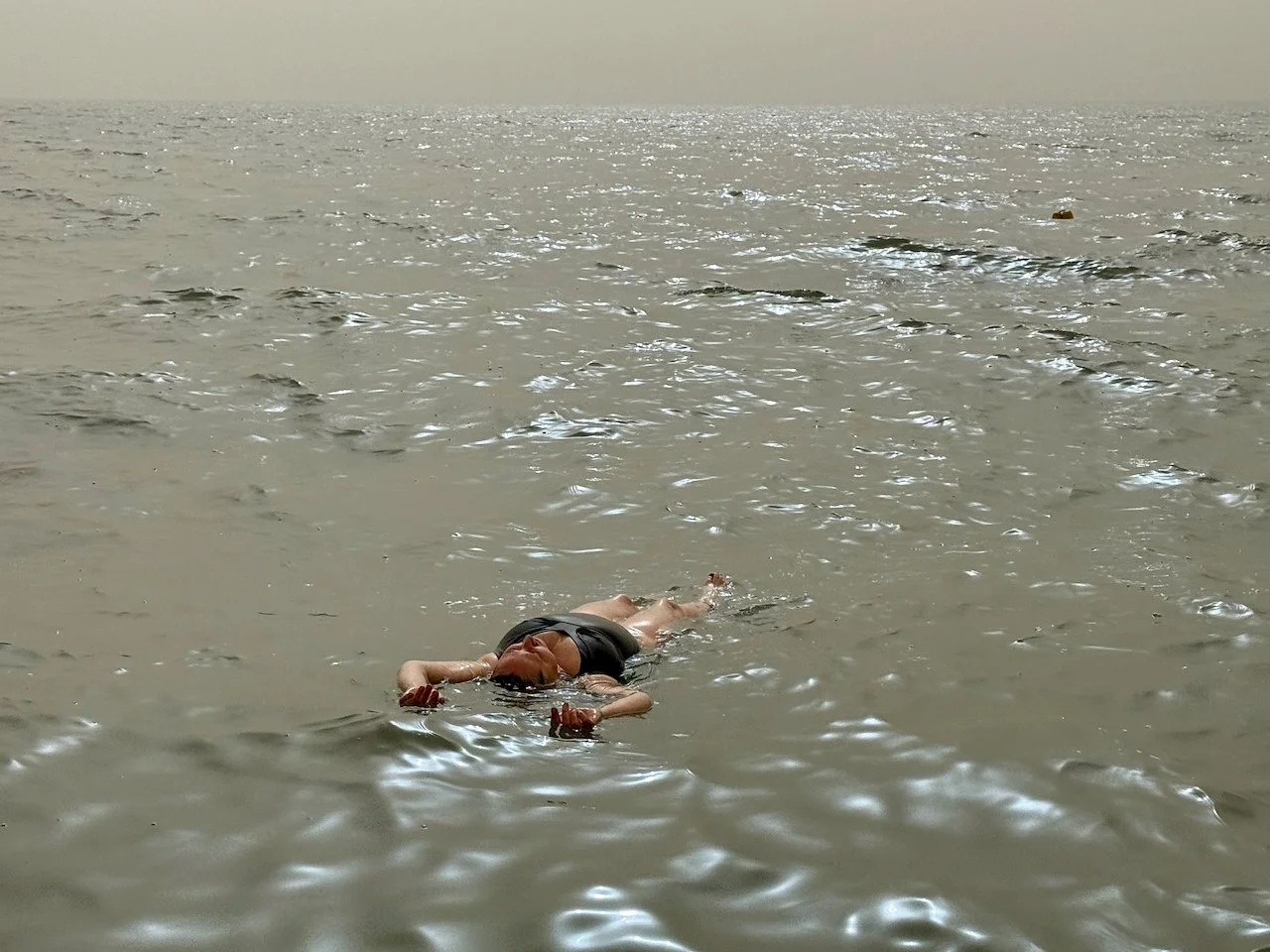
Floating.
On the way back, just a few miles from all the posh resorts, was a military training area, with big guns and tanks right next to the road. We picked up the South Korean woman then went back to Amman.
In the evening we treated ourselves to a meal at Jafra, a stylish and atmospheric restaurant recommended to us. Old-fashioned wooden tables and chairs, with ancient analogue wirelesses gathering dust on shelves, black and white photos on the walls and exposed pipes on the ceiling, the aroma of shisha smoke in the air, all combined to give it a unique, boho atmosphere.
We got back to the hotel late. It was Valentine’s Day, but any thoughts of romance were soon dashed by the dodgy plumbing in our bathroom, where shit and water would rise from the shower floor and flood the bathroom whenever we used the toilet or sink, soon making it a no-go zone.
Sunday 15th February 2026
Our last morning, strolling through town, we bought some delicious pastries from a bakery, then a strong Turkish coffee a few doors along. I was starting to enjoy Amman. We had a lot to fit in on our last day as we had to be back by 12pm for an appointment – a driver was picking us up to meet my colleague’s former colleague, Khaled, who runs a publishing company in Amman.
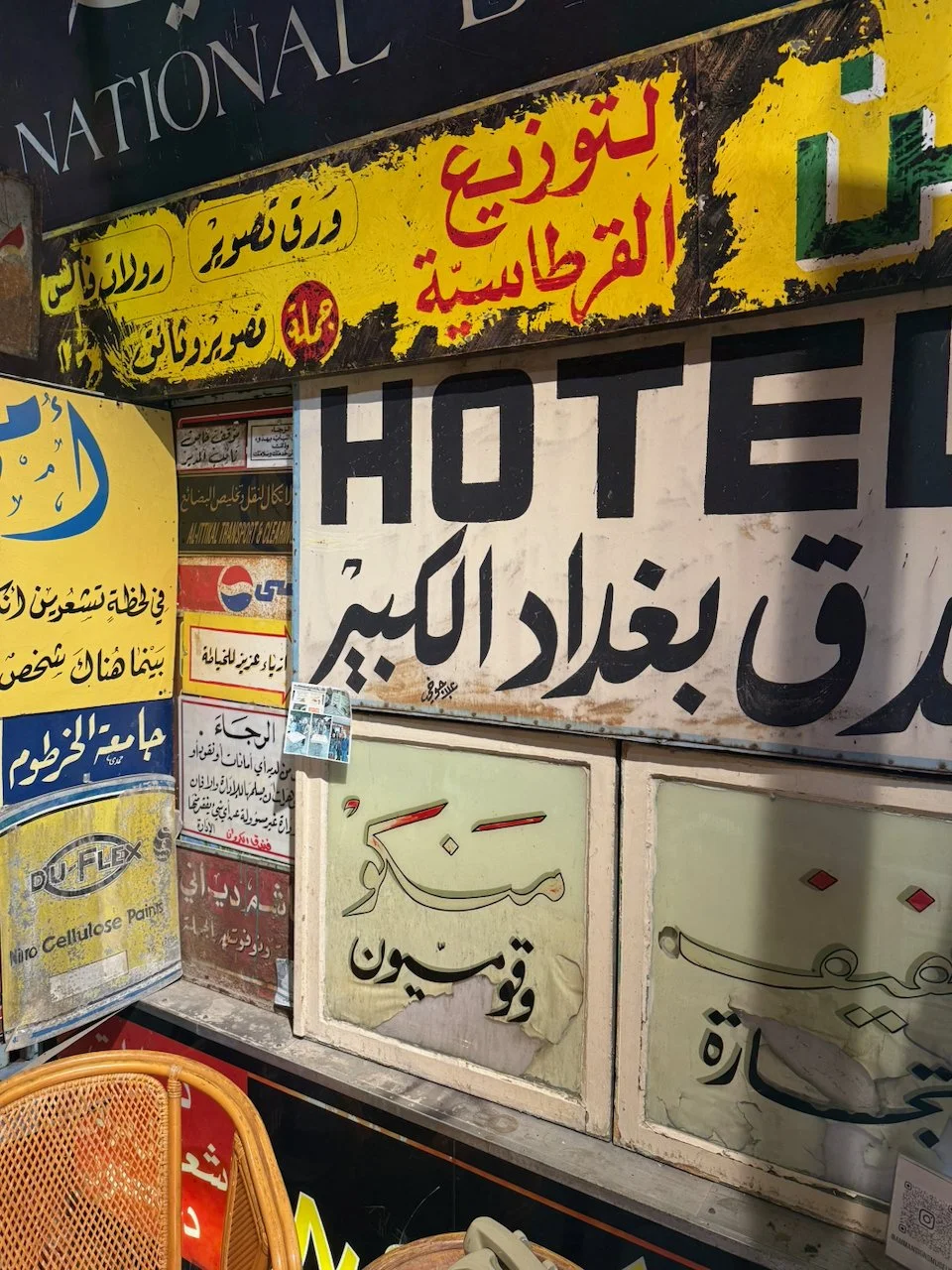
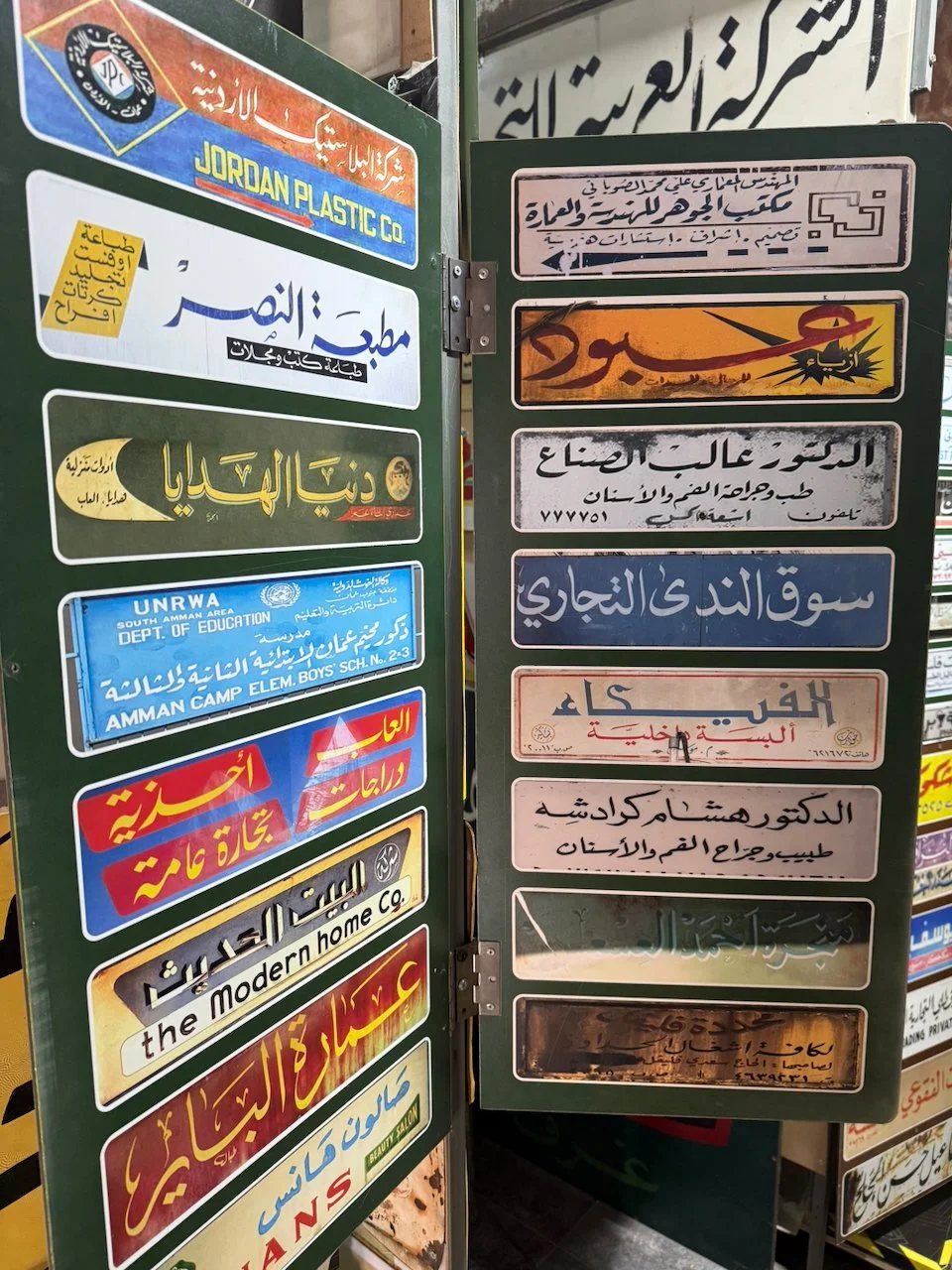
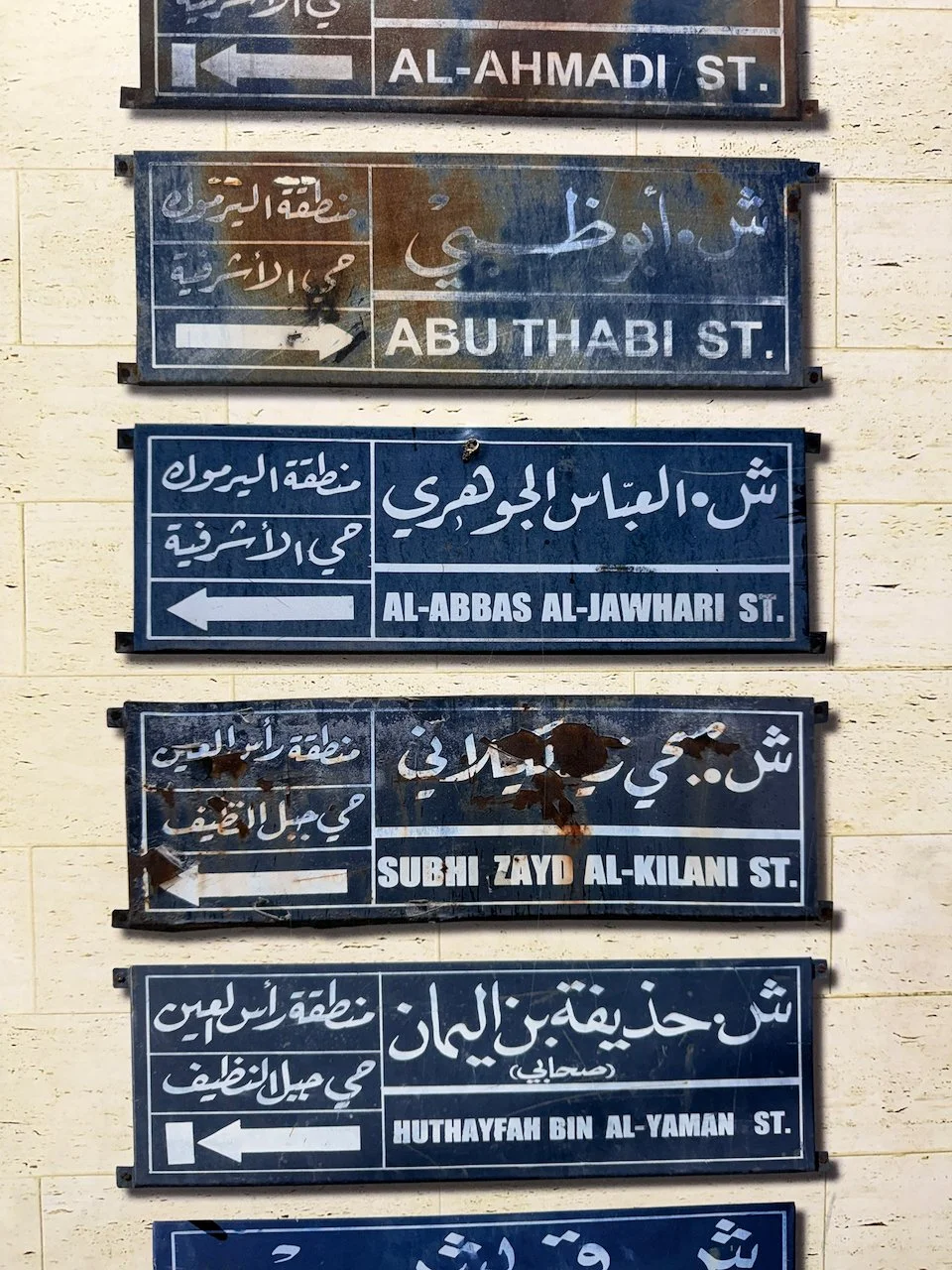
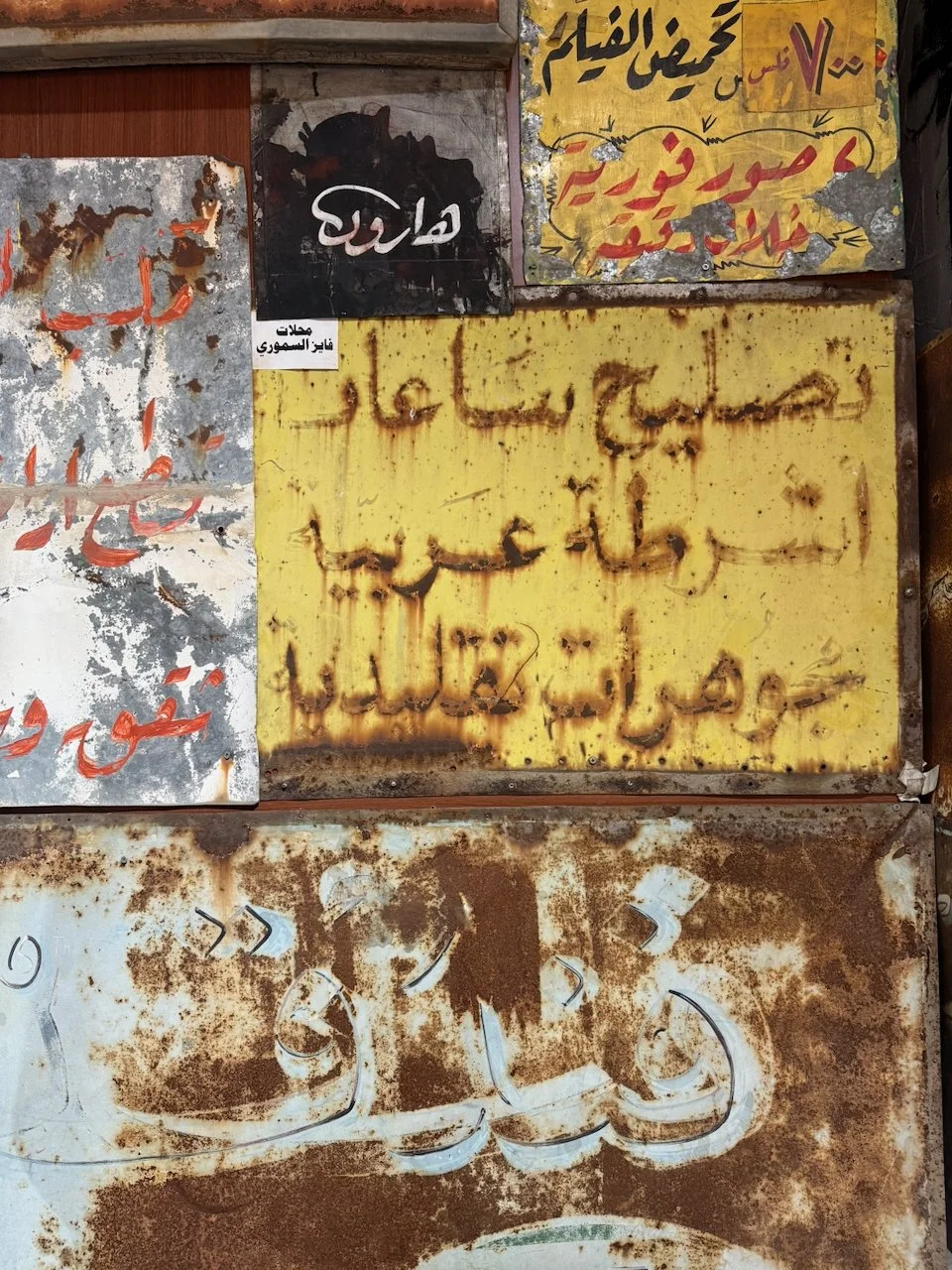
I’d seen signs before for the Amman Sign Museum (very high on my list of things to do in Amman, I’d seen it in Atlas Obscura, a fascinating site for quirky things off the beaten path), but one sign seemed to lead to another sign and it felt like a wild goose chase. This time it was different, I told H, who seemed doubtful. There was a sign leading to a sign leading up some stairs. This was the place. And what a place. Old street signs, restaurant and cafe signs, every kind of sign, floor to ceiling, in English and Arabic, as well as film posters and newspapers. It was a treasure trove. I wanted postcards, a catalogue, a glossy coffee table book, a leaflet, anything, but they had nothing at all to sell me.
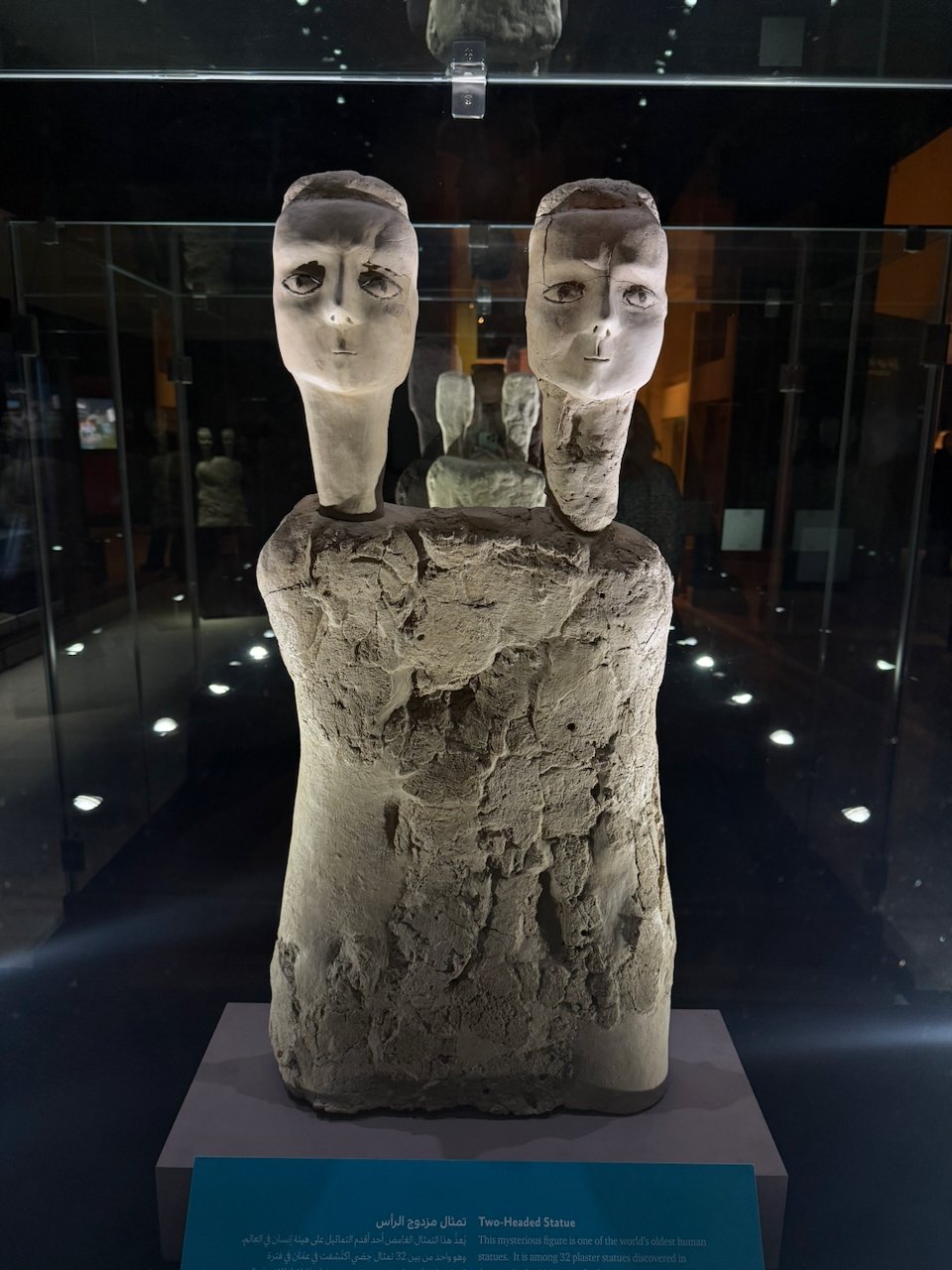
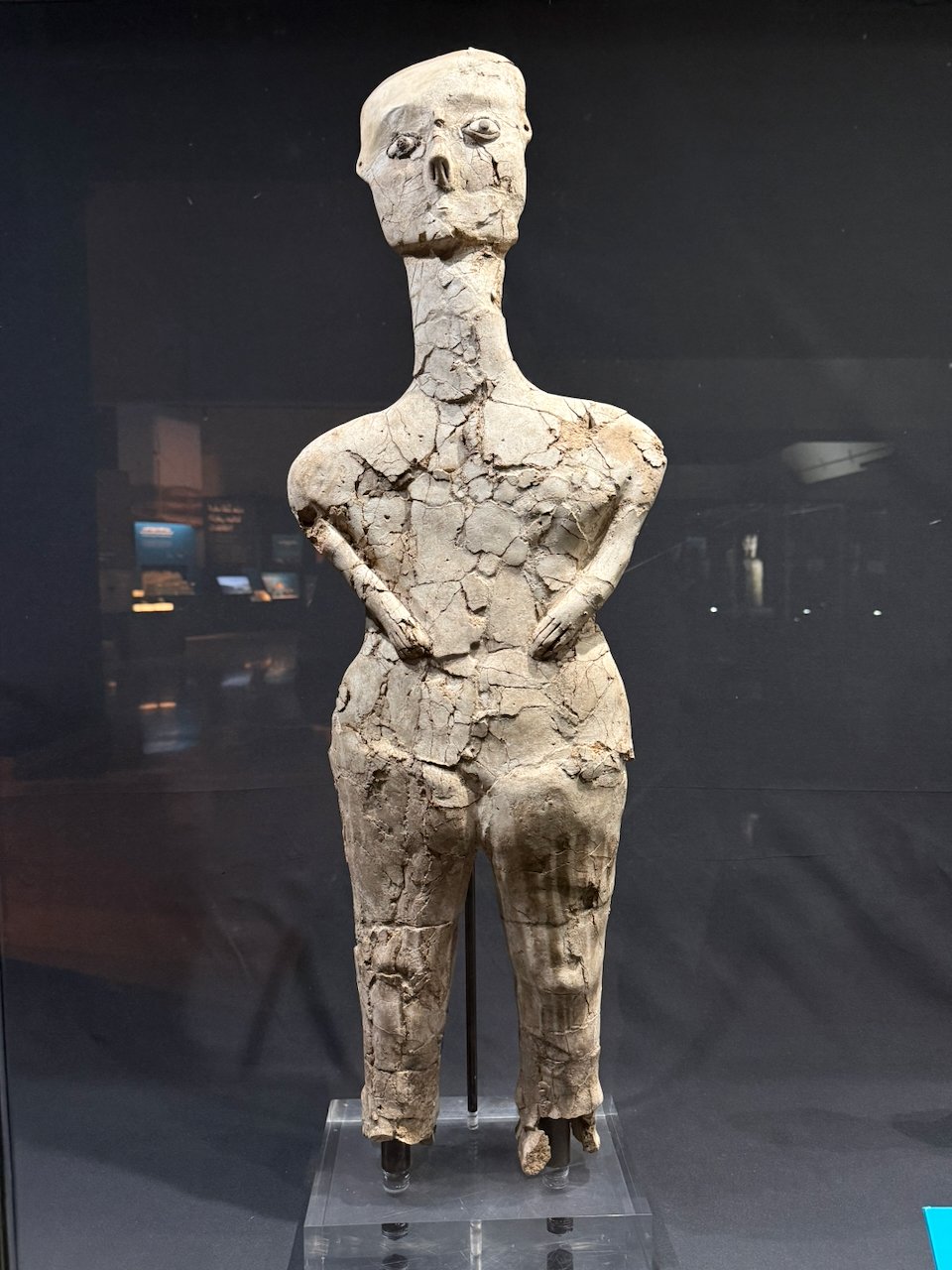
After that we really had to rush to get to the Jordan Museum. We knew at least that it houses some of the Dead Sea Scrolls, but we had no idea about the oldest human sculptures ever made (about 9,000 years ago) also being there. On the way back we stumbled across The Duke’s Diwan, former post office and ‘oldest building in downtown Amman (open to visitors)’.
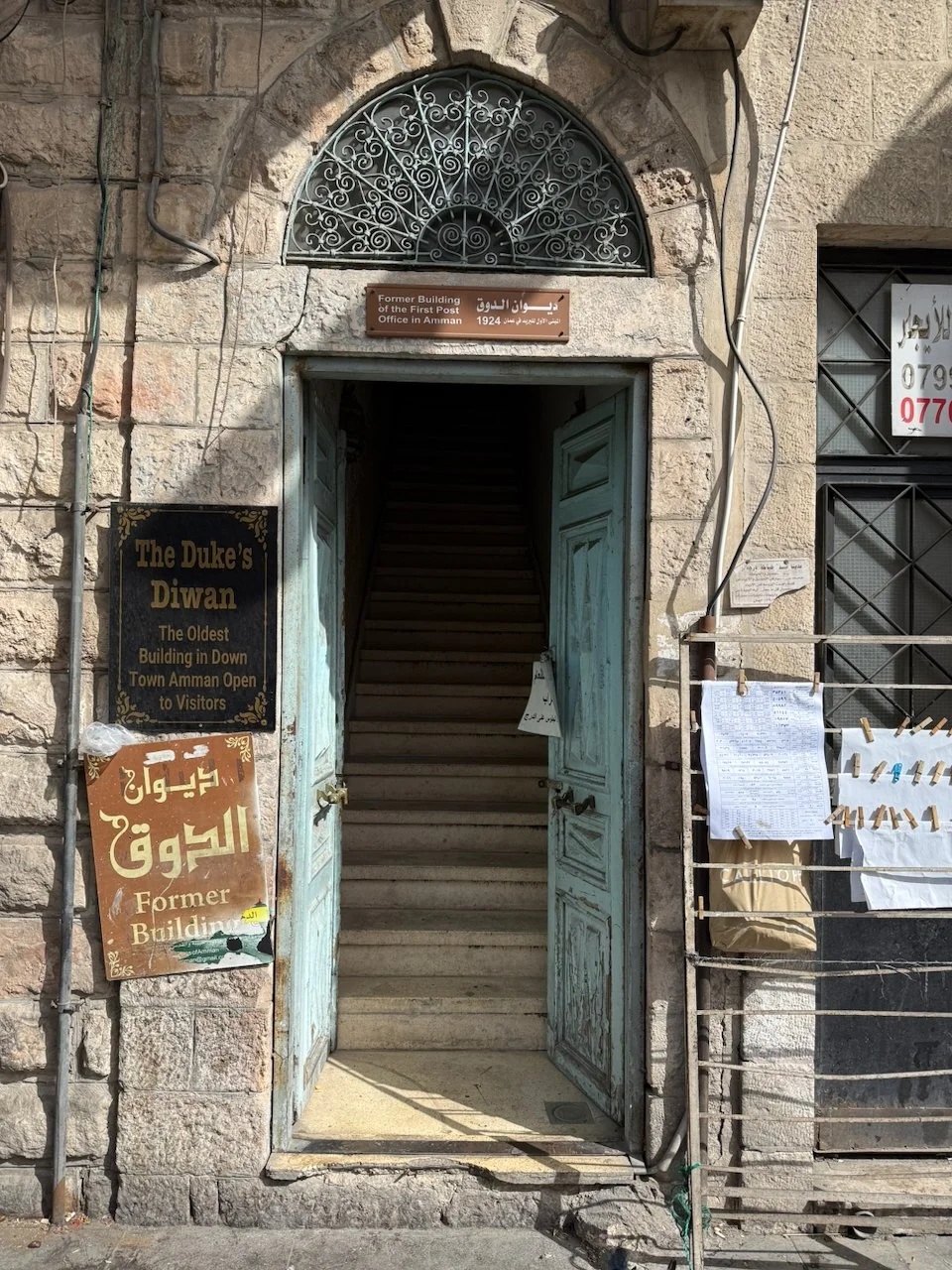
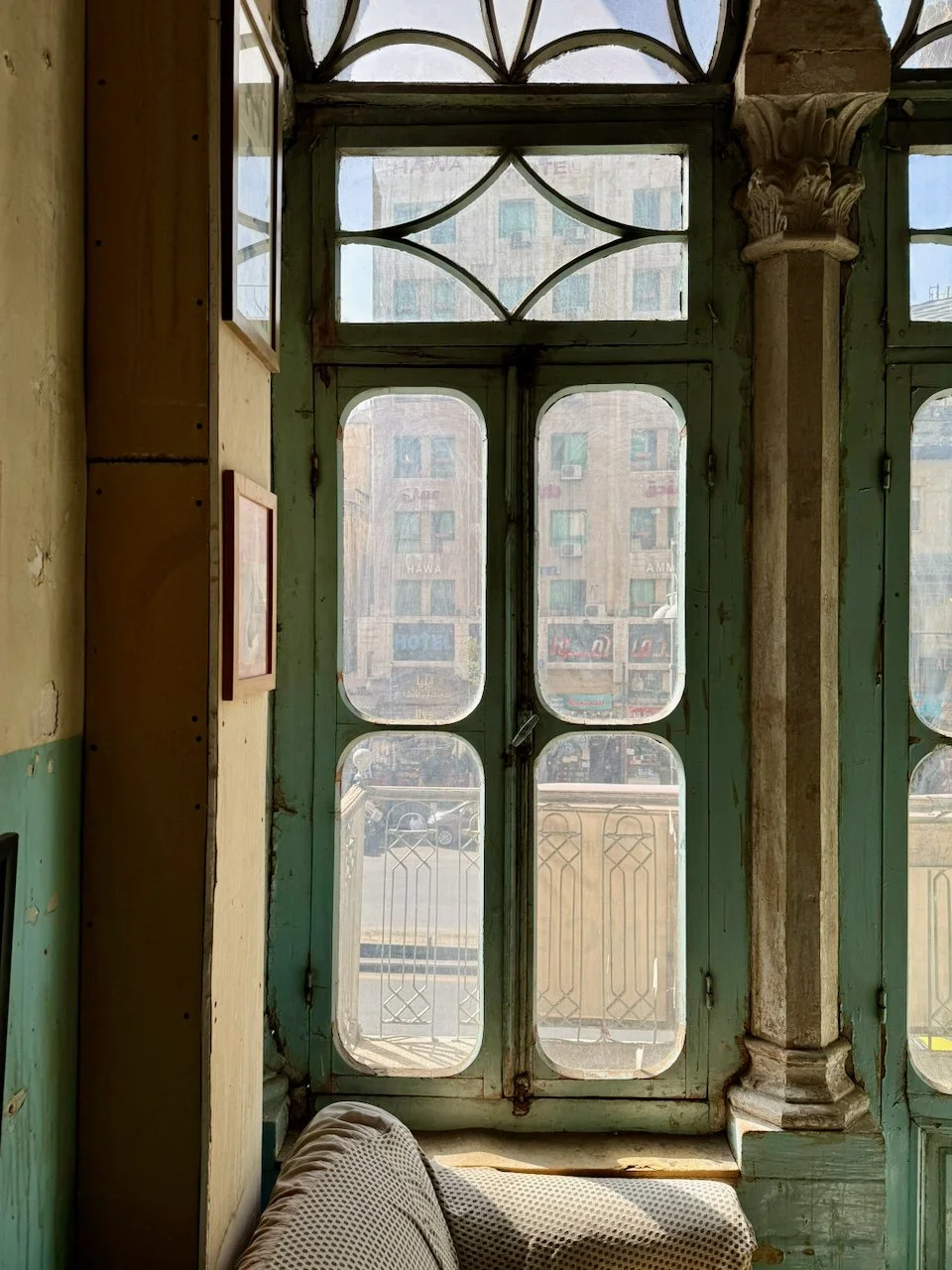
We just made it back to meet Khaled’s driver, who spoke no English, and spent the next hour in traffic. We had our bags with us, and we really were cutting it fine. We met Khaled in his office and had a lovely chat over kunafa and coffee but we were constantly worried about the time.
Just when we were sure we had to leave, Khaled insisted he take us to one of his bookshops. Just five minutes, just around the corner. We were looking at our watches every few minutes. We looked around the bookshop, took photos, then grabbed our bags out of Khaled’s car and into his driver’s car (Khaled had insisted his driver take us to the airport; he also gave us a box of dates), and we spent another hour in traffic.
No matter what shortcut the driver tried, down numerous side streets, we always ended up in a large road full of traffic. On the radio the driver played the hypnotic sound of a man chanting, I can only assume, verses from The Koran. It sounded very soothing in this somewhat tense situation.
Of course we made it to the airport on time. Just. Travel always works out. Unless it doesn’t.
H and I didn’t get to sit together on the plane back (we were on a budget airline; we didn’t get so much as a free glass of water for a five hour flight). I was sat in the middle between two passengers. I didn’t speak to the man at all on my left (until he spilt a whole glass of beer on me), and didn’t speak to the woman on my right for the first hour. Then I made a remark to her, and we ended up speaking non-stop for the next four hours.
She was actually Palestinian (but living in Canada) and had just visited her parents on the West Bank. Despite the ceasefire at the time, she said, Israeli soldiers were still murdering Palestinians on a daily basis. She told me of a phone app which lets people know when Israeli soldiers are in the area (she had been going to visit a place one day but advised not to as a family member had seen it targeted on the app). We spoke of other things, our families, pets, stuff like that. It made the time go quick.
I’d told her I had a partner, of course, but after the plane landed and we were in the airport, I couldn’t see H, and the Palestinian woman came up to me and asked me if I’d lost her. I looked around helplessly but still couldn’t see H. I saw the woman again later, when the strap of her handbag briefly got caught on the bannister of an escalator.
• Less than two weeks later, on February 28th, the United States and Israel attacked Iran, causing more death, mayhem and instability to the region.
Jordan in film, books and photography
FILM (All filmed in Wadi Rum except Indiana Jones, The Hurt Locker and Zero Dark Thirty)
Lawrence of Arabia (Lean, 1962)
Indiana Jones and the Last Crusade (Spielberg, 1989)
Red Planet (Hoffman, 2000)
Mission to Mars (De Palma, 2000)
The Hurt Locker (Bigelow, 2008)
Prometheus (Scott, 2012)
Zero Dark Thirty (Bigelow, 2012)
Last Days to Mars (Robinson, 2013)
Theeb (Nowar, 2014)
The Martian (Scott, 2015)
Rogue One: A Star Wars Story (Edwards, 2016)
Star Wars: The Rise of Skywalker (Abrams, 2019)
Aladdin (Ritchie, 2019)
Dune trilogy (Villeneuve, 2021, 2024 and 2026)
BOOKS
Seven Pillars of Wisdom by TE Lawrence
Appointment with Death by Agatha Christie
Married to a Bedouin by Marguerite van Geldermalsen
Our Last Best Chance by King Abdullah II of Jordan
Petra and the Lost Kingdom of the Nabataeans by Jane Taylor (I picked this up in a nice Folio Society edition from a charity shop for £5 a few weeks after I got back)
PHOTOGRAPHY
Steve McCurry loves Wadi Rum and though I’m not his biggest fan, his photos are quite evocative. He calls Wadi Rum “One of my most favorite locations in the world to get lost”.
A NOTE ON HOW WE DID IT
I know I always make out I’m some hardcore traveller when I’m obviously not (though travel is a state of mind) but we try to be fairly independent when we go abroad. H organised most of it, as per usual; hotels through booking.com and some of the transport too, though it’s very easy to arrange once in the country (but you’re never sure of this until you arrive). I used to always take public transport when I’d have the luxury of a month or two in a foreign country; nowadays, with only a week to see an entire country, hiring cars and drivers seemed the quickest way around, and not that expensive.
Though I moan about guided tours all the time, one of the reasons is simply the price: we saw a lot of Jordan for about £2,000 for the two of us (flights, hotels, food, transport); guided tours (where your hand is held like a child every step of the way and all your experiences are completely contrived) can cost up to £3,330 per person.
Previously on Barnflakes
Head in the Clouds
Moggies of Marrakesh
Costa Rica, on the cheap and without a guide (well, at least we tried)
Myanmar Moggies
Myanmar Days
White clouds, dark skin